








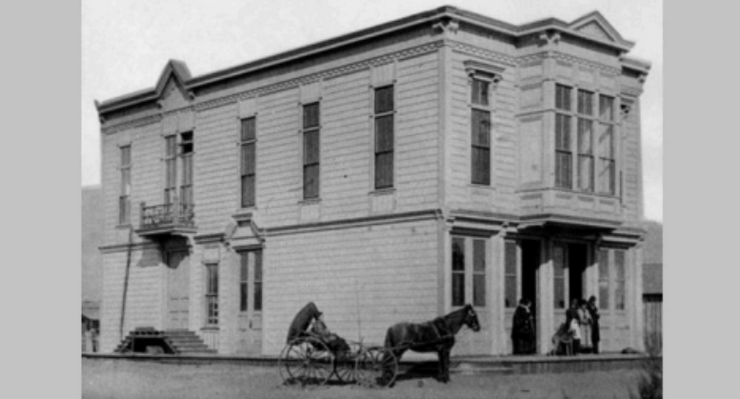
In 1876, a merchant named L.D. Hollingsworth opened a general store and post office on this precise corner — a rough plank building at the dusty center of a young agricultural colony, surrounded by orange groves and little else.
Every era that followed — the railroad resort, the Red Car suburb, the Route 66 automobile city, the freeway age, and today’s walkable, transit-connected boulevard — played out on the same mile-long stage.
Colorado Boulevard has not merely witnessed Pasadena’s 150-year history. It is that history, inscribed in asphalt and brick and the bones of the city around it.
A small grace note is worth acknowledging: the street was platted as Colorado Street as far back as 1874, when Indiana Colony settlers first staked out the grid of their new community along the Arroyo Seco.
But it was 1876 — when Hollingsworth’s store gave the corridor its first commercial heartbeat — that Colorado Street became a living thing. That distinction matters. Streets exist on paper; corridors come alive when someone opens a door.
Today, the Pasadena Museum of History at 470 W. Walnut Street is hosting Happy Birthday Pasadena 2026 — a free, family-friendly celebration marking three converging milestones: the city’s 140th birthday, the centennial of Route 66, and the 150th anniversary of Colorado Boulevard.
From noon to 4 p.m., Mayor Victor Gordo and special guests will mark the occasion with a birthday cake ceremony at 2 p.m.
Vintage automobiles from the Jewel City Model A Club, motorcycle collections from the Pasadena Motorcycle Club, live music, historic tours of the 1906 Fényes Mansion, and the museum’s new exhibition — Where History Meets the Road: Celebrating Route 66 & Colorado Boulevard — make the day as layered as the boulevard itself.
That exhibition, which opened this month, traces the impact of Route 66 and what curators call “the evolution of roadside culture along Colorado Boulevard,” examining the street as “both a transportation corridor and cultural symbol” whose themes — “mobility, commerce, nostalgia, and reinvention” — have shaped Pasadena’s urban landscape across generations.
The description fits. Colorado Boulevard has been all of those things, in all of those eras, along all of its miles.
Walk the length of it today and you can read its whole story: the corner at Fair Oaks, where a general store fed a farming colony; the old Santa Fe rail corridor, now carrying A Line trains; the Playhouse, still producing plays a century after Gilmor Brown opened his first season; the Norton Simon, standing guard at the Orange Grove intersection where the parade route bends; the midcentury motor hotels, their neon dim but their bones intact; and the new mixed-use blocks rising around the light rail stations, with their ground-floor cafes and upper-floor apartments designed for people who arrive by train.
One hundred and fifty years of a city have been written on a single street.
The “Happy Birthday Pasadena 2026” celebration takes place Sunday, June 14, from noon to 4 p.m. at the Pasadena Museum of History, 470 W. Walnut St. Admission is free; no reservations required. The exhibition “Where History Meets the Road: Celebrating Route 66 & Colorado Boulevard” is on view at the museum through the summer.
 Get our daily Pasadena newspaper in your email box. Free.
Get all the latest Pasadena news, more than 10 fresh stories daily, 7 days a week at 7 a.m.