







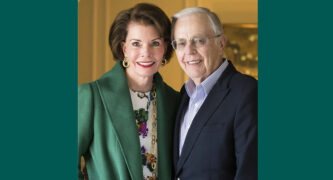
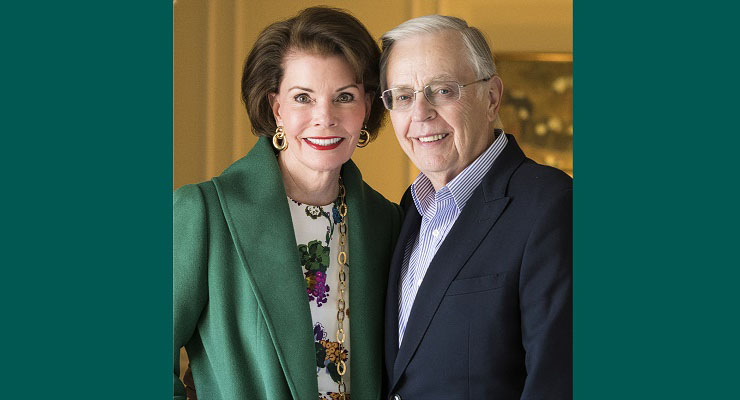
The California Institute of Technology (Caltech) has received a $50 million commitment from Caltech Trustee Lynn Booth and Life Member Kent Kresa, former chair of the Board of Trustees. Made jointly with their family foundations, the gift endows and names the Lynn Booth and Kent Kresa Department of Aerospace, securing the Institute’s continued leadership in the rapidly evolving sectors of space science and exploration.
“The history of aerospace research and technology development is deeply woven into Caltech’s DNA,” says Caltech President Thomas F. Rosenbaum, the Sonja and William Davidow Presidential Chair and professor of physics. “One could not imagine more fitting philanthropists than Lynn and Kent to name the department given their long-time dedication to Caltech, their appreciation for what makes the Institute special, and Kent’s own storied career in aerospace.”
The Lynn Booth and Kent Kresa Department of Aerospace, home to the Graduate Aerospace Laboratories of the California Institute of Technology (GALCIT), is renowned for advancing aerospace science and engineering with applications that reach across society. Since its founding in 1928, the department has helped shape aerospace—from pioneering aerodynamics and fluid mechanics that fueled Southern California’s aircraft industry to establishing JPL in 1936 and, more recently, the Center for Autonomous Systems and Technologies CAST, which advances robotics and autonomy.
The Booth–Kresa gift bolsters education and accelerates research. It expands work in bio-inspired engineering for ocean and medical applications and provides resources for faculty, staff, and students to develop technologies in autonomous systems, quantum devices, hypersonics, and space, while supporting talent recruitment and retention.
This new gift continues a tradition of generosity and reflects a deeply personal partnership rooted in Caltech. Booth, a prominent Los Angeles philanthropist, and Kresa, a leader in the aerospace industry, have been deeply engaged with the Institute for years. Both were widowed, and they often crossed paths at board meetings and campus events. Those encounters sparked a connection that evolved into a life bond, and they married in 2017. That same year, they made a joint gift to establish the Booth–Kresa Leadership Chair for CAST, underscoring their shared enthusiasm for innovation in robotics and autonomous systems to help improve life on Earth and explore our universe.
“Kent and I believe in the power of curiosity and the importance of giving researchers the freedom to pursue bold ideas,” says Lynn Booth, president of the Otis Booth Foundation. “Especially during this time of accelerating discovery on Earth and in space, we are proud to support the Institute’s faculty and students as they survey new frontiers and develop technologies that will benefit society.”
Supporting Innovation in a New Era
We are in a watershed era of space exploration, marked by partnerships between national agencies and private companies, multinational missions, and ambitions to return Mars samples that may hold evidence of life.
In partnership with JPL, NASA, and private companies, the Lynn Booth and Kent Kresa Department of Aerospace is helping to define advances in autonomous space exploration and infrastructure. Caltech manages JPL, NASA’s only federally funded research and development center (FFRDC). Researchers from Caltech explore how humans and robots can work together across land, air, and space, from multirobot response swarms to new generations of flying and walking machines.
“Lynn and I have seen firsthand how CAST and the department as a whole push the boundaries of exploration,” says Kent Kresa, chairman emeritus of Northrop Grumman Corporation. “For us, this gift is a way to help fuel that spirit of exploration, accelerating progress in drones and autonomous systems, hypersonic flight, space technology, and so much more, while opening doors for a new generation of bright young minds who want to help imagine and build the future.”
The department is developing technologies for spacecraft to survive high-speed atmospheric entry and build self-sustaining space infrastructure that can generate power, communicate, and repair itself. Faculty studying hypersonic flight are improving heat shield and trajectory design for future missions. The history-making Space Solar Power Demonstrator, launched in 2023, proved that lightweight, modular platforms can beam power wirelessly to Earth—a step toward space-based solar power. Bio-inspired robots that fly, roll, climb, and reconfigure hint at future teams able to scout terrain, assemble platforms, and maintain infrastructure on the Moon, Mars, and beyond. Together, these advances maintain Caltech’s leadership in building the autonomous vehicles and flexible, in-space systems that will help define the next era of space exploration.
Fueling Research and Innovation
Philanthropy fuels exploration, enabling faculty and students to test high-risk concepts, gather data, and position work for major funding and commercialization. The gift creates the Booth–Kresa Bridge Fund and Initiative for Emerging Research to support high-impact projects, short-term sprints, and cross-disciplinary collaborations. This catalytic funding allows the department to pivot quickly to meet new challenges.
“Lynn and Kent’s philanthropy is particularly important during this time of uncertain research funding, allowing us to explore new avenues that might otherwise be out of reach,” says Mory Gharib, the Hans W. Liepmann Professor of Aeronautics and Medical Engineering. “It gives us the freedom to pursue concepts that will define the field.”
Sustaining Education and Mentorship
Today, Caltech students and recent graduates are already serving as mission designers, spacecraft operators, and leaders in space science. They build telescopes, develop autonomous robots and drones, and lead small-satellite missions. Working side by side with faculty and engineers at JPL, they gain the experience to transfer ideas from the lab into flight hardware and missions.
The Booth–Kresa Graduate Fellowship Program and the Booth–Kresa Postdoctoral Fellowship Program, both established through this gift, will provide vital support for emerging scholars who drive discovery and mentor the next generation. By supporting them at pivotal stages in their careers, which frees them to take intellectual risks, collaborate across disciplines, and pursue bold questions, these fellowships will help accelerate innovation in aerospace science and technology.
“The Lynn Booth and Kent Kresa Department of Aerospace is uniquely positioned to shape the future of exploration,” says Harry A. Atwater, the Otis Booth Leadership Chair of the Division of Engineering and Applied Science and Howard Hughes Professor of Applied Physics and Materials Science. “This gift equips us to engage in paradigm-shifting research while preparing leaders who will chart the future.”
Recruiting and Retaining Talent
The Booth–Kresa Faculty Recruitment and Retention Fund and the Lynn Booth and Kent Kresa Leadership Chair have also been established with the gift. Together, they strengthen the department’s ability to attract and retain exceptional talent while advancing strategic priorities.
“Lynn and Kent’s philanthropy is essential to maintaining our global leadership in aerospace,” says Sergio Pellegrino, Joyce and Kent Kresa Professor of Aerospace and Civil Engineering, JPL senior research scientist, co-director of the Space-Based Solar Power Project, and director of the Graduate Aerospace Laboratories. “Their gift helps ensure that the most daring ideas from the most ambitious individuals can take flight.”
A Legacy of Innovation
Caltech’s history is shaped by a succession of luminaries who shaped the field of aeronautics and beyond. Theodore von Kármán brought international stature and an emphasis on interdisciplinary research and education, laying the groundwork for Caltech’s long-standing ties to industry and government. Frank Malina, Jack Parsons, and Qian Xuesen (Tsien Hsue-Shen), members of the founding team of the Jet Propulsion Laboratory, propelled the United States into the space age with early rocketry experiments and breakthroughs in high-speed aerodynamics and jet propulsion. Hans W. Liepmann’s research into fluid mechanics and hypersonics influenced generations of engineers. Anatol Roshko helped deepen our understanding of fluid dynamics, while Julian Cole and Hans Hornung advanced computational methods and high-enthalpy flow research.
Alumni such as Satish Dhawan (DAA ’69, ENG’ 49 AE/PHD ’51 AE), Ozires Silva (DAA ’92, MS ’66 AE), and Susan Wu (DAA ’13, PHD ’63AE) gained worldwide recognition for pioneering experimental fluid dynamics, leading a national space program, founding a major aircraft company, and advancing magnetohydrodynamic power generation. More recently, Chair of the Caltech Board of Trustees David W. Thompson (MS ’78) influenced commercial spaceflight by cofounding and leading Orbital Sciences Corporation (later part of Orbital ATK), which developed the Pegasus rocket, the world’s first privately developed space launch vehicle.
“From our founders’ first successful rocket tests to today’s fleet of spacecraft exploring our solar system and beyond, Caltech and JPL have always been partners in pushing the boundaries of possibility,” says David Gallagher, director of JPL and vice president of Caltech. “This $50 million gift strengthens that partnership at its source, enabling our scientists, engineers, and innovators to dream bigger together and turn more of their bold ideas into real missions and technologies.”
Just as these visionary leaders foresaw and enabled entirely new realms of exploration, Booth and Kresa’s transformative investment ensures that Caltech’s scholars will continue to push the boundaries of discovery, shaping the future of flight, space, and beyond.
“This is more than a gift—it’s an investment in tomorrow,” says Provost David Tirrell, Ross McCollum–William H. Corcoran Professor of Chemistry and Chemical Engineering and holder of the Carl and Shirley Larson Provostial Chair. “It provides vital funds for Caltech to explore the unknown, educate leaders, and develop new technologies to benefit humanity. The Caltech community is grateful for Lynn and Kent’s friendship and support.”
 Get our daily Pasadena newspaper in your email box. Free.
Get all the latest Pasadena news, more than 10 fresh stories daily, 7 days a week at 7 a.m.