









A Pasadena day laborer’s account of being detained during a 2025 immigration sweep is part of a closely watched federal lawsuit that a Los Angeles judge on Thursday declined to dismiss, leaving the case without a final ruling for now.
U.S. District Judge Maame E. Frimpong did not indicate when she would issue her decision on the Trump administration’s bid to dismiss the lawsuit.
Filed in July 2025, Vasquez-Perdomo v. Noem alleges that the U.S. Department of Homeland Security “has unconstitutionally arrested and detained people in order to meet arbitrary arrest quotas set by the administration of President Donald Trump,” while “denying them access to legal counsel.”
According to the complaint, the alleged “pattern of conduct” began in June 2025, when the federal government sent immigration agents onto the streets, worksites and neighborhoods of Los Angeles and surrounding counties, creating a weekslong immigration dragnet. The lawsuit asserts that U.S. Border Patrol agents relied on perceived race or ethnicity to select who to stop, conducted suspicionless stops, executed warrantless home raids and carried out illegal workplace operations.
Government attorneys argued that the raids were entirely lawful and that the lawsuit should be dismissed in its entirety. In their motion to dismiss, they wrote that “Plaintiffs’ allegations arise from discrete enforcement operations during June 2025, which the Supreme Court has since recognized as lawful exercises of statutory authority,” and contended that immigration officers were operating under a “reasonable suspicion of an immigration violation before executing a stop.”
Frimpong issued a temporary restraining order in July barring immigration stops based solely on race or ethnicity, language, location or employment. The U.S. 9th Circuit Court of Appeals later agreed. But the U.S. Supreme Court afterwards lifted restrictions barring federal agents from making immigration arrests resulting from “roving patrols” that Frimpong determined targeted people for deportation based on their race or language. The high court ruled by a 6–3 margin, granting the federal government’s emergency appeal of the judge’s temporary restraining order freezing the raids as they had been carried out.
In his majority opinion, Justice Brett M. Kavanaugh wrote that “apparent ethnicity alone cannot furnish reasonable suspicion” but that it can be relevant when considered along with other factors. In the dissenting opinion, Justice Sonia Sotomayor wrote that the Trump administration “has all but declared that all Latinos, U.S. citizens or not, who work low-wage jobs are fair game to be seized at any time, taken away from work and held until they provide proof of their legal status to the agents’ satisfaction.”
In a statement shared with City News Service after the ruling, White House spokeswoman Abigail Jackson said the administration would continue conducting its immigration enforcement operations in the district.
The roving raids targeting car washes, parking lots where day laborers gather and garment factories disrupted immigrant communities throughout the region for weeks in June and July. Los Angeles Mayor Karen Bass called the ruling “un-American” and “a danger to working families in the region.”
Frimpong issued a permanent injunction in November 2025 requiring that detainees confined in the basement facility known as B-18 in the federal building in downtown Los Angeles be given access to lawyers as required by the Fifth Amendment right to counsel. At a previous hearing, Frimpong heard that immigrants were detained for extended periods at B-18 in conditions that prevented private communication with attorneys. Lawyers reported that clients were denied access to phone lines, turned away from in-person meetings and pressured to sign legal documents before speaking with a lawyer.
In her written ruling, the judge converted an existing temporary restraining order into a preliminary injunction to ensure continued compliance while litigation proceeds. According to plaintiffs’ attorney Mark Rosenbaum, who represented individuals who said they were held at the processing center in illegal conditions while being denied access to lawyers, the order “affirmed that the Constitution does not stop at the doors of a detention center.”
The Justice Department countered at an October 2025 hearing that detainees were never intentionally barred from contact with attorneys, but that circumstances during unrest on the streets over ICE immigration operations caused conditions at B-18 that were far from normal. Government attorney Jonathan Ross said conditions at B-18 have “normalized” and that even without a court order, “The government is going to do the right thing” and ensure that detainees have access to counsel. “The court should not be ordering the government to do what it is already doing,” Ross said, adding that “The record shows plaintiffs are receiving what’s required.”
Frimpong responded from the bench that in the period after she issued the TRO in July, “There were still violations,” so any future injunction would deal with the “future.”
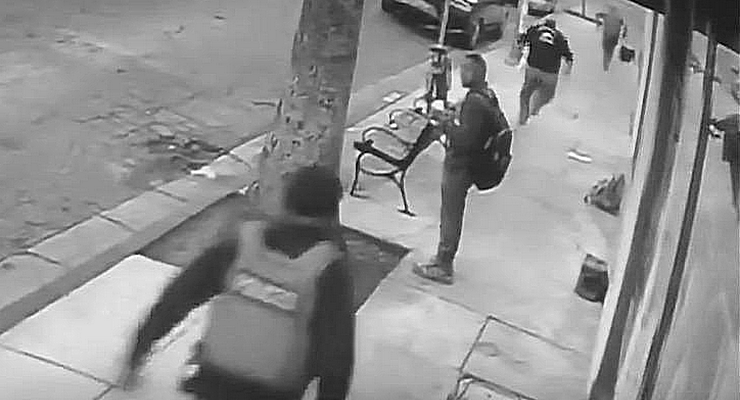
The lawsuit’s lead plaintiff, Pedro Vasquez Perdomo, 54, a day laborer from Pasadena, says he was waiting to be picked up for a construction job at a Metro bus stop in front of a Winchell’s Donuts in Pasadena on the morning of June 18, 2025, when he and two others were surrounded by masked men with guns, unlawfully arrested and taken to the detention center, where he remained for three weeks, much of that time without access to attorneys. He has since been granted bond and released.
The judge gave no timeline for her decision.
 Get our daily Pasadena newspaper in your email box. Free.
Get all the latest Pasadena news, more than 10 fresh stories daily, 7 days a week at 7 a.m.


