












While his influence was felt across the nation, Jackson forged a significant and recurring connection with Pasadena, visiting the city at pivotal moments to address issues of racial injustice, advocate for the marginalized, and challenge the city’s power structures.
Jackson’s involvement in Pasadena spanned decades, from a 1984 presidential campaign stop to a 2012 visit to address the police shooting of an unarmed Black teenager. He notably led a successful protest against the Tournament of Roses for its lack of diversity and comforted a grieving city from the pulpit of All Saints Episcopal Church in the aftermath of the 1992 riots. His repeated presence in Pasadena underscored the city’s importance as a microcosm of the broader American struggle for equality and justice that Jackson championed throughout his life.
A Voice in Times of Crisis
In May 1992, just days after the acquittal of the police officers in the Rodney King beating case sparked widespread civil unrest in Los Angeles, Jackson came to All Saints Episcopal Church in Pasadena. At the invitation of then-Bishop Suffragan Chester Talton, he preached to an overflow crowd of 1,300, urging unity and action. “Pasadena and Watts, lock arms and make a new America,” Jackson implored the congregation, calling on them “to build bridges, to care, to reach out… to create a new California.”
The event, which also served as a massive food drive for riot-torn areas, demonstrated Jackson’s role as a national leader seeking to heal and guide communities through crisis.
Challenging the Tournament of Roses
A year later, in 1993, Jackson again turned his attention to Pasadena, this time targeting the leadership of the Tournament of Roses. For 104 years, the powerful executive committee had been composed entirely of white men. Jackson, speaking again from All Saints Church, attacked this lack of diversity, comparing the situation to segregation-era Birmingham and threatening to organize a counter-parade.
Following a rally led by Jackson and pressure from the city councils of Pasadena and Los Angeles, the Tournament of Roses expanded its five-member executive committee in November 1993 to include two Black men, a Hispanic man, an Asian-American woman, and a white woman, a direct outcome of the activism Jackson had spearheaded.
Advocate for Justice
Jackson returned to Pasadena in April 2012 in the wake of another tragedy: the fatal police shooting of Kendrec McDade, an unarmed 19-year-old Black man. The day before a major rally, Jackson visited Pasadena High School, where he spoke to students, distributed voter registration forms, and was joined by McDade’s family.
He called for transparency from authorities and urged students to channel their grief into positive action. “We must turn pain to power, we must teach conflict resolution,” Jackson stated. “There is no future in eye for an eye, tooth for a tooth.”
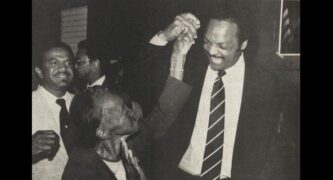
His first documented visit to the city was during his groundbreaking 1984 presidential campaign, where he was photographed greeting a 90-year-old Pasadena resident, Virginia Mance, during a local stop.
A Life of Activism
Born in Greenville, South Carolina, on October 8, 1941, Jackson became a key lieutenant to the Rev. Martin Luther King Jr. in the 1960s. After King’s assassination, he founded Operation PUSH and later the Rainbow Coalition, organizations dedicated to fighting for social and economic justice. His two presidential campaigns, in 1984 and 1988, shattered barriers and reshaped the landscape of American politics.
Jackson’s family announced his death on Tuesday, February 17. He had been diagnosed with Parkinson’s disease in 2017 and later with Progressive Supranuclear Palsy (PSP), a neurodegenerative disorder.
A family statement said he “died peacefully” surrounded by loved ones.
 Get our daily Pasadena newspaper in your email box. Free.
Get all the latest Pasadena news, more than 10 fresh stories daily, 7 days a week at 7 a.m.

