







Juneteenth commemorates June 19, 1865, the day Union Maj. Gen. Gordon Granger issued General Order No. 3 in Galveston, Texas, informing the people of Texas that enslaved people were free, more than two years after President Abraham Lincoln issued the Emancipation Proclamation. The holiday became a federal legal public holiday in 2021.
For Jones, who represents District 3, the holiday is not only a national commemoration. It is also a Pasadena story — one rooted in his family’s history and the legacies of other local Black families, churches, and civic institutions.
“What’s changed is basic civic awareness,” Jones said in written responses. “Five years ago, you still had to explain the history of the day [Juneteenth] to a lot of people; today, it’s a standard part of Pasadena’s calendar, and residents expect the city to mark the occasion.”
But, he added, symbolism cannot do the work of policy.
“A federal holiday doesn’t build affordable housing, it doesn’t close the wealth gap, and it doesn’t automatically fix the aging infrastructure in historically underserved neighborhoods,” Jones said. “Recognition is a good starting point, but our focus on the council has to stay on those real, everyday policy gaps.”
His comments come as Juneteenth and the Fourth of July fall 16 days apart in the year Jones points out is the country’s 250th anniversary. Jones said the two holidays should be understood together, rather than separately.
“The Fourth of July represents the birth of a profound ideal, a blueprint for a nation built on liberty,” he said. “Juneteenth represents the long, painful, and absolutely necessary work of forcing America to live up to that blueprint for everyone.”
“You can’t truly celebrate the country’s 250th anniversary if you ignore the chapters where Americans had to fight just to make those founding words apply to them,” Jones said. “The two
holidays belong together because one is the promise, and the other is the reminder of the work it takes to keep it.”
Jones applied a similar frame to Pasadena, pointing to both the city’s Black history and the policy gaps he said remain unresolved.
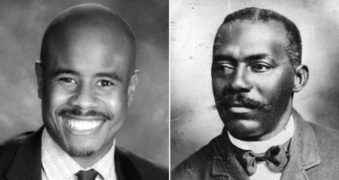
Asked what part of Pasadena’s Black history he wishes more residents knew, Jones pointed first to the depth of Black roots in the city, including his own family’s history. He said his great-great-grandfather, Seaborn Carr, came to Pasadena from Georgia in 1893, becoming part of an early Black community that helped shape the city even as it confronted segregation.
“These early Black families didn’t just move here; they dug in and built the foundations of this city while fighting strict segregation at every turn,” Jones said.
He cited First AME Church in Pasadena, established in 1887, as one of the city’s early Black spiritual and civic anchors. He also said that by 1902, his family was publishing what he described as Pasadena’s first Black-owned newspaper to give the community a voice.
“Modern Pasadena sits on the shoulders of that grit,” Jones said. “Our presence here isn’t an accident. It was fought for and built piece by piece.”
Jones said residents are not asking elected officials merely for symbolic wins, speeches or appearances. They are asking for practical results.
“People in the community aren’t asking us for symbolic wins, inspiring speeches, or to just show up to luncheons,” he said. “They want practical results.”
The list, he said, is concrete: housing affordable enough that residents’ children are not priced out of the city where they grew up, safe streets, reliable public utilities and economic investments that last beyond any one council term.
“The expectation is clear: move past the milestones and deliver sustainable results,” Jones said.
That message gives Jones’ Juneteenth reflections a distinctly local edge. In his telling, the holiday does not sit apart from Pasadena’s debates over housing, infrastructure, utilities, neighborhood investment or the cost of staying in the city. Instead, it raises the question of whether freedom is becoming tangible in residents’ daily lives.
Jones said he would make a similar point to young people in his district.
“I always tell them that history isn’t just something passive you read about in a textbook,” he said. “It’s a living responsibility that belongs to them now.”
In 2026, he said, Juneteenth should not be understood merely as a day off or a celebration of the past. It should be a call to participation — including learning how local government and community systems operate.
“It should be a reminder that freedom takes work,” Jones said. “It requires active participation, civic engagement, and actually learning how your local government and community systems operate so you can help fix them.”
For Jones, that is the thread connecting Juneteenth, Pasadena’s Black families in the late 19th and early 20th centuries, the country’s 250th anniversary and the city’s current policy gaps.
“The story of Pasadena isn’t finished yet,” he said, “and they have a hand in writing the next chapter.”
 Get our daily Pasadena newspaper in your email box. Free.
Get all the latest Pasadena news, more than 10 fresh stories daily, 7 days a week at 7 a.m.