






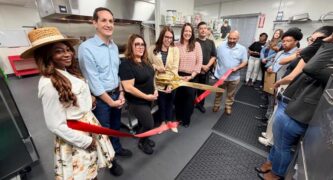

Union Station Homeless Services celebrated its newest commercial kitchen at 1060 E. Colorado Blvd. in Pasadena, a stainless-steel-filled facility designed to feed people experiencing homelessness while teaching others the skills to find work in the restaurant industry.
Inside, chefs had prepared an inviting spread of appetizers, from golden-brown macaroni and cheese croquettes to colorful vegetable platters and carefully arranged hors d’oeuvres. The occasion felt more like the opening of a fashionable restaurant than a food production center.
But the kitchen’s mission is considerably larger than Tuesday’s celebration.
“We’re thrilled this is going to allow us to provide all of our meals in house eventually for all of our interim housing sites, which is several hundred people getting off the street every night,” said Katie Hill, CEO of Union Station Homeless Services.
The facility is the organization’s third commercial kitchen, joining existing kitchens at its adult and family centers.
According to Chief Operating Officer Amanda Green, the new space will eventually prepare three meals daily for approximately 500 people at five interim housing locations.
“Everything will be cooked here, and then we’ll be transporting the food three times a week to each of the locations and individually portioned meals,” Green said.
The kitchen can accommodate 10 to 12 people working at once.
Marissa Gamboa, Union Station’s director of food services, said initial production is expected to reach 300 breakfasts, 300 lunches and 300 dinners daily.
Previously, the organization purchased individually packaged meals from Everytable, an outside food provider. Preparing meals internally should give Union Station greater control over menus, portions and food waste.
The financial benefits may take time to materialize.
“We’re basically right now figuring it’s going to be more or less break even for the first year,” Hill said, explaining that Everytable had not raised its prices since the pandemic, sparing the organization from significant increases.
Several grants helped finance the new kitchen, she said.
Beyond feeding residents, the facility will expand Union Station’s culinary training program, which provides a three-week introduction to restaurant employment.
Participants spend their first week learning workplace expectations, preparing résumés and developing employment skills. Two additional weeks with Gamboa include food safety certification and hands-on instruction for entry-level kitchen jobs.
The program has already served nearly 20 participants, according to advancement officer Venice Dunn.
Local restaurateurs Brett and Lucy, associated with Pez Cantina and Pez Coastal Kitchen, have hired two participants for catering work and are recruiting another for a regular position, Dunn said.
The goal is not necessarily to produce executive chefs, but to help people secure employment as dishwashers, preparation cooks and other entry-level restaurant workers, with opportunities to advance.
“Really the idea is how can we get you in the door and employment as soon as possible?” Dunn said.
The larger kitchen also creates additional opportunities for community volunteers to help prepare meals.
For Hill, the combination of food service and job training represents a practical extension of Union Station’s work: meeting immediate needs while helping people build more stable futures.
Outside the kitchen’s gleaming equipment and carefully arranged appetizers, the work ahead is straightforward. Hundreds of breakfasts, lunches and dinners will need to be prepared, packaged and delivered, day after day.
And for some of the people learning to prepare those meals, the kitchen may also provide the first steps toward a new livelihood.
 Get our daily Pasadena newspaper in your email box. Free.
Get all the latest Pasadena news, more than 10 fresh stories daily, 7 days a week at 7 a.m.