









Credit: Lance Hayashida/Caltech
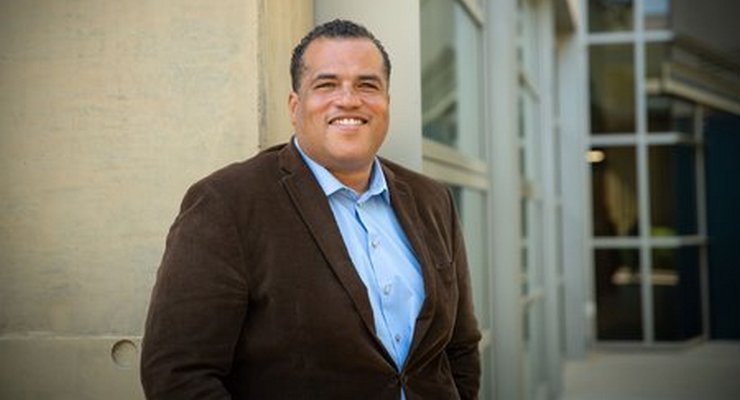
Caltech chemistry professor Hosea Nelson (PhD ’13) has his eyes on a big goal: He wants to know the three-dimensional (3D) structure of all the molecules found in the natural world. No one knows exactly how many structures that entails, but certainly, he says, it is at least millions. Those unknown structures make up what Nelson and others calls “chemical dark matter.” Just as astrophysicists and cosmologists believe dark matter is thought to make up a high percentage of all the matter in the universe, Nelson says molecules without solved structures are thought to make up the majority of natural material on Earth.
Now Nelson has been selected to lead a team that will receive $17 million from the National Science Foundation (NSF) to create a “programmable cloud laboratory,” an automated lab that will allow scientists and artificial intelligence (AI) agents to conduct experiments remotely, analyzing and storing data online. He will be relying on the AI expertise of Caltech co-investigators Katie Bouman, and Yisong Yue. The team’s cloud lab, dubbed ELECTRA (Electron Diffraction Cloud Laboratory for Research and Autonomy), will help scientists from around the country elucidate chemical structures more quickly and efficiently.
“ELECTRA represents a bold move in accelerating scientific discovery,” says Caltech President Ray Jayawardhana, the Sonja and William Davidow Presidential Chair and professor of astronomy. “This project also captures something powerful about Caltech’s culture of curiosity-led exploration and shared inquiry. Harnessing deep expertise in multiple disciplines, the ELECTRA team is developing a transformative open-access resource that will fuel breakthroughs across chemistry, biomedicine, materials science, and beyond at unprecedented speed.”
The NSF announced its funding of 20 new cloud laboratories on July 22. The commitment addresses one of the National Science and Technology Challenges posed by the US government’s Genesis Mission: “Achieving AI-driven Autonomous Laboratories.” The White House also announced on July 22 that the Genesis Mission, originally created as an initiative of the U.S. Department of Energy, is now a national effort to harness AI to accelerate scientific discovery.
Nelson and his colleagues use a specialized technique they brought to chemistry from the world of structural biology. The method, microcrystal electron diffraction (microED), is particularly good at elucidating the position of every atom in a molecule even when only a miniscule sample of that molecule is available. Over the last decade, Nelson’s group has used microED to solve the structure of many small molecules found in nature, or what chemists call natural products, providing chemists with new goals for materials that could be synthesized and potential targets for pharmaceuticals as well as foundational information for biologists. There are millions of such structures yet to solve, and the tool is useful in a wide variety of disciplines.
Additional Caltech investigators on ELECTRA include Theo Agapie (PhD ’07), the John Stauffer Professor of Chemistry and executive officer of chemistry, and Sarah E. Reisman, Bren Professor of Chemistry and the Norman Davidson Leadership Chair of the Division of Chemistry and Chemical Engineering. Katie Bouman is a professor of computing and mathematical sciences, electrical engineering and astronomy, Rosenberg Scholar, and Heritage Medical Research Institute Investigator. Yisong Yue is a professor of computing and mathematical sciences. The team also includes Jose A. Rodriguez of UCLA, Garret Miyake of Colorado State University, Fort Collins, Emily Balskus of Harvard University, and Alison Narayan of the University of Michigan.
We recently spoke with Nelson about ELECTRA and what the new NSF funding means for the effort to shine light on chemical dark matter.
What is the overarching goal of ELECTRA?
Everything is made of molecules; molecules are invisible, and we don’t know what most of them are. Let’s say you go outside and grab a tree branch and ask, “What molecules are in here?” A biology book will tell you roughly what types of molecules are there, but the specific molecules and exactly how all the elements are arranged within them will be unknown for most things, whether it’s from nature or rocks in the earth. We call it “chemical dark matter.” It’s really just all of those known unknowns (and unknown unknowns), and there are a lot of them. We have tools that allow us to make guesses at many structures, but this project is about revealing all of those 3D structures on large scale. To some extent, it is the equivalent of the human genome project for natural products.
Is there a specific area of molecules that ELECTRA will focus on?
One of them is biomedical. Many drugs come from nature; they’re natural products. You can think of taxol, which is used for chemotherapy and is derived from the Pacific yew tree. Another classic example is acetylsalicylic acid, which is the active ingredient in aspirin and originally came from the bark of willow trees. There are all sorts of natural products in nature, and we have only studied less than 1 percent of the organisms they come from. It’s wild.
As we figure out what everything is, that will unlock new drugs, for example.
Another area is basic biology. The mysteries of biology often arise from us not knowing what all the molecules are, how they’re behaving, and what they do. This work could really change our understanding of biology.
You could say the same thing for geology. Everyone is very interested in rare earth minerals right now because they are important for making cell phones, computer components, and things like that. Where do you get those? You have to be able to analyze samples from the earth to figure out what types of rocks they will be embedded in. So, there are applications in geoscience too.
You have been working with microED for about a decade now. What is new about this ELECTRA approach?
What’s exciting is all this new technology. There are robots now that can run experiments really fast and on a really large scale, whereas experiments used to be run by just one person. The analogy I’ve used involves solving the molecular structure of a single molecule. In the 1920s, figuring that out meant a Nobel Prize [as with Heinrich Otto Wieland who was awarded the Nobel in 1927 for the discovery that many bile acids share the same chemical backbone]. In the 1940s, this was the work of two or three PhDs over maybe 15 years. In the 1990s, maybe it took a couple years, and in 2018, maybe a couple weeks. Now we want to make that kind of determination in less than a minute.
It will give us this massive ability to quickly determine what things are. It takes advantage of technology and also computer science—that’s where Katie Bouman’s and Yisong Yue’s expertise really comes in. Then we’ve added experts from many different fields. Jose Rodriguez is a structural biologist. Emily Balskus is an expert in the gut and vaginal microbiomes. Sarah Reisman brings tremendous expertise in natural product synthesis. Theo Agapie is an expert in inorganic materials. Garret Miyake is an expert in polymers. We don’t know what these molecules are in many cases, so we pulled together experts in disparate fields to help us build out a platform that can apply to all of them. For example, Emily Balskus is going to figure out the chemical structures of molecules made by the gut or vaginal microbiome that will unlock clues to several health issues in human health, including women’s reproductive health.
What is the challenge that AI will help you address?
Large-language models (LLMs) like ChatGPT and Claude train those models on datasets of billions of characters. It’s massive. In biology, there is a system called AlphaFold, which had a pretty big training set too—a couple million protein structures, each with 20 different amino acids in each residue. In chemistry, the problem is bigger than in either of those cases, but at the same time, we don’t have enough data to build analogous models. So, a big part of this center is going to be generating massive amounts of data. And in order to do that, we have to use robots that collect data themselves and AI that can interpret it. I guess we’re creating the new data ecosystem where chemistry will operate.
So there will be a bunch of high-throughput machines testing and getting data?
Exactly. To do that, we’re crowdsourcing it to the whole country. We will say, “OK, we’re this center with all this automation. Send us your sample, and we will collect the data. We will use that data to fuel our database. Moreover, we have a cloud, and you can log into it and allow it to collect the data from your instruments, and all the data can be shared.”
We’re kind of like a data farm for chemistry that is centered around this one method that our groups developed, microED. That’s the core technology, but we’re doing it for all of the chemistry technology used to characterize molecules.
 Get our daily Pasadena newspaper in your email box. Free.
Get all the latest Pasadena news, more than 10 fresh stories daily, 7 days a week at 7 a.m.