




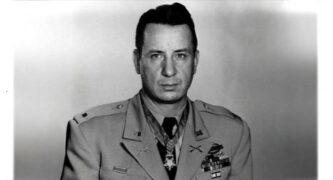
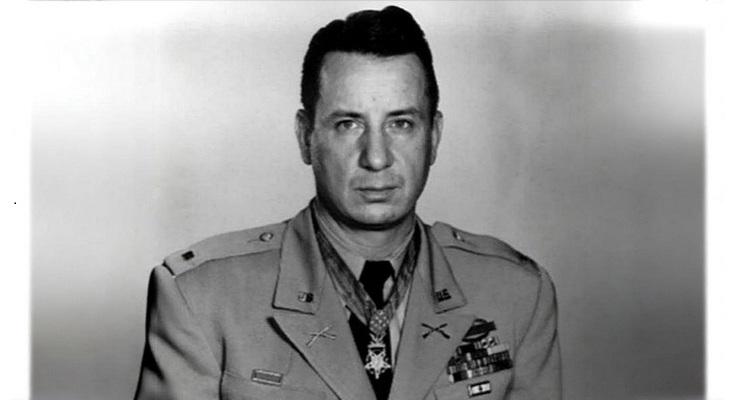
Four months later, President Harry S. Truman placed the Medal of Honor around Captain Raymond G. Harvey’s neck at the White House. His foster parents, who had raised him in Pasadena and ran a music store in the city, were there to see it.
Then, slowly, Pasadena forgot him.
But on Wednesday morning — National Medal of Honor Day — the city will correct that wrong.
A bronze plaque honoring Harvey will be unveiled at Victory Park, at the southeast corner of Altadena Drive and Paloma Street, in a ceremony attended by community leaders, veterans, and local officials.
Mayor Victor Gordo is scheduled to perform the unveiling. Los Angeles County Supervisor Kathryn Barger to deliver remarks. A representative of the 17th Infantry Regiment Association — the very unit Harvey commanded on that Korean hillside — to present to offer military recognition.
The plaque was donated, paid for, and shepherded through the city’s approval process by one man: William Paparian, a former mayor of Pasadena who has spent decades tending to the city’s military memorials. Paparian covered the cost of the plaque, its installation, and its future maintenance — at no expense to the city.
‘I Was Stunned’
Paparian’s involvement with Pasadena’s veterans stretches back to 1987, when he was first elected to the city council. At the time, he noticed the city had no memorial for Vietnam veterans. He championed that project and brought it to completion. In the years that followed, he became a fixture at Veterans Day ceremonies, deployment sendoffs, and homecoming events for the local Marine Reserve battalion.
Two years ago, while preparing materials for the city’s first Memorial Day commemoration, Paparian came across something that stopped him cold: contemporaneous 1951 news reports about Raymond Harvey. The coverage was extensive. Harvey had been a local celebrity. But with the passage of decades, his name had vanished from the city’s consciousness. There was no park, no plaque, no tribute of any kind.
“I was stunned,” Paparian said in an interview. He noted that Pasadena’s two other Medal of Honor recipients — Reginald Desiderio, who has a park named after him, and Joe Hayashi, who has a plaque in Victory Park — had been publicly honored for years.
Harvey, arguably the most decorated of the three, had nothing.
What he found as he dug deeper made the omission harder to fathom.
Twelve Years, Every Award for Heroism
Raymond G. Harvey was born on March 1, 1920, in Ford City, Pennsylvania. He grew up in Sulphur, Oklahoma, and was of Chickasaw heritage — a citizen of the Chickasaw Nation. He was raised by foster parents in Pasadena, a couple who owned a music store in the city. On Aug. 16, 1939, at the age of 19, he enlisted in the United States Army, listing Pasadena as his home of record.
What followed was a military career of almost incomprehensible valor. During World War II, Harvey served with the 79th Infantry Division, arriving in Normandy shortly after D-Day and fighting through campaigns in northern France and Germany. His decorations from that war alone were extraordinary: the Distinguished Service Cross — the Army’s second-highest award for heroism — two Silver Stars, two Bronze Stars, two Purple Hearts, and the French Croix de Guerre with Palm.
He returned home to Pasadena after the war but was called back to active duty for Korea. He took command of Company C, 1st Battalion, 17th Infantry Regiment, 7th Infantry Division, shortly after the division landed at Inchon in September 1950. Six months later, on that hillside near Taemi-Dong, he earned the Medal of Honor.
“He enlisted in the Army in 1939 at the age of 19. Twelve years later — only twelve years later — he had received every award for heroism that our country can bestow,” he said. “He was decorated by foreign governments. In twelve years. Think about that.”
By the end of his career, Harvey’s full decorations included the Medal of Honor, the Distinguished Service Cross, three Silver Stars, three Bronze Stars, three Purple Hearts, the French Croix de Guerre with Palm, and the Chungmu Cordon Medal with Gold Star from the Republic of Korea. Researchers have verified the claim that Harvey ranks among the most highly decorated soldiers in United States Army history.
Grand Marshal, Man of the Year, Hollywood Advisor
On July 5, 1951, President Truman presented Harvey with the Medal of Honor at a White House ceremony. Six months later, on New Year’s Day 1952, Harvey rode down Colorado Boulevard as one of seven Medal of Honor recipients from the Korean War serving collectively as Grand Marshals of the Tournament of Roses Parade — the largest group of Grand Marshals in the parade’s history. That same year, the Pasadena Junior Chamber of Commerce named him Man of the Year.
Harvey also found work in Hollywood. He served as technical advisor on the 20th Century Fox film “Fixed Bayonets!” which depicted events he had personally experienced just months earlier. He went on to advise on two more films: “Cease Fire” in 1953 and “Verboten!”
In 1952, he built a home on Tropical Avenue in Upper Hastings Ranch, anchoring himself in the community he had enlisted from over a decade earlier. He retired from the Army in 1962 at the rank of lieutenant colonel. After his military career, he worked with the Northrop Corporation, served as an investment banker, and became what Paparian described as a very strong advocate for Native Americans — eventually being hired by the state of Arizona to direct Indian Affairs for the Division of Emergency Services.
His daughter Cynthia Pereira has said that her father’s sense of pride and duty carried through into his work with the Bureau of Indian Affairs, where he remained steadfast in his commitment to protecting and restoring the rights of all Indigenous peoples. Another daughter, Johnece Firestone, put it more simply: he was not going to be conquered, she said. He was not going to let them get the best of him. And he didn’t.
Harvey died on Nov. 18, 1996, and was buried with full military honors at Arlington National Cemetery. He was posthumously inducted into the Arizona Veterans Hall of Fame, the Oklahoma Military Hall of Fame, and the Chickasaw Hall of Fame.
‘Unconquered and Unconquerable’
Wednesday’s ceremony was organized by Leadership Pasadena under its “Duty Honor Pasadena” initiative, which launched last year at Caltech and focuses on advocacy for veterans. Nancy Carol Inguanzo, the organization’s executive director, will serve as emcee and open the morning’s remarks.
“Lt. Colonel Raymond G. Harvey chose this city, and Pasadena claims him with pride,” Inguanzo said.
She spoke to the importance of telling Harvey’s full story, including his Chickasaw heritage, and remembering the whole person who lived it in Pasadena.
Inguanzo said she hoped residents would leave the ceremony with a sense of both pride and reflection — pride in knowing that someone who made his life in Pasadena lived with extraordinary courage, and reflection on what his example asks of the rest of the community.
Inguanzo frames military service in deeply human terms: stories like Harvey’s remind us that service is ultimately about people, not politics, she said. Young men and women step forward and carry the weight of decisions made far beyond their control, doing so with courage, discipline, and a deep sense of responsibility to one another.
Supervisor Barger, in a prepared statement, called Harvey’s life of service inspiring, saying it reflects a selfless commitment to the nation.
“As we dedicate this plaque on National Medal of Honor Day, we ensure his legacy endures in the community he called home,” Barger said. “I’m hopeful that his plaque will enable his story to reach future generations and inspire them to live with courage and a commitment to service.”
Paparian, who plans to speak about Harvey’s Chickasaw heritage during the ceremony, framed his remarks in an interview around the motto of the Chickasaw Nation: unconquered and unconquerable. He described the moment on Hill 1232 in vivid terms: Harvey rose alone while his men were under fire and bleeding, the hill was slipping away, and he cleared a pathway for his brothers so they could live. He refused aid. He refused retreat. He refused anything less than complete victory.
“President Truman draped the Medal of Honor on him,” Paparian said, “but the true crown for Raymond Harvey was this Chickasaw warrior spirit that he lived and personified — unconquered and unconquerable.”
‘Not Simply Military Heroism’
The event also honors Pasadena’s two other Medal of Honor recipients, Desiderio and Hayashi, who already have memorials elsewhere in the city. Brian Giroux of the 17th Infantry Regiment Association will provide the military service recognition. The Martin Severance Chapter of the Daughters of the American Revolution (DAR) will host a reception with coffee and light refreshments at the Recreation Center immediately following the ceremony.
Paparian originally explored placing a plaque in front of Harvey’s former home on Tropical Avenue in Upper Hastings Ranch but was told that process would be long and complex. Victory Park offered a more fitting and direct path — it is a park dedicated to World War II, the conflict in which Harvey earned his Distinguished Service Cross. He submitted his proposal in November, and the Pasadena Parks and Recreation Commission approved it the following month, with the city’s Department of Parks, Recreation and Community Services recommending approval.
Asked what he hoped younger Pasadena residents would take away from the plaque, Paparian offered a broad vision of Harvey’s meaning. He said Harvey’s legacy does not rest in bronze alone — it is a story that needs to be lived in acts of kindness and courage. He expressed hope that the memorial would inspire the next generation of the unconquered and unconquerable to stand unbowed, to fight with a heart wide open, to protect the vulnerable, to lead with quiet valor, and to serve without end.
“It’s not just something that the military do,” Paparian said. “We see it in schools, we see it in firefighters, we see it in community activists rising up and putting the good of the greater community over our own self-interest. That’s what Raymond Harvey’s story really represents in the end. It’s not simply military heroism.”
IF YOU GO
What: Medal of Honor Plaque Dedication for Lt. Colonel Raymond G. Harvey
When: Wednesday, March 25, 2026, 9 a.m.
Where: Victory Park flagpole, southeast corner of Altadena Drive and Paloma Street, Pasadena
Reception: 9:30 to 10:30 a.m. at the Recreation Center. Coffee and light refreshments hosted by the Martin Severance Chapter, Daughters of the American Revolution (DAR).
Admission: Free and open to the public.
Presented by: Leadership Pasadena, with support from the Daughters of the American Revolution (DAR), the City of Pasadena, and the Office of Los Angeles County Supervisor Kathryn Barger.
 Get our daily Pasadena newspaper in your email box. Free.
Get all the latest Pasadena news, more than 10 fresh stories daily, 7 days a week at 7 a.m.