




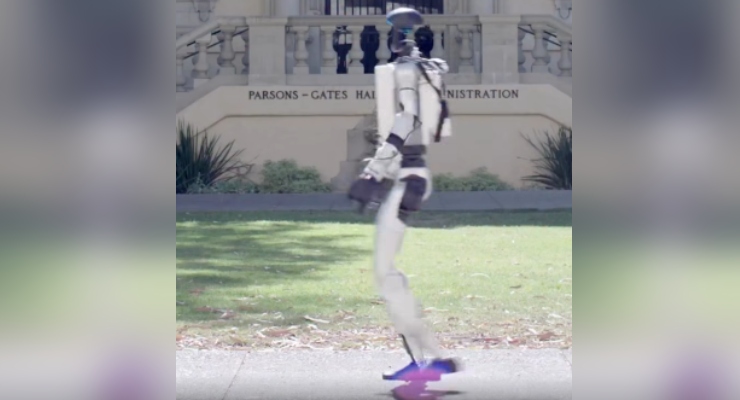
Both things happened last month at the World Humanoid Robot Games in Beijing, where a machine called Tiangong Ultra clocked 8.64 seconds in the 100-meter final, according to Live Science — nearly a full second under Usain Bolt’s human world record of 9.58 seconds, set in 2009. Other accounts put the robot’s fastest time at 8.86 seconds. The robots ran under robot-specific categories and conditions, so the times are not official comparisons with human marks. Several competitors couldn’t slow down after the line, according to news accounts of the games. Some slammed into padding. A few were carried from the arena on stretchers.
That gap — between raw speed and safe, controlled movement — is the problem a laboratory in Pasadena has been working on for years.
At Caltech, researchers in the AMBER Lab, led by engineer Aaron Ames, study what the university calls safety-critical robotics: the underlying control meant to let an autonomous machine move through a crowded, unpredictable space without running into the people, walls and obstacles around it.
The point, as Caltech framed it in a recent post, is not simply to make robots faster. It is to make them dependable enough to work around humans — in busy workplaces, in places too dangerous for people, or in ordinary rooms alongside us.
Ames is the Bren Professor of Mechanical and Civil Engineering, Control and Dynamical Systems, and Aerospace at Caltech, and in 2025 he was named director and Booth-Kresa Leadership Chair of the Institute’s Center for Autonomous Systems and Technologies, known as CAST. In his field he is best known for helping develop control barrier functions, a mathematical tool that treats safety as a hard limit a robot’s controller is not allowed to cross — a way of guaranteeing, in the math itself, that a machine stays within a safe range of motion.
“Right now, robots can fly, robots can drive, and robots can walk,” Ames said in a Caltech announcement in October. “Those are all great in certain scenarios.”
The harder question his group works on is trust: whether those machines can be relied on once they leave the lab. Ames has argued in recent talks that as robots lean more heavily on machine learning, safety has become the main obstacle to deploying them reliably around people.
The work is concrete. In 2025, members of the AMBER Lab published methods for generating safe paths in real time from a robot’s own sensor data, and demonstrated them on humanoid and four-legged robots moving through spaces filled with shifting obstacles, according to papers presented at robotics conferences. The lab also designs and tests bipedal robots, prosthetic limbs and exoskeletons, part of a longer effort to turn human-like walking into machines that can help people move.
Through CAST, Ames’s group recently worked with the Technology Innovation Institute in Abu Dhabi on a system pairing a walking humanoid with a drone that can launch off its back — one example, the university said, of the multi-robot autonomy the center is pursuing.
 Get our daily Pasadena newspaper in your email box. Free.
Get all the latest Pasadena news, more than 10 fresh stories daily, 7 days a week at 7 a.m.