










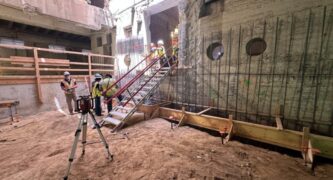

Seven Pasadena craftworkers had logged 2,250 hours and received $186,235 in wages and benefits through June 30, according to a Public Works Department report scheduled to go before the City Council on Monday. Pasadena residents account for 4.28% of the 52,555 craft hours worked on the project since construction began.
But the cumulative figure includes the project’s early specialized demolition and hazardous materials work, when almost no Pasadena residents were working on the job.
“The numbers in our latest report show clear progress from our last update,” Jones told Pasadena Now on Sunday. “The goal of local hire is to ensure that when our city invests in major projects, every part of Pasadena benefits. As we invest to retrofit our Central Library, our community must share directly in that investment. That means good-paying jobs for our residents and real opportunities for our local small businesses. We’re moving in the right direction, but there’s still work to do.
“I will remain focused on ensuring we deliver on our local commitment on this project, so that when the doors reopen, our library continues to make the same transformative, positive impact on a new generation of students that it made on me and countless others growing up in this city.”
Since full Phase 2 construction began in March, Pasadena residents have performed approximately 10% of the project’s craft hours, according to city staff.
The increase comes after Jones and Hampton pressed PCL Construction Services Inc. and city officials earlier this year for more concrete commitments to local hiring.
In February, the City Council voted 6-2 to delay approval of a $177.5 million Phase 2 construction contract after learning that few, if any, Pasadena residents had worked on the project’s first phase. Jones said that during a tour of the construction site, a foreman told him there were no Pasadena residents working there.
Hampton said he was unwilling to support a contract approaching $200 million without a concrete plan explaining how Pasadena residents would benefit.
Jones subsequently called for Pasadena to consider establishing a dedicated city position or task force to monitor local hiring and local business participation on major projects, including future development of the former 710 Freeway corridor.
The council ultimately approved Phase 2 in March after receiving additional details about PCL’s Local Economic Impact and Workforce Plan. The plan established an aspirational goal of at least 10% local craftworker participation.
The latest numbers show a significant change from the project’s earliest months.
No Pasadena craft hours were recorded between August 2025 and January 2026. Pasadena residents worked just 40 hours in February, representing 1.63% of the month’s project craft hours.
That number jumped to 288 hours in March, or 13.32% of all craft hours that month. Pasadena residents worked 432 hours in April, accounting for 11.5%; 740 hours in May, or 9.06%; and 750 hours in June, or 9.17%.
The project’s definition of local workforce participation extends beyond Pasadena.
The city tracks workers through three cumulative geographic tiers. Tier 1 consists solely of Pasadena. Tier 2 covers the Foothill Workforce Development Board service area and includes Pasadena. Tier 3, the broadest category, covers workers living approximately 10 miles from the project.
Through June, 34 workers in the Tier 3 area had performed 8,670.5 hours, representing 16.5% of all project craft hours and $673,824 in wages and benefits. Eight workers in the Tier 2 area, including the seven Pasadena workers, accounted for 4.74% of total hours.
The project does not have a project-specific labor agreement requiring local hiring. City officials said local participation instead is being pursued through contractor cooperation, union and apprenticeship referrals, job fairs, weekly workforce meetings and outreach by the city, PCL and community organizations.
The issue has been a recurring concern for Jones and Hampton. During earlier discussions of the library project, Jones said the city needed to ensure that money being spent on the seismic retrofit stayed in the local economy, while Hampton underscored opportunities for small Pasadena businesses that employ local workers.
Those efforts have included a June 25 Central Library job fair that drew more than 100 job seekers and 12 project trade partners for interviews, employment applications and information about upcoming opportunities. About 21 weekly workforce meetings have also been held, reaching more than 90 unique participants.
The local impact is also being measured in dollars.
Through June, about $1.02 million had been directed to qualifying local workers, trade partners, suppliers and material providers, representing 10.1% of approximately $10.09 million in eligible direct construction costs.
That included $186,235 for Pasadena craftworkers, $220,625 for local trade partners and subcontractors and $147,560 for local supplies and materials. Another $464,645 was attributed to qualifying professional-services workers and PCL on-site project management staff.
PCL has also identified approximately $15.92 million in additional local subcontractor and vendor commitments that have been executed, confirmed or are moving toward award. Those commitments have not been included in the $1.02 million figure because the associated work has not yet been performed and paid.
City staff said the numbers should continue to increase as additional trades move onto the job.
The Central Library renovation remains on schedule and within its City Council-approved budget. Substantial completion is scheduled for Aug. 31, 2028.
 Get our daily Pasadena newspaper in your email box. Free.
Get all the latest Pasadena news, more than 10 fresh stories daily, 7 days a week at 7 a.m.