


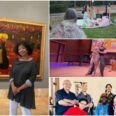


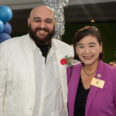

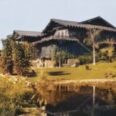


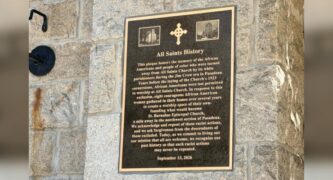
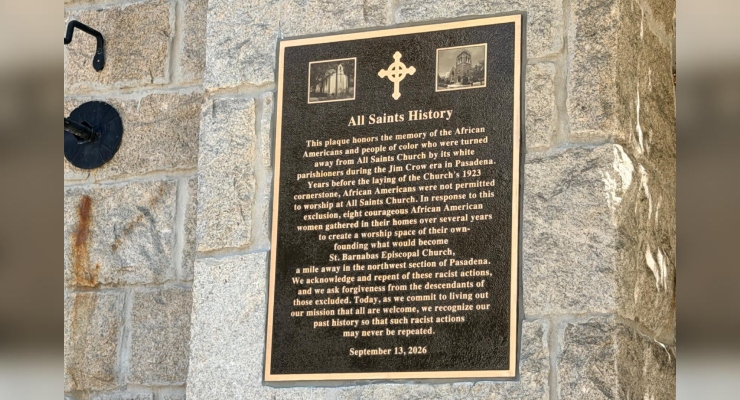
Clergy, city officials and parishioners gathered Monday at All Saints Episcopal Church in Pasadena to unveil a plaque acknowledging the church’s history of racial segregation, a ceremony organizers framed as an act of truth-telling rather than a finished resolution.
The Reverend Tim Rich, priest in charge at All Saints, opened the service by describing the day as a chance for the congregation to write a new chapter, one that says “all of you belong.” The Right Reverend Dr. Antonio Jose Gallardo Lucena, Bishop of the Episcopal Diocese of Los Angeles, offered a blessing, telling the crowd, “I’m here to ask for forgiveness, because we need to do that.”
The Reverend Mark Chase read the text of the plaque, which states that African Americans were barred from worshiping at All Saints in the years before the church’s 1923 cornerstone was laid. In response, the plaque notes, eight African American women gathered in their homes over several years and founded what became St. Barnabas Episcopal Church, a mile away in Northwest Pasadena. Chase thanked members of the church’s Telling the Whole Story Committee and welcomed a representative from St. Barnabas Church.
John Williams, Executive Director of the Center for Restorative Justice, placed the church’s history within Pasadena’s broader story of racial covenants, segregated schools and restricted access to public spaces including the Brookside Plunge.
“Pasadena is a city of competing narratives,” Williams said. He argued that memory carries obligation. “Reconciliation without memory is not reconciliation,” he said. “It’s amnesia.” He added that exclusion had also produced resistance: “When black residents were excluded from institutions, they built institutions. When doors were closed, they organized.”
Pasadena Mayor Victor Gordo said the city could not move past its mistakes without first admitting them, and announced plans to appoint residents to a reconciliation committee that will advise the City Council on the city’s own history of exclusion, including its treatment of Japanese American and African American residents.
Councilmember Jason Lyon, a former vestry member at All Saints, called the plaque a marker rather than an ending.
“This is not the work,” Lyon said. “It’s a symbol of the work, and the work that goes on.”
Rich closed by noting the plaque had been “a long time in the making,” adding, “it required courage. It required grace. It required hard, hard conversation.”
The ceremony ended with a communal reading of the plaque and a prayer led by the Reverend Susan Russell, who told the gathering that “no one is outside your love” and that “everyone belongs in the embrace.”
 Get our daily Pasadena newspaper in your email box. Free.
Get all the latest Pasadena news, more than 10 fresh stories daily, 7 days a week at 7 a.m.


