




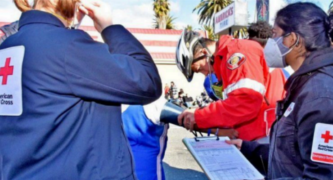


They are preparing for what Paul Stephan, the 2024 Rose Parade Incident Commander, called the organization’s defining operational doctrine: “Red Cross teams own the first eight minutes of every medical aid call.”
In a crowd of that size—hundreds of thousands attended the parade and Rose Bowl Game combined last year—those eight minutes can be the difference between life and death.
When a spectator collapses from a cardiac event or illness along a packed boulevard, an ambulance dispatched from across the city may take 20 minutes or longer to navigate the crowds.
The Red Cross volunteer stationed nearby does not wait. They treat and stabilize the patient, then pass care to paramedics when the ambulance arrives.
Last year, that model produced a striking outcome: Red Cross teams treated 115 patients along the parade route and, by the organization’s count, saved 10 lives.
The partnership between the Red Cross and the Tournament of Roses is now 62 years old. It began in 1964, when Tournament officials asked the Pasadena chapter to set up three first aid stations along the route. The operation has since expanded more than fourfold, growing into a sophisticated medical network integrated with Pasadena’s Incident Command System and coordinated through the city’s Multi-Agency Communications Center at Pasadena Police headquarters.
This year’s volunteers include EMTs, nurses, doctors, paramedics, and about 60 young people trained through the organization’s Youth First Aid Station Training program, known as YFAST. Every medical responder is certified through public entities or the Red Cross Training Services division, according to Stephan. Volunteers make up 90 percent of the Red Cross workforce.
The cases they handle range from the mundane to the critical. Historically, about 85 percent of patients at parade first aid stations are treated and released on-site—blisters, headaches, dehydration. The remaining 15 percent require hospital transport.
Each station operates with a three-person team structure designed to handle volume without sacrificing readiness: one volunteer provides direct care, another documents patient details, and a third radios for backup if needed. Roving leadership teams and logistics crews support the fixed stations.
Jacquelyn Clites, the chief executive of the American Red Cross Los Angeles Region, said the coordination behind that structure is something she wishes the public better understood.
“Our volunteers start setting up at 4 a.m., deploying to 13 stations along the route, supported by shuttle teams, radio operators, and an Incident Command structure,” Clites said. “We work hand-in-hand with Pasadena Fire and the Tournament of Roses to ensure every detail, from medical supplies to communication protocols, is in place.”
The Pasadena Fire Department handles cases requiring paramedic intervention, while Red Cross stations address first aid–level needs—distinct patient populations with differing transport rates. At Rose Bowl events, ambulance golf carts are staffed by either an EMS Reserve member paired with a Red Cross volunteer, or by two EMS Reserves, according to the Fire Department’s EMS Reserve program.
In 2025, Red Cross volunteers contributed 2,451 hours to parade and Rose Bowl operations alone.
But the numbers, Clites suggested, do not fully capture what draws volunteers back year after year to a pre-dawn deployment on a holiday.
“Beyond logistics, there’s an emotional side,” she said. “Volunteers know they may save lives that day.”
The 2026 Rose Parade steps of Wednesday, January 1, on Colorado Boulevard in Pasadena. This year’s theme is “The Magic in Teamwork.”
 Get our daily Pasadena newspaper in your email box. Free.
Get all the latest Pasadena news, more than 10 fresh stories daily, 7 days a week at 7 a.m.