







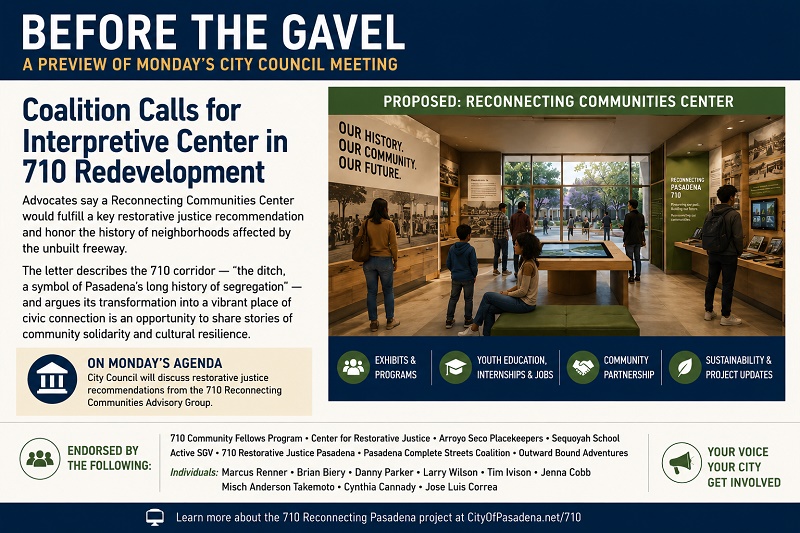
A coalition of community organizations, educators, transportation advocates and residents is urging the City Council to include a public interpretive center in plans for the redevelopment of the former 710 Freeway corridor, arguing the facility would serve as a lasting restorative justice component of the Reconnecting Pasadena project.
“The transformation of the ‘ditch,’ a symbol of Pasadena’s long history of segregation, into a vibrant place of civic connection provides a unique opportunity to share stories of community solidarity and cultural resilience that represent the best of our city,” wrote Marcus Renner.
The proposal is backed by the 710 Community Fellows Program, Center for Restorative Justice, Arroyo Seco Placekeepers, Sequoyah School, Active SGV, 710 Restorative Justice Pasadena, Pasadena Complete Streets Coalition and Outward Bound Adventures, along with individual supporters including Brian Biery, Danny Parker, Larry Wilson, Tim Ivison, Jenna Cobb, Misch Anderson Takemoto, Cynthia Cannady and Jose Luis Correa.
In the letter, submitted to the City Council ahead of Monday’s discussion on restorative justice recommendations, Renner of Arroyo Seco Placekeepers called for the creation of a “Reconnecting Communities Center” within the project area. The proposed facility would fulfill one of the recommendations made by the 710 Reconnecting Communities Advisory Group, which called for the creation of a permanent, publicly accessible space that reflects the history and culture of neighborhoods affected by the freeway project.
Council members are expected to discuss recommendations developed by the advisory group as the city moves forward with planning for the redevelopment of approximately 50 acres of land acquired decades ago for the never-completed extension of the Long Beach Freeway.
The former freeway corridor remains one of Pasadena’s most visible reminders of a transportation project that displaced hundreds of residents and businesses, primarily in communities of color, before the freeway extension was halted.
In recent years, city officials have framed redevelopment of the properties as an opportunity not only to build housing and community amenities, but also to address the social and economic impacts left by the project.
In the letter, supporters describe the corridor, often referred to as “the ditch,” as a symbol of Pasadena’s history of segregation and disinvestment.
“The transformation of the ‘ditch,’ a symbol of Pasadena’s long history of segregation, into a vibrant place of civic connection provides a unique opportunity to share stories of community solidarity and cultural resilience that represent the best of our city,” the letter states.
Advocates envision a center of at least 1,500 square feet that could be incorporated into another building planned for the site. The facility would host exhibits, film screenings, workshops, public meetings and arts and cultural programming.
Supporters say the center could also provide educational opportunities for local students, youth internships and employment programs, while serving as a location where residents can learn about the area’s history and track progress on the redevelopment effort.
Under the proposal, management of the center would be shared by the city and a collaborative of local cultural and heritage organizations, including a Restorative Justice Community Oversight Committee recommended by the advisory group.
The letter argues that a dedicated community space would help connect residents to what is expected to be a decades-long redevelopment effort and ensure that the history of neighborhoods affected by the freeway project is preserved and shared with future generations.
The City Council’s discussion comes as officials continue work on the Reconnecting Pasadena 710 Vision Plan, which envisions a new mixed-use neighborhood with housing, parks, open space, mobility improvements and community-serving uses on former Caltrans-owned properties.
Earlier planning concepts called for at least 1,800 housing units and emphasized reconnecting neighborhoods long divided by the freeway corridor.
Supporters are asking the City Council to endorse the concept and direct the Planning Department to incorporate the interpretive center into the scope of work for the area’s future specific plan.
 Get our daily Pasadena newspaper in your email box. Free.
Get all the latest Pasadena news, more than 10 fresh stories daily, 7 days a week at 7 a.m.


