





A $10.1 million plan that would steer two years of Pasadena’s Measure M money mostly toward zero-emission buses and pedestrian-safety projects is scheduled to go before the city’s Transportation Advisory Commission on Thursday for review — the first step on a multi-stage approval path that the advisory panel does not control.
The seven projects the Department of Transportation has flagged as priorities are not a loose wish list. Their combined cost — about $5.7 million for transit and $4.4 million for street work — matches the city’s funding allocation to the dollar, fixing how much can go to each category, though the commission could still recommend a different mix of projects from a longer list. The advisory body is being asked only to “review and provide comments to the City Council,” which would have to approve the plan before it advances to two regional boards for final approval.
The money comes from Measure M, formally the Los Angeles County Traffic Improvement Plan, which county voters approved on Nov. 8, 2016, and reaches the city through its Multi-Year Subregional Program, or MSP. Pasadena, with a population of 136,988, is allocated about 27.5 percent of the $36.3 million available to six Arroyo Verdugo-area communities, split between transit and complete-streets categories, for the 2029 and 2030 fiscal years, through the Arroyo Verdugo Communities Joint Powers Authority, which distributes the funds by population. Only Glendale draws a larger share.
On the transit side, roughly $4.68 million would buy replacement and expansion buses, divided between Dial-A-Ride and Pasadena Transit, to continue the city’s shift to a zero-emission fleet, with another $985,819 for bus-stop improvements.
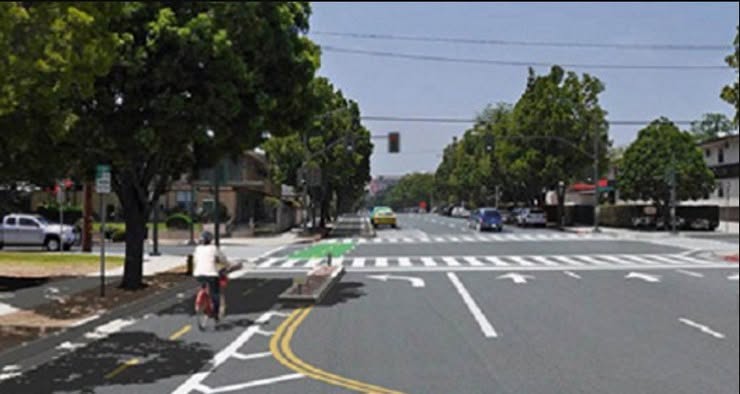
The rest of the money tells the more pointed story. The four street projects, about $4.4 million, are almost entirely about people on foot: a new traffic signal at Avenue 64 and Nithsdale Road ($1 million); pedestrian hybrid beacons, known as HAWKs, at three crossings on Washington, Fair Oaks and Del Mar ($2.1 million); a $600,000 program to install flashing beacons at three crossings that have met the city’s criteria; and $748,554 for high-visibility “continental” crosswalk markings citywide. Of those, the staff report says, the $600,000 crossing program “reduces potential safety risks consistent with the City’s goal of zero traffic fatalities by 2035.”
Beyond the seven priorities, the report attaches a much longer roster of projects whose costs, it concedes, “far exceed the available funding for this MSP funding cycle.” Among them are a $45 million feasibility study for an Arroyo Link walking and biking path to the Rose Bowl, a reconfiguration of North Fair Oaks Avenue, and pedestrian improvements in the Playhouse and Old Pasadena districts — items kept on the list so the city can act if more money appears. The roster updates a project list the Council last approved on April 11, 2022.
After the commission comments and the Council acts, the plan would be folded into a regional package for the Arroyo Verdugo joint powers authority and then sent to the Los Angeles County Metropolitan Transportation Authority, or Metro, which must sign off before a single bus is bought or crosswalk repainted.
The Transportation Advisory Commission is scheduled to meet at 4 p.m. on Thursday, June 25, in Grand Conference Room S038 in the basement of City Hall at 100 North Garfield Avenue, in Pasadena. For more information call (626) 744-7311 or visit https://www.cityofpasadena.
 Get our daily Pasadena newspaper in your email box. Free.
Get all the latest Pasadena news, more than 10 fresh stories daily, 7 days a week at 7 a.m.