

After winning the Rose Parade’s top prize for the first time in January, the Cal Poly Universities student float team has gathered every element and mechanism of its next entry, “Soaring as One,” in Pomona, where students from campuses about 250 miles apart are now building side by side ahead of a December move to Pasadena.
The 78th Cal Poly float, built around the Tournament of Roses’ 2027 theme, “Welcome,” will be decorated in Pasadena during a Dec. 26-30 Deco Week that is open to volunteers, before it appears in the 138th Rose Parade on Friday, Jan. 1, 2027. One of the team’s two student presidents said the program measures itself less by trophies than by the students who build the float.
“I think one thing that’s important to realize for us is that it’s not just about winning awards,” said Bennett Parisi, president of the San Luis Obispo team, who worked in the electronics department on last year’s float. “Our priority every single year is about building up our students to be the best versions of themselves.”
 Parisi said turnover comes every year in a university program, and that newcomers arrive without experience. “We pride ourselves on our students not needing to have any prior experience coming into this program,” he said.
Allyson Castillo, president of the Cal Poly Pomona team and last year’s design chair, said “we have 60 students that are leads in our program, but we cover over 300 students or more.” She said those students come from many majors, including English and art students who learn to weld. “Regardless of wherever you started and whatever your background is, there is always different ways for every student to contribute to our program,” Castillo said.
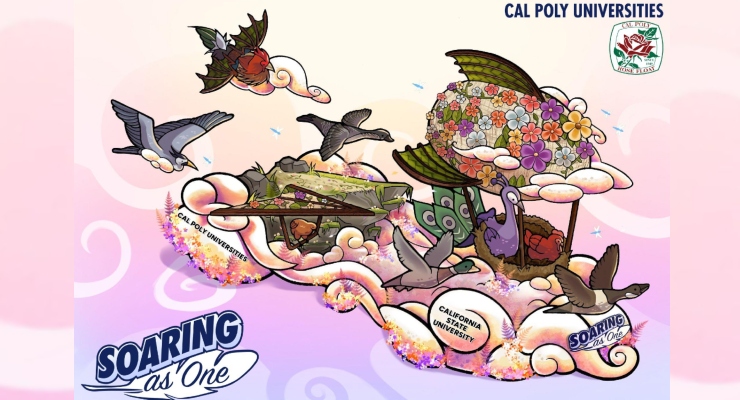
According to a Cal Poly press release, the float shows flying and usually flightless birds traveling together, led by a Canada goose with a 16-foot wingspan in a V-formation that includes a mallard duck, a nene goose and a great blue heron. A kiwi flies a hang glider, a blimp carries a peacock and a Rhode Island red chicken, and prosthetic wings lift a jungle fowl, the release said. The float is estimated to carry roughly 42,000 flowers.
The release listed concealing a mechanism to lift and lower the 2,000-pound blimp among the year’s engineering challenges. Castillo said the blimp’s mechanism does two jobs: it tilts, and it serves as the float’s overheight mechanism so the float can pass under the freeway on the parade route. The blimp’s balloon is cut at a certain point, she said, and “the top section of it will drop down using a hydraulic piston.” A simple piston provides the tilt, she said; “its tilting mechanism is meant to rock the blimp back and forth so it looks like it’s soaring through the clouds,” Castillo said.
Castillo said each element typically starts as pencil steel that students shape, bend and weld, then cover with a screen layer similar to screen-door mesh and a cocooned base layer of webbing that decorations are applied to. The construction team also has to account for whether decoration is wet or dry, whether it includes fresh flowers, and how much it weighs, she said.
“It’s a bit difficult, but we may be two campuses, but we are one team,” Parisi said. He said the Pomona team travels to San Luis Obispo for an April planning weekend to work through the concept and story, and that in the fall “we in San Luis Obispo are traveling down to Pomona basically every weekend to actually work on the float.” Castillo said the two halves of the chassis were joined in Pomona in early October and fully joint lab days were set to begin Oct. 24.
 Students will work Saturdays and some Sundays until move-out, Castillo said. A mechanical and technical inspection by the Tournament of Roses is set for Nov. 7, after which students will finish welding the base float and then sheet and foam it, creating the surface people can stand on. Finals come next, and students may not join the work until their exams are done. Castillo said “we are students first because we wouldn’t be in this program if we weren’t students.”
In December, the team moves the float to Pasadena. “That is when we will take the float and take it all the way to Pasadena to actually do our final touch-ups and then we’ll do deco week in Pasadena,” Castillo said.
For the first time on campus, the team is growing celosia and gomphrena, which the press release said will give the birds their feathery look; Castillo said the campuses have typically grown statice or marigolds. Parisi said the decorations department holds harvesting days every week on flower fields at both campuses, and that backup plans are in place. He said “we do try to make sure that we’re not just relying purely on our harvest.” Castillo said the team also seeks donated plant material: “So last year, for example, we actually got some donations from the Huntington Library Gardens and the LA Arboretums.”
Castillo said she started as a freshman learning to weld and shape pencil steel, then managed a team of 15 as pod coordinator before serving as assistant design chair, design chair and now president. She said the experience means “I know that I’m ready from day one with those skills needed.” Parisi, an electrical engineering graduate student who specializes in control systems, said he helped create the animation system the team has used since its “Shock n’ Roll” float. “When we have a mechanism on the float, it’s there to tell a story,” he said.
Last year’s “Jungle Jumpstart” had giant LED screen eyes on its robot, Parisi said. The float, which measured 53 feet long, 25 feet high and 18 feet wide with a 40-foot robot, won the Sweepstakes Award at the 137th Rose Parade on Jan. 1, 2026. Cal Poly Pomona said it was the first time students had won the award. The program says it has won 65 awards since 1949. “It has definitely brought a lot more eyes to our program,” Parisi said of the win, adding that university leadership has paid closer attention.
The program traces its start to Don Miller, an ornamental horticulture student whose family were longtime Pasadena-area residents. At the end of summer 1948, the Pasadena Rose Parade Committee asked whether Cal Poly could produce a float within 100 days, according to the program’s history; the first float, “Rocking Horse,” was built on a $258 budget, appeared Jan. 1, 1949, and won the Award of Merit. When the campuses divided in 1966, students agreed to keep the float a joint entry.
Parisi said the program is funded through the universities but relies on donations, and keeps decorations and operations wish lists of needed supplies. He said “we do rely a lot on donations and a lot of help.” He said Deco Week lets residents get hands-on and say, “Oh, I helped make that one little part on the float.”
Deco Week volunteering is free, with sign-ups through Eventbrite, and every volunteer gets a tour of the float. Volunteers must be 16 to decorate on the float or scaffolding; the program says the tasks are not suited to children under 8, and children 8 to 12 may decorate briefly with full parental supervision. Information is available at rosefloat.org or (909) 869-3204, Monday through Thursday, 10 a.m. to 3 p.m.
 Get our daily Pasadena newspaper in your email box. Free.
Get all the latest Pasadena news, more than 10 fresh stories daily, 7 days a week at 7 a.m.