






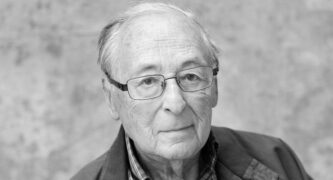

Mandel was born on August 24, 1926, in Antwerp, Belgium, to a German-speaking Polish Jewish family and educated in French schools until the Nazis invaded Belgium in May 1940. His family fled to New York City when he was 14 and lived in Forest Hills, Queens, where he learned English. Mandel earned a bachelor’s degree in 1947 from New York University, a master’s degree from Columbia University in 1948, and a doctorate from Ohio State University in 1951.
In 1953, Mandel was conscripted into mandatory service in the US Army and served for two years, then later spent five years on the faculty at the University of Nebraska, during which he spent time in Amsterdam as a Fulbright Fellow. He married his wife, Adrienne, in 1960.
Mandel first came to Caltech as a visiting associate professor of English in 1961. He joined the faculty as an associate professor of English in 1962, became a full professor in 1968, and professor of literature in 1980. A prolific scribe, Mandel wrote in both French and English. His works range from fiction, plays, and poetry to essays on literary theory and art history.
In a 1994 interview for Caltech’s Oral History Project, Mandel said he began writing as a child. “That was always an absolute part of me,” he recalled. “There was never any doubt. Even as a child, and even in New York, I began to write in French. But then I fell in love with the English language and simply mastered it and quickly went over to English. I made a point of mastering English. I was never without a dictionary at my side.”
Mandel also translated numerous works written in French or German into English. His dramatic works have been produced on radio and in theaters in the United States, France, Switzerland, and at the Royal Lyceum Theatre in Edinburgh, Scotland.
“Oscar Mandel was a remarkable figure within Caltech’s Humanities faculty,” recalls Diana Kormos-Buchwald, the Robert M. Abbey Professor of History and director and general editor of the Einstein Papers Project. “He joined Caltech as a young professor at a time when the Humanities division resembled what he fondly described as a ‘gentlemen’s club’—a community of dedicated teachers with limited emphasis on scholarly research. By the 1980s, however, the group had shifted toward a more research-driven culture. Oscar believed that the growing emphasis on specialization came at a cost: a diminishing appreciation for the arts, music, and literature, all of which he passionately championed. He lamented the absence of a structured aesthetic education at Caltech. Deeply knowledgeable in art, theater, and poetry across multiple languages and cultures, he embodied the ideal of a true intellectual at a time of increasing academic narrowness. He resisted passing scholarly trends, favoring instead a disciplined and rigorous approach to education. Oscar combined wit with skepticism, ambition with humility. Above all, he produced significant scholarly contributions whose impact will endure.”
In 2003, after more than 40 years of teaching English and comparative literature at Caltech, he retired and became professor emeritus.
“Caltech in general, and the division in particular, remained kind to me and rewarded me as a teacher, scholar, and writer,” Mandel told Caltech magazine in 2014. “By teaching the basics of English literature, drama from the Middle Ages to the mid-20th century, and fundamentals of the art of poetry, did I produce a generation of Caltech graduates who are cultivated scientists who read Jane Austen when not tweaking electrons or synapses, subscribe to chamber music series, and frequent art museums and theaters? We cannot know, but we do our duty by opening doors to realms of thoughts and passions neighborly to those that the sciences offer.”
 Get our daily Pasadena newspaper in your email box. Free.
Get all the latest Pasadena news, more than 10 fresh stories daily, 7 days a week at 7 a.m.