



The special Design Commission meeting is scheduled for 6:30 p.m. at the Pasadena Convention Center, Room 211, located at 300 East Green Street. This marks the second time commissioners will review the project, which was continued from a December 9 hearing after the commission voted 6-0 to ask developers to reduce the building’s mass along its southern edge where it borders the school’s playground.
Project History and Details
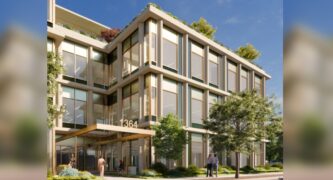
The California Institute of Technology, in partnership with developer TC LA Development, Inc. and real estate firm Trammell Crow Company, is proposing to construct a four-story, 93,539-square-foot research and development building with office and laboratory spaces on property it owns at the southeast corner of Green Street and Holliston Avenue. Nancy Moses, a Principal at Trammell Crow Company, serves as the applicant for the project. Architecture firm Gensler designed the contemporary-style building.
The project site currently functions as a 115-space surface parking lot covering 41,573 square feet. Plans call for 260 parking spaces in the new development: 14 at-grade spaces plus a three-level subterranean garage. The building would reach 79 feet in height with an additional 17-foot mechanical screen on the roof.
The project underwent preliminary consultation with the Design Commission on May 13. On September 10, the Urban Forestry Advisory Committee reviewed a request to remove two protected street trees—a California Fan Palm and an Incense Cedar along Holliston Avenue—to accommodate the redesigned driveway entrance. The City Manager approved the tree removals on September 22.
The project first came before the Design Commission for concept design review on December 9. Following nearly two hours of public testimony revealing deep divisions between school parents and Caltech supporters, commissioners voted unanimously to continue the hearing. Commissioner Rob Tyler directed the applicant “to work on the south elevation scale and proximity to the school parking lot, playground, and the overhead structure in an effort to reduce the mass of the building”. Commissioner Srinivas Rao added that the design team’s stated inspiration from nearby PCC buildings “does not really work as yet. It’s a good start. I think it needs further work”.
The School’s Concerns
St. Philip the Apostle School, located at 1363 Cordova Street, sits directly adjacent to the proposed development site on its east and south property lines. Founded in 1927, the Catholic parish school serves approximately 550 students from transitional kindergarten through eighth grade. Jennifer Ramirez serves as principal.
Parents and parishioners have raised multiple concerns about the project’s potential impacts on the school community:
Safety and Security Concerns: Multiple speakers at the December 9 hearing expressed alarm about the building’s height creating unobstructed vantage points into the school yard. One parent of three children at St. Philip told commissioners that “to put a building of this scale and create a higher ground with unobstructed vantage points into the school yard is baffling to me as a mother and in light of the tragic events in schools across the country”. The security concerns carry particular weight given a 2019 incident in which an armed intruder broke into the school through an exterior girls’ restroom, remaining on campus for approximately 15 minutes before an alarm sounded.
Construction Impacts: Christina Blacker, a parent at St. Philip, told commissioners that the school’s transitional kindergarten classroom is located just 88 feet from the edge of the current parking lot. “The noise … the dust from a safety and health perspective for the kids” during construction of the 93,000-square-foot building poses serious concerns, Blacker stated.
Scale and Compatibility: Mary Forrest, a parent of four boys at the school, argued the building “simply does not belong on this block” and would “permanently reshape the environment our children learn and worship in”. The proposed structure would tower over the surrounding neighborhood, which is characterized by one- to three-story buildings.
Traffic Safety: Erika Foy of District 7 challenged the adequacy of the City’s traffic analysis, arguing the mobility study “uses commuter peak hours” rather than studying “the real conflict times at the school,” when drop-off occurs from 7:30 to 8 a.m. and dismissal at 3 p.m.
Alleged Lack of Community Engagement: A Change.org petition created in September claims Caltech purchased the property and pursued the project “without any meaningful community engagement”. The petition urges the City to “STOP THIS PROJECT” until full safety, traffic, environmental, and community impact studies are completed.
Gina Cockriel, St. Philip the Apostle School Board President, sent an email to the parish community stating: “We strongly encourage all members of the St. Philip the Apostle Parish and School community to attend in support of our neighborhood and to voice opposition to this development”.
Caltech Supporters Make Economic Case
Several Caltech faculty members and affiliates spoke in support of the project at the December 9 hearing, stressing the facility’s potential to retain scientific talent and startup companies in Pasadena.
Joe Parker, a Caltech professor of biology and biological engineering who has three sons attending St. Philip, found himself in the unusual position of speaking against the project despite his Caltech affiliation. Parker said he felt “morally compelled as a parent and also a concerned faculty member to urge you guys to really take seriously many of the issues that are raised here”.
However, other Caltech representatives made an economic case for the project:
Fred Farina of Caltech told commissioners that over the past 30 years, Caltech has launched an average of 12 startup companies annually, but “over 50% of these companies have been forced to relocate to San Francisco, Bay Area, San Diego, Boston, and other innovation labs” due to lack of suitable lab space.
Viviana Gradinaru, a Caltech neuroscience professor and Pasadena resident, supported the project, noting her own lab’s work has led to biotech startups raising over $100 million and creating nearly 200 jobs. “But none of those jobs were in Pasadena because when it came time to translate these discoveries, we and many others had no choice but to go elsewhere,” she said.
Shayna Chabner McKinney, Caltech’s Chief Communications and External Relations Officer, stated that “we see this as an additive opportunity to take what is currently an underdeveloped, underutilized parking lot, and to bring another layer of vitality and opportunity”.
The project represents what would reportedly be the first time Caltech has subleased its land for commercial development. Caltech officials have described the facility as an “innovation center” designed to support the institute’s growing startup ecosystem.
Environmental and Regulatory Framework
The City has determined the project is categorically exempt from the California Environmental Quality Act (CEQA) under Section 15332, Class 32 for in-fill development projects. City staff found the project would not result in significant effects relating to traffic, noise, air quality, water quality, or cultural resources.
The project site is zoned EC-MU-N (East Colorado Specific Plan, Mixed-Use Neighborhood) with a General Plan designation of Medium Mixed Use (0-2.25 FAR; 0-87 dwelling units per acre). The East Colorado Specific Plan was adopted by the City Council on February 28, 2022, and became effective in June 2022.
City staff recommended the Design Commission approve the concept design review application, finding the project complies with design-related goals and policies in the General Plan’s Land Use Element, the Design Guidelines in the 2022 East Colorado Specific Plan, and the Design Guidelines for Neighborhood Commercial and Multi-family Districts.
Regional Context: Lab Space Shortage
The dispute over the Green Street project unfolds against a backdrop of acute life science real estate shortages in the greater Los Angeles area. According to commercial real estate data, metropolitan Los Angeles has a life science availability rate of just 3%—the lowest among the country’s largest biotech markets and a small fraction of the rates seen in Boston and San Francisco.
Los Angeles County municipal leaders have been streamlining permitting processes and connecting local developers with potential tenants to create biotech space. Pasadena revised its zoning regulations in 2022 to streamline approvals for life science development. “The number of companies that are spun out of each of those universities on an annual basis is incredible,” Patrick Church, managing director at JLL and lead of the brokerage’s Los Angeles life science practice group, told CoStar News, referring to institutions including Caltech, UCLA, and USC. “When they’re ready to go from point A to point B, they don’t necessarily have a year or two to wait for space to get built out”.
What Happens Next
The January 27 special meeting represents a critical juncture for the project. If the Design Commission approves the concept design review, the project would advance to final design review. Any approval would be subject to conditions that must be satisfied before final design review.
The special meeting is being held at the Pasadena Convention Center rather than the typical City Hall Council Chambers location, because of a scheduling conflict with the Municipal Services Committee, according to the city. The agenda lists only two items: the 1364 East Green Street project and one other development proposal.
Members of the public can attend in person or participate virtually. The full agenda and staff reports are available on the City’s website at:
cityofpasadena.net/
The outcome of Tuesday’s hearing will determine whether the project moves forward in the design review process or returns to the drawing board for further revisions to address community concerns about scale, safety, and compatibility with the adjacent school.
 Get our daily Pasadena newspaper in your email box. Free.
Get all the latest Pasadena news, more than 10 fresh stories daily, 7 days a week at 7 a.m.