




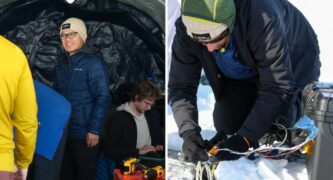


Caltech scientists are enduring the bone-chilling cold of Antarctica to get an unprecedented view of what is happening at the edges of its ice sheets. The team behind the GLASS mission (Grounding zone Long-term Acoustic Sensing of Structure) reached the frozen continent just before Thanksgiving to begin a remarkable new mission that aims to understand how the ice will behave under a changing climate. Their project is supported by the Institute’s Brinson Exploration Hub, which, since 2024, has worked to realize a new age of discovery by implementing projects of remote exploration.
Zhongwen Zhan (PhD ’14), professor of geophysics and the Clarence R. Allen Leadership Chair and director of Caltech’s Seismological Laboratory, has spent years showing how fiber-optic cables meant for communications could be used for science. His work on campus has involved repurposing existing fiber-optic networks to be used as earthquake detectors. Using laser emitters to shoot beams of light down the cables, he and his colleagues can detect seismic waves by observing how they cause light to bounce to a receiver.
Zhan has put this same idea to work in Antarctica to study seismic activity under the surface of the ice. GLASS represents the next phase of that work. The project team will deploy up to 10 kilometers of fiber-optic cable on Union Glacier on the West Antarctic Peninsula and use it to analyze the glacier’s grounding line: the interface where it protrudes from land and floats on seawater. (Read more about this ambitious field project and others being undertaken by Caltech researchers who aim to better understand the physical properties governing frozen regions so that national and local governments are better informed and prepared to respond to climate change and changing sea levels.)
To read more about the GLASS expedition—featuring photos, videos, and updates about this research—visit the Brinson Hub’s frequently updated page of field notes.
 Get our daily Pasadena newspaper in your email box. Free.
Get all the latest Pasadena news, more than 10 fresh stories daily, 7 days a week at 7 a.m.