










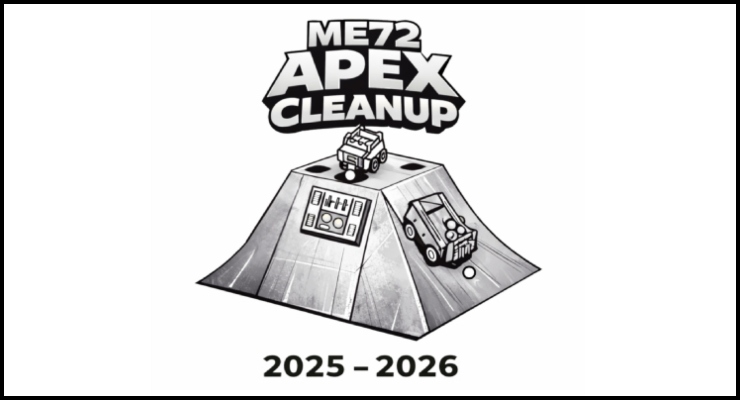
This year’s challenge, called “Apex Cleanup: Summit, Mint, Bank,” is the culmination of two academic terms of hands-on engineering in which students designed and built robotic systems from scratch — progressing from concept development through prototyping, fabrication, testing, and iteration, according to the ME72 competition website. The pyramid, a steel-skinned structure with 37-degree sloped faces and a flat three-by-three-foot summit deck, is both the visual centerpiece and the central engineering problem.
The rules are straightforward, the execution anything but. Three teams compete simultaneously on a 40-foot-square field. Each match lasts four minutes and 30 seconds, beginning with a 30-second autonomous period before switching to teleoperated control. Each team fields up to two robots.
Robots collect scattered “Hot Pellets” from the field and haul them up the pyramid’s steel slopes. Pellets deposited at the summit are converted into “Energy Credits,” which roll back down to the field. Credits banked at ground-level “Vaults” score points. Teams can also intercept opponents’ Energy Credits before they reach the Vaults — and bank those for bonus points.
The strategic split is clear: summit scoring offers higher payoffs but demands robots that can reliably climb, crest, and descend a 37-degree steel incline. Ground-level “Depot” routes are faster but score fewer points. Physical contact between robots is permitted within safety guidelines.
The six competing teams are Big Red, Clanks, Pharaobots, Pyramaniacs, Climb & Punishment, and MechE Wed: After Party. Team sizes range from five to seven students, all mechanical and civil engineering undergraduates.
Students fabricated custom chassis and mechanisms using additive manufacturing and precision machining, according to the competition website. They integrated motors, sensors, electronics, and embedded control systems. The work, the website states, “closely mirrors professional engineering practice.”
Michael Mello, a teaching professor of mechanical and civil engineering who leads the ME72 course, has described the competition’s value in prior years. “They make everything with their hands from the fabrication to the building to the coding to the assembly,” Mello said in a 2023 interview. “And the idea is that they go through everything together and they go through the challenge that simulate the challenge that they face in the real world in private industry.”
ME72 is one of Caltech’s long-running engineering traditions, now in its 41st year. Past competitions have featured amphibious robots, sumo-wrestling bots, racquetball-launching machines, and — in the 40th edition — street-hockey-playing robots on a ferromagnetic rink. The 2024 competition sent remote-controlled blimps through an aerial “quadball” course. The competition is sponsored by Northrop Grumman.
The event takes place at Scott Brown Gymnasium on Caltech’s campus at 1200 East California Blvd. in Pasadena. More information is available at me72.caltech.edu.
“It feels great to win,” MechE Wednesdays team member Nico Jimenez said after the 2023 competition. “We put many, many hours in over the last two terms, but it’s all been worth it.”
Today, six new teams will find out if their hours were worth it, too.
 Get our daily Pasadena newspaper in your email box. Free.
Get all the latest Pasadena news, more than 10 fresh stories daily, 7 days a week at 7 a.m.