








Can residents help decide how government spends public money?
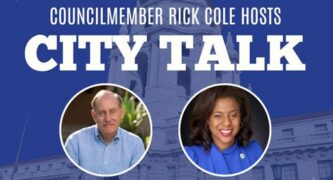
That was the question at the center of the latest CityTalk webinar hosted by City Councilmember Rick Cole, featuring Capri Maddox, General Manager of the City of Los Angeles Department of Civil + Human Rights and Equity.
The discussion focused on participatory budgeting, an approach that gives community members direct authority to help allocate public funds rather than simply offering comments on spending decisions made by elected officials and staff.
Cole noted that Pasadena is currently adopting both its annual $1.2 billion operating budget and a capital improvement budget that includes roughly $250 million in projects ranging from street repairs and sidewalk improvements to water and electric infrastructure upgrades. Behind those funded projects, he said, sits an estimated $2 billion backlog of additional infrastructure needs.
“Participatory budgeting is about taking these giant budgets and beginning to think about how citizens might help decide where some of those dollars should go,” Cole said.
The concept has gained traction internationally since it was first pioneered in Brazil in 1989. According to Maddox, more than 7,000 cities around the world have experimented with participatory budgeting in one form or another.
Los Angeles launched its own effort using approximately $10 million in federal COVID relief funds targeted toward neighborhoods that experienced some of the highest mortality rates and economic impacts during the pandemic.
Rather than having only City Hall determine how the money should be spent, residents in nine underserved communities were invited to help design the process, submit ideas, develop proposals and ultimately vote on which projects would receive funding.
The results surprised many skeptics.
“People didn’t use these dollars for glamorous things,” Maddox explained. “They used them for structural needs for families to function and to have an opportunity to earn income or make their communities better.”
Funded projects included rental assistance programs that helped families avoid eviction, after-school programs, youth services, community health initiatives and street medicine programs that brought medical care directly into underserved neighborhoods.
One lesson, Maddox said, was that residents consistently demonstrated good judgment when entrusted with meaningful responsibility.
“When we trust the community, we win,” she said.
The conversation resonated with Cole, who shared a similar experience from his time as City Manager of Azusa. There, he redirected federal Community Development Block Grant funds into a neighborhood-driven decision-making process.
Cole said that initially, Azusa residents greeted the idea with deep skepticism.
“You people at City Hall have never helped us,” Cole recalled hearing at early meetings. Residents doubted that government would actually allow them to decide how money would be spent.
But after projects selected by the community were completed, participation increased dramatically and private investment followed. Homeowners began improving their properties, businesses invested in commercial centers and residents developed a stronger sense of ownership in their neighborhood’s future.
One community-selected project involved constructing a shade structure at a local elementary school that served both students and neighborhood families who used the campus after hours.
For Cole, the experience reinforced a broader lesson.
“Giving people power is not giving away the power of elected officials,” he said. “It’s actually multiplying the power.”
Both speakers argued that participatory budgeting can help address growing public distrust of government by moving residents from the role of spectators to active participants.
Maddox described the process as a shift away from traditional public hearings, where residents often receive only a few minutes to comment on billion-dollar budgets. Participatory budgeting instead gives people an opportunity to deliberate with neighbors, develop priorities and make collective decisions.
The approach also reflects a broader philosophy known as Asset-Based Community Development, which focuses on identifying a community’s strengths rather than simply cataloging its problems. Drawing on those strengths to empower community residents is at the heart of participatory budgeting.
As Pasadena confronts major decisions about infrastructure, housing, public services and long-term investment priorities, Cole suggested participatory budgeting could become one way to deepen civic engagement and strengthen trust between residents and government.
“We do it for the people, and the people should have a say in how it’s done,” he concluded.
Councilmember Cole hosts monthly City Talk webinars on the first Tuesday of the month at 7 pm (this one was postponed due to the election on that evening). He also hosts monthly Issue Forums on the third Tuesday.
The next one, scheduled for June 16, focuses on the future of the 710 Stub development. The Issue Forums also start at 7 p.m. and are online as well as in person at the Jefferson School Auditorium, 1500 E. Villa.
 Get our daily Pasadena newspaper in your email box. Free.
Get all the latest Pasadena news, more than 10 fresh stories daily, 7 days a week at 7 a.m.