










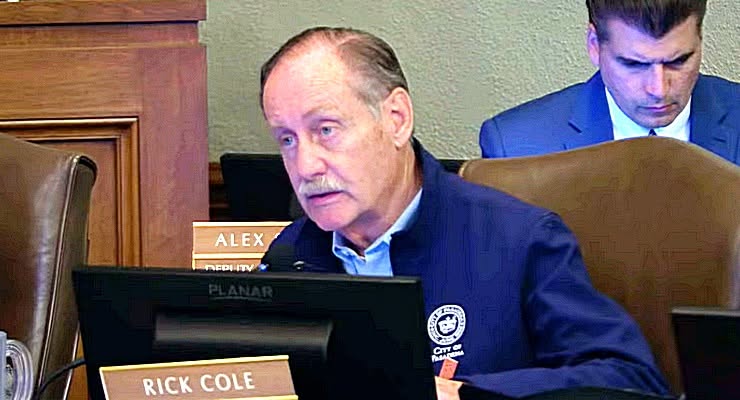
With less than a month remaining before the deadline to place measures on the November ballot, Pasadena City Councilmember Rick Cole is urging a broader public discussion about the possibility of asking voters to approve new taxes while warning that any decision could have long-term implications for the city’s finances and public services.
In a public statement ahead of Monday’s City Council meeting, Cole said the city faces growing fiscal pressures but cautioned against rushing into a tax proposal. Cole also said that the city must act on emergency preparation.
“A decision on proposing new taxes is not one that should be rushed. But neither can we afford to wait to invest in fire response in our community. The Eaton Fire reminded us of our vulnerability and the twin quakes in Venezuela only underscored the urgency. If we wait until two of our fire stations fail in an earthquake, it’s too late. If we wait to build a ninth fire station until we’ve experienced another wind-driven firestorm, it’s also too late. We have other critical needs that require investment as well and our budget only stretches so far.”
City staff outlined several potential revenue measures for the Nov. 3 ballot in a city staff report, including a quarter-cent transaction and use tax, a parking occupancy tax, a real property transfer tax, modernization of the city’s business tax and a special parcel tax dedicated to public safety and infrastructure.
At this stage, staff stressed that all options remain preliminary and are seeking direction from the council on which, if any, should advance for additional legal and fiscal analysis before the Aug. 7 deadline to submit measures to Los Angeles County.
“There has been little public discussion so far — and that bothers me,” Cole said. “Important decisions deserve ample opportunity to look at all sides.”
Cole acknowledged that Pasadena has approved significant increases in water, sewer and electric utility rates over the past two years, describing those increases as necessary after rate adjustments were largely deferred during the COVID-19 pandemic while inflation drove up operating costs.
Pasadena’s budget has been balanced over the past three years through a combination of one-time revenues and reserve funds, but city staff warned in a report to the council that rising costs, inflation and slower revenue growth have created a widening structural deficit.
Officials said the city has reached a point where long-term funding decisions are needed to maintain existing services while addressing priorities that include fire station upgrades, street repairs, year-round homeless shelter operations and economic development initiatives.
Among the options under consideration is a quarter-cent transaction and use tax, similar to Pasadena’s voter-approved Measure I in 2018. Finance officials estimate the tax would generate about $11 million annually while bringing Pasadena’s local sales tax structure in line with many neighboring cities. Staff said the measure would be relatively straightforward to place on the ballot because it closely mirrors the city’s existing sales tax ordinance.
Staff also presented a proposal for a 10% tax on parking occupancy, modeled after similar taxes in Los Angeles, Burbank, Inglewood and Santa Monica. The tax would apply to paid parking facilities and could generate between $1 million and $5 million annually, depending on its final structure. Officials said the tax would likely exempt city parking meters and certain long-term residential or hotel parking arrangements.
Another option would establish a local real property transfer tax on the sale of real estate. Pasadena currently receives only its share of the county’s transfer tax, but a locally adopted tax could produce an estimated $26 million annually depending on the rate and the strength of the real estate market. Staff cautioned, however, that transfer tax revenues can fluctuate significantly from year to year and may face organized political opposition from real estate interests.
The report also recommends modernizing Pasadena’s business tax, which has remained largely unchanged since 1966. Under one concept, the city would replace its current employee-based formula with a gross receipts model similar to those used in other California cities. Staff estimated such a change could increase annual General Fund revenue by $10 million to $15 million while allowing the city to tailor tax rates to different industries.
For dedicated public safety and infrastructure funding, staff outlined a parcel tax based on developed square footage. Depending on the rate selected, the measure could generate roughly $20 million annually for fire services alone or nearly $30 million a year for both fire protection and street maintenance. Unlike a general tax, a parcel tax would require approval by two-thirds of voters because revenues would be restricted to specific purposes.
The report concludes that a transaction and use tax offers the most stable and predictable revenue stream for general city operations, while a parcel tax would provide the most reliable funding for specific services such as fire protection and road maintenance. Staff said a real property transfer tax could generate substantially more revenue but would likely be more volatile and politically contentious.
If the council decides to pursue one or more ballot measures, staff recommends scheduling a special meeting on July 27 or Aug. 3 to approve final ballot language and related documents before the county’s Aug. 7 filing deadline for the Nov. 3 municipal election.
Cole said that while the city’s growing list of infrastructure and service needs makes it prudent to consider additional revenue, he would prefer to focus on reducing and reallocating existing expenditures while finding ways to grow revenue without increasing taxes, utility rates or fees.
“What I’d really like to focus on is reducing and reallocating our expenses and growing our revenue in ways that don’t involve hiking taxes, utility rates and fees,” Cole said.
 Get our daily Pasadena newspaper in your email box. Free.
Get all the latest Pasadena news, more than 10 fresh stories daily, 7 days a week at 7 a.m.