








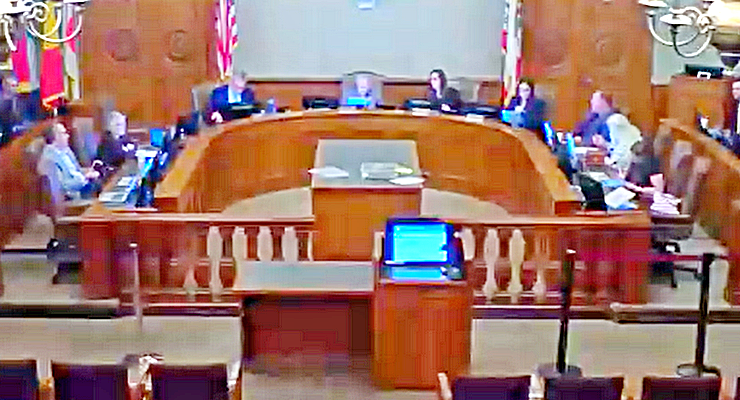
The Pasadena Planning Commission on Wednesday, April 8, unanimously found 28 new capital improvement projects consistent with the city’s General Plan, recommending their inclusion in the fiscal year 2027–2031 Capital Improvement Program.
The projects are part of a broader $3 billion CIP portfolio encompassing 228 active projects. Of that total, $1 billion has been appropriated to date, $243.7 million is recommended for appropriation in fiscal year 2027 and $1.7 billion remains unfunded. An additional 49 future unfunded projects carry an estimated cost of $437 million.
Principal Planner Martin Potter presented the staff recommendation to the six commissioners present. Commissioners Philip Burns, Michael Albrecht and Beverly Sims were absent; Chair Carol Hunt Hernandez presided.
The CIP Subcommittee, which had met March 25, had already reviewed the proposals and unanimously recommended approval. Commissioner Jennifer Higginbotham, reporting for the subcommittee, told the full commission the panel was impressed with staff’s work and supported the recommendation.
The 28 new projects span eight categories:
- three municipal building and facility improvements, including a compressed natural gas station upgrade, shade structures at the Lamanda Park and Allendale branch libraries and accessibility improvements at the Linda Vista Branch Library;
- two street and streetscape projects;
- five parks and landscaping initiatives;
- two Arroyo-area improvements;
- one active transportation project tied to the 2028 Olympics;
- two pedestrian hybrid beacon installations;
- five water system projects, including reconstruction of the Don Benito Reservoir damaged in the Eaton fire; and
- eight electric system projects focused on solar installation and substation upgrades.
The artificial turf replacement planned for Robinson Park and Villa Park drew the sharpest exchange.
Cynthia Cannady, chair of Pasadena 100 — a coalition of 20 nonprofit organizations — urged the commission to delay approval, calling the turf an environmental justice concern for neighborhoods where Black and brown children play. She noted the city’s Environmental Advisory Commission had recommended against the $2 million expenditure.
But Koko Panossian, new Director of Pasadena’s Parks, Recreation & Community Services Department, told commissioners the turf at both parks has reached the end of its usable life and will become unplayable within a year.
Panossian said his staff is proposing a geofill material using sand and natural byproducts such as cork, coconut husks or olive pits instead of traditional rubber pellets, which would reduce heat and address health concerns.
The City Council’s Municipal Services Committee reviewed the issue March 25 and requested additional information.
City staff plans to present additional turf data to the full council on April 20, at which point the council may give direction on which option to pursue.
Final adoption of the CIP is scheduled for May 4.
Cannady also challenged the commission on solar energy funding, arguing the CIP funds only two of the 20 megawatts of local municipal solar called for in the city’s Optimized Strategic Plan.
During the meeting portion addressing committee reports, Commissioner Mic Hansen announced that the Reconnecting Communities 710 Advisory Group has concluded its formal meetings after three years.
The committee’s findings were presented to the City Council as an informational item, with deliberation and public comment scheduled for Monday, April 13.
Planning staff indicated the project — covering approximately 50-plus acres on the former 710 freeway stub, with roughly 30 acres of that developable after accounting for infrastructure and roadways — would transition to the Planning Department for a specific plan process.
The CIP next goes to the Finance Committee on April 20 and to the full City Council for adoption on May 4.
 Get our daily Pasadena newspaper in your email box. Free.
Get all the latest Pasadena news, more than 10 fresh stories daily, 7 days a week at 7 a.m.


