

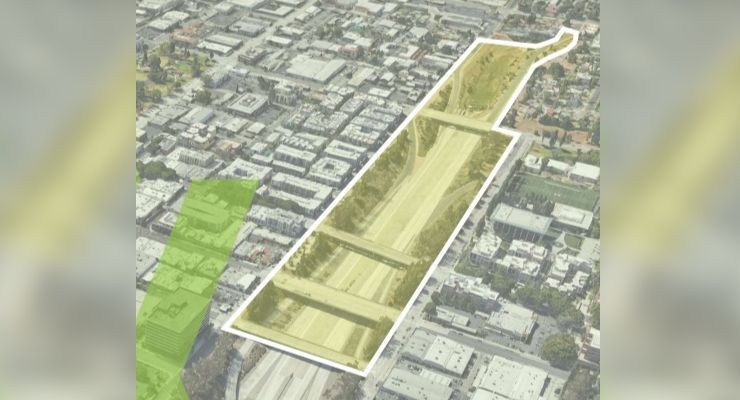
For decades, a stretch of unfinished freeway carved through the heart of Pasadena. It displaced families. It divided neighborhoods. Now, as the city prepares to transform that scar into new development, one resident says the stakes are about more than real estate.
The Pasadena Human Relations Commission meets Tuesday, March 3, at 6:30 p.m. at the Jackie Robinson Community Center. On the agenda: a presentation arguing that how the city designs public space in the so-called 710 project area will shape community relations for generations.
Marcus Renner, a Pasadena resident affiliated with the 710 Community Fellows Program and the Arroyo Seco Placekeepers, will make the case. His presentation draws on urban sociology, planning research and Pasadena’s own fraught racial history.
The 710 stub — a roughly 38-acre corridor where a freeway extension was never completed — is now under review by the City Council. Two draft configurations have been proposed. Both reserve between 20 and 24 percent of the land for public space, amounting to roughly 7.5 to nine acres of parks.
Renner’s slides frame “the ditch” as a symbol.
A timeline in his presentation connects the corridor to a long chain of racial exclusion in Pasadena. It begins with a Chinese washhouse fire in 1885. It moves through the 1924 Pasadena KKK chapter meeting that “overflows w/ people,” wartime Japanese American internment in 1942 and a school desegregation battle in 1950. The freeway’s construction, beginning in the 1960s, fits squarely into that arc.
The presentation cites a 2019 report by Occidental College researchers ranking Pasadena second only to San Francisco in statewide income inequality. It also notes that fewer than half of school-age children attend district-managed public schools. That, the slides argue, is a legacy of white flight and retreat from shared public life.
The argument draws on scholars including Jane Jacobs, William H. Whyte and Yale sociologist Elijah Anderson, who studied how markets and plazas in Philadelphia promoted civic tolerance. An NYU sociologist’s work on “social infrastructure” is cited as evidence that well-designed public space can reduce isolation — and, literally, save lives.
Renner urges the Human Relations Commission to advocate for public spaces that are active, diverse in programming and genuinely accessible. The draft vision plan, he notes, has not yet addressed how parks would be funded, programmed or managed over time.
His presentation also highlights what he sees as a gap in the planning process itself. Rather than having designers present proposals for public feedback, he argues the community should define and design the spaces from the start.
The 710 Advisory Group has already approved a recommendation urging the city to formally acknowledge its history. The recommendation calls for a permanent, publicly accessible space reflecting the cultural life that existed before freeway construction. It also calls for an educational or performing arts component rooted in the history of the 710 stub area.
Renner goes further. He proposes a public market, maker spaces, artist studios, an amphitheater and a multi-use interpretive center. Such a center, he argues, could tell the story of the displacement, center the cultural histories of diverse Pasadena communities — including the Gabrieleno/Tongva peoples — and serve as a starting point for school groups.
A sketch by Muir High School students enrolled in the 710 Community Fellows Program envisions a “Great Lawn” for public markets, a ceremonial pond and a rose-shaped cultural museum and amphitheater. The students allocated more acreage to public space than either of the city’s draft configurations.
Renner’s presentation closes with a question: Is seven to nine acres enough public space to bring Pasadena together?
The commission has been tracking the 710 project closely. In November, Commissioner Sandy Greenstein reported attending a meeting hosted by a Councilmember on the 710 stub, noting community interest in its social justice dimensions. In February, Renner appeared during public comment and urged commissioners to advocate for public space and social infrastructure before the City Council’s March review.
The public may comment in person or submit written remarks to jconcul@cityofpasadena.net at least 30 minutes before the meeting.
Tuesday, March 3, 6:30 p.m. Jackie Robinson Community Center, 1020 N. Fair Oaks Ave., Pasadena. For more, email jconcul@cityofpasadena.net.
 Get our daily Pasadena newspaper in your email box. Free.
Get all the latest Pasadena news, more than 10 fresh stories daily, 7 days a week at 7 a.m.