





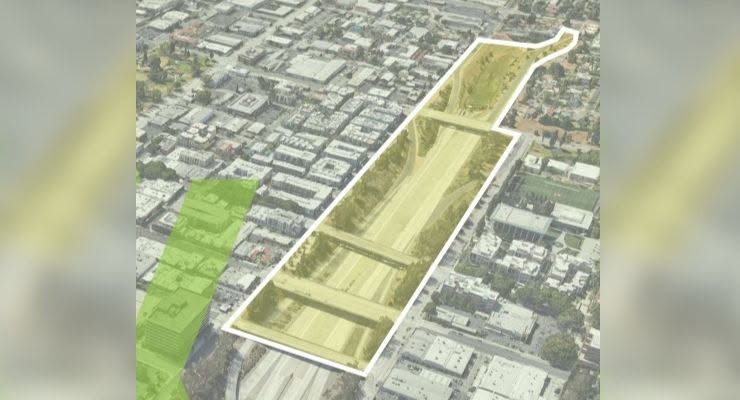
Pasadena’s City Council unanimously adopted 10 restorative-justice elements proposed for the state-relinquished 710 Freeway “stub” in West Pasadena on Monday night, committing to affordable-housing targets, a community oversight board and home-ownership help for displaced families.
The 8-0 vote went further than the city’s own staff had asked. The written staff report recommended that the council receive the committee’s presentation and provide direction on the elements and next steps; at the meeting, staff clarified it was recommending “further study” of the 10 elements rather than adoption. The council instead committed to the full slate outright.
Councilmember Rick Cole signaled the override at the very start of the item, telling staff he was “deeply disappointed that we would work on this for two years with staff involved in it and we’re coming tonight to say we’re going to study it some more.”
After the committee’s presentation and the public-comment period, Councilmember Tyron Hampton moved to accept all 10 elements, and Councilmember Justin Jones seconded.
“This is going to cost us nothing, but if we don’t get this right, it will cost us everything,” Hampton said before making the motion.
The motion adopted Attachment C to the staff report — the Restorative Justice Committee’s 10 elements in full detail — and added direction for staff to coordinate the city’s environmental justice element with the effort.
The roll call recorded yes votes from Cole, Hampton, Jones, Councilmember Jason Lyon, Councilmember Steve Madison, Councilmember Gene Masuda, Vice Mayor Jess Rivas and Mayor Victor Gordo.
The unanswered question: who pays
The vote committed the city to the elements without a financing plan attached, and the question of cost surfaced directly during deliberations. Masuda asked staff whether Pasadena has the financial ability to finance construction of the 710 stub area after layering on the restorative-justice obligations.
Interim City Manager Matthew Hawkesworth told the council that building out the property while meeting the restorative-justice objectives is “absolutely economical,” but stopped short of a financing commitment.
“There’s not a decision today to be made to determine it’s economical because the market will help drive how that economy is done,” he said.
The most concrete cost figure came from the committee, not staff.
Presenting the wealth-generation element, advisory group member Jasmine Schupper proposed that the total housing benefit for displaced and impacted residents be valued at no less than $25 million in 2025 dollars, or 1% of the estimated value of housing and commercial development on the site, whichever is greater.
Individual remuneration payments to displaced homeowners, business owners and institutions would be calculated at roughly $150,000 each, funded from that 1% set-aside.
Councilmember Steve Madison questioned the math, saying “1% of nothing is nothing” and that the city first needs a development plan to realize a return on the approximately 50-acre property.
A two-year process, capped in one night
The vote punctuates a two-year deliberation by the Reconnecting Communities 710 Advisory Group, a 16-member body appointed by the council and guided by consultants Perkins Eastman and Estolano Advisors — though, as Gordo observed, it also marks “the beginning of a process” of implementation still to come.
At the council’s April 13 meeting, members separated the restorative-justice component from the rest of the 710 Vision Plan to allow fuller discussion; Cole noted the council had already adopted nine related staff recommendations that night, arguing the vote was “catching up” rather than premature.
Advisory group members Tina Williams and Jasmine Schupper, introduced by staff as the chairs and vice chairs of the Restorative Justice Standing Committee, walked the council through the 10 elements. They range from a formal acknowledgment of harm caused by State Route 710 construction and a mayoral apology, to thre formation of a Restorative Justice Community Oversight Committee (RJCOC), a community benefits planning framework, an affordable-housing registry requiring 25% to 35% of units built in the 710 Stub Area to be affordable, business-development support and workforce-development commitments.
Williams floated a permanent interactive museum component, citing the Equal Justice Initiative’s legacy sites in Montgomery, Alabama, as a model.
Gordo committed to delivering the apology element.
“Recognition and apology is a no-brainer, and I will be proud to take that action on behalf of the city of Pasadena,” he said.
Eaton Fire and oral-history threads
Public comment tied the freeway’s legacy to Pasadena’s present displacement crisis. Brandon Lamar, president of the NAACP Pasadena branch, told the council that many families displaced by the Eaton Fire in Altadena and Pasadena are themselves descendants of families pushed out of the 710 and 210 corridors.
“Pasadena has a history of displacing families, and I think this is one of the ways that we can make it right,” Lamar said.
Suzanne Madison, founder of Allegra Consulting and a District 6 resident, said her team documented displaced residents, business owners and faith leaders through more than 30 oral-history interviews over the two-year project, work she hopes will serve as a catalyst for repair.
What’s next
Lyon backed the motion but questioned whether the city should stand up a new oversight body rather than fold the work into existing commissions, and urged the council to broaden the reckoning to the city’s wider history of redlining, the Pasadena Improvement Association and the 210 Freeway.
Gordo countered that the council itself is the city’s ultimate oversight body and said he wants the full council to review governance models before creating any new committee, citing a June 17, 2026, trip to the Presidio in San Francisco that he, Madison and Lyon took with the interim city manager and some staff to study its governance structure.
Acting Assistant City Manager Jennifer Paige said staff would return with an implementation program identifying a timeframe, responsible department and Specific Plan status for each element, potentially as early as the council’s July 13 meeting.
Hawkesworth said forming the oversight committee — which will require a new municipal code section — would be the first priority, in a build-out the council deemed to agree is likely to span more than 20 years.
 Get our daily Pasadena newspaper in your email box. Free.
Get all the latest Pasadena news, more than 10 fresh stories daily, 7 days a week at 7 a.m.