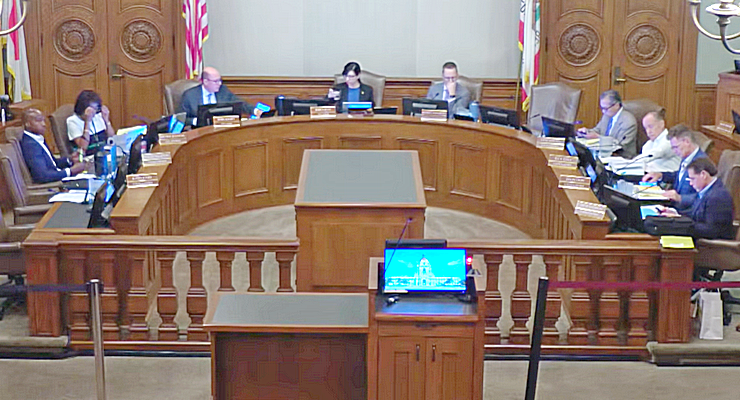











The Pasadena City Council approved more than $1.6 million in contracts to wire the city’s maintenance yards for electric vehicles and changed how it will build every project in its municipal solar and energy storage program — all without debate.
The four linked items passed as part of a single “sweep” motion by Councilmember Steve Madison, approved without objection, with no council discussion of any of them. Mayor Victor Gordo had stepped away during the vote.
Three of the items awarded contracts for the Maintenance Yards Electric Vehicle Charger Expansion Project, all handled by the city’s Water and Power Department: $282,744 to OpConnect, Inc., for direct current fast charging equipment; $407,226 to Royal Industrial Solutions for electrical switchgear and communications equipment; and $949,474 to Motive Energy Storage Systems, LLC. Combined, the three deals total nearly $1.64 million.
A fourth item authorized a broader change: the council switched the city’s municipally owned solar and energy storage program from a “progressive design-build” approach to a “design-build” approach, and authorized that method for all sites in the program. The recommendation directed the city to keep using the Alternative Project Delivery method the council had previously approved. The agenda recommendation did not state what prompted the change.
Each of the three maintenance-yard contracts carries a one-year term and a built-in contingency for change orders. The OpConnect award includes a base amount of $257,040 plus a $25,704 contingency, on a bid dated April 23. The Royal Industrial contract — awarded to Consolidated Electrical Distributors Inc., doing business as Royal Industrial Solutions — includes a $370,205 base and a $37,021 contingency, also on an April 23 bid. The Motive Energy contract includes an $863,158 base and an $86,316 contingency, on a bid dated April 16. Each was described in the agenda as the lowest and best bid.
The agenda framed all four items as routine. The three equipment contracts were found categorically exempt from the California Environmental Quality Act under an “existing facilities” provision, and the delivery-method change was found not to be a “project” subject to the act.
The consent calendar is designed to move uncontested business in one motion and one vote, and items are debated only if a Councilmember or the public asks that they be pulled. None of the electric-vehicle or solar items was pulled Monday.
By contrast, the same consent calendar’s transit items did draw comment. Councilmember Rick Cole spoke at length about the city’s roughly $150 million in transit capital spending — including a new bus yard, a hydrogen fueling station and 35 new buses — arguing the system needs more frequent service to be worth the investment. He noted that the transit money is “almost entirely state grant funds and transportation dollars that come to us through county taxes,” not general fund money. The agenda summary listed no funding source for the maintenance-yard or solar items.
 Get our daily Pasadena newspaper in your email box. Free.
Get all the latest Pasadena news, more than 10 fresh stories daily, 7 days a week at 7 a.m.