

Pasadena City Councilmembers sent a pointed message to city staff Monday night: the five budget priorities identified last December are not aspirations — they are funding commitments, and the city must find cuts elsewhere to pay for them, even if a structural deficit looms over the general fund.
The sharpest declaration came from Councilmember Jason Lyon, who told Assistant City Manager Matt Hawkesworth that when the Council identified priorities at its December budget workshop, it meant that “funding for these is sacrosanct.”
“None of these get cut, and potentially they grow,” Lyon said. “And that’s where the budget starts. And then we work out from there, which might mean that there are cuts in other places.”
The five Council priorities are:
- modernizing fire department facilities and enhancing fire prevention;
- improving roadways and implementing pedestrian and bike safety strategies;
- investing in year-round shelters and transitional housing;
- moving Pasadena decisively toward a carbon-free future; and
- implementing the City’s economic development strategic plan with a place-making focus.
Chief Information Officer Phillip LeClair presented the priorities framework, while Hawkesworth addressed the funding realities.
Several Councilmembers suggested a disconnect had emerged between what they intended by setting priorities and how staff received the direction.
Lyon said staff appeared to interpret the priorities as “things we really need to figure out looking for external funding for,” rather than as baseline budget commitments that take precedence over other spending.
“What I heard in your presentation tonight … is you heard like, ‘Oh, these are things we really need to figure out looking for external funding for,’ which I think is also true — but not what we meant when we said these are a priority,” Lyon said.
Councilmember Rick Cole was equally direct, saying he found the proposed Capital Improvement Program (CIP) budget “with the exception of a couple of departments, really disappointing” and “not responsive to our five priorities.”
Cole pointed to the City’s track record of following through when it sets clear goals — including a $200 million library renovation, $37.4 million in water infrastructure spending and $112 million in electricity infrastructure — and said the same commitment is now needed for the five priorities.
“To these five priorities, we are actually moving backward — on sidewalk. on road repair,” Cole said.
Hawkesworth acknowledged the City faces a structural deficit in its general fund and said revenues have not significantly improved while expenses have not decreased. He told the Council that federal funding reductions, while not as severe as initially threatened, have still resulted in the elimination of competitive grant funding, particularly around public health.
Approximately 20 positions in the public health department funded by expiring grants are expected to be lost this year, though City Manager Miguel Márquez said the City is working to find alternative positions for those employees within city government.
On roads, Lyon said the Council had previously been told that a minimum of $12 million per year in the road paving budget is needed to make even incremental progress in improving the City’s roadways. He declared that “we are done with the days when we put the cost of maintenance on future generations because we want to save a buck here and there.”
The carbon-free electricity goal drew some of the sharpest public comment of the evening.
Multiple speakers criticized Pasadena Water and Power’s proposed CIP budget for earmarking $33 million for a new PWP headquarters building while, they claimed, leaving solar generation and battery storage projects unfunded.
Cole urged the City to look inward before asking taxpayers for more money. He noted that Pasadena’s total annual spending is $1.5 billion, with $362 million in general fund appropriations, and argued that finding even one percent in efficiency gains or spending reallocation would generate $7.2 million.
“After raising water rates, after raising sewer rates, after raising electricity rates, and after going to the voters for a bond issue on the library, we have a limited capacity to ask our ratepayers, our voters, to continue to add and add and add when we do not have the discipline and the courage to actually make changes in the way we’ve done business,” Cole said.
Staff presented several potential revenue options for the Council’s consideration, including a quarter-cent local sales tax that could generate approximately $11 million annually, a parcel tax, benefit assessment districts, a parking tax and a real estate transfer tax.
Hawkesworth cautioned that a proposed constitutional amendment backed by the Howard Jarvis Taxpayers Association and the California Business Roundtable, which has submitted 1.3 million signatures and is expected to qualify for the November ballot, could prohibit real estate transfer taxes statewide and repeal all existing special transfer taxes if passed. The same measure would also require two-thirds voter approval for all future special taxes, including those placed on the ballot through citizen signature-gathering efforts.
Cole noted one revenue option absent from staff’s presentation: a residential or commercial vacancy tax, which he said is already contemplated in the City’s adopted housing element.
“To leave it off of consideration, I think is an omission,” Cole said, while acknowledging the idea “has pluses and minuses and may not generate the kind of revenue that we would like to see.”
The Council also discussed a proposed Los Angeles County half-cent sales tax measure.
Hawkesworth said approximately $22 million in revenue would be generated from Pasadena sales if the measure passes, but the City’s public health department expects to receive only $1 million to $2 million in return — far short of offsetting the public health funding the City has lost in recent years. He added that a number of cities and groups of cities are expected to oppose the County measure, and legal challenges are anticipated. The County’s proposal would also consume the last remaining quarter-cent of available sales tax capacity under the state’s 2 percent cap, potentially foreclosing future local options.
On the economic development front, Hawkesworth said staff is actively exploring the creation of an Enhanced Infrastructure Financing District (EIFD) that would expand beyond the 710 freeway stub to include North Lincoln Avenue and North Lake Avenue, areas the Council has identified for focused economic development investment.
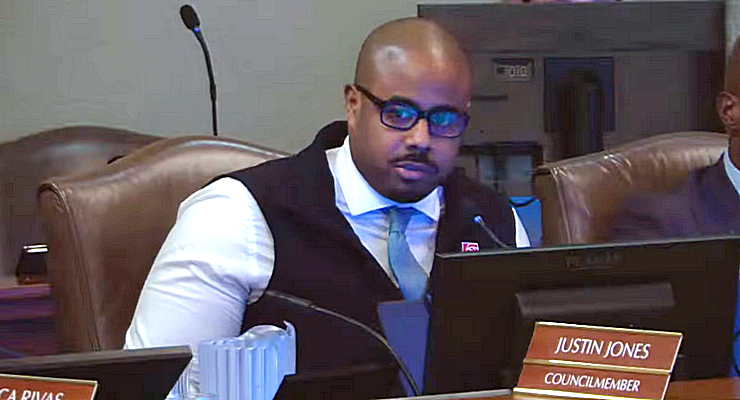
Jones expressed support for the concept, noting that residents in those areas have told him the 710 effort is welcome but they want assurance that City services and investment will reach their neighborhoods as well. Hawkesworth said staff expects to bring the EIFD proposal back to the Council or the Economic Development and Technology Committee in the next couple of months.
Councilmember Tyron Hampton urged the City to explore a deeper partnership with the Pasadena Unified School District, which has $1.4 billion in bond funds restricted to facilities improvements. Hampton said the two staffs should meet to identify joint projects — such as bike safety infrastructure around school campuses — where Pasadena Unified School District bond dollars could advance the City’s own priorities. Lyon agreed, suggesting the topic be placed on the agenda for the City’s upcoming joint meeting with the school District. Márquez said he is in regular contact with the Pasadena Unified School District superintendent and that the two organizations’ staffs are already engaged in collaborative work.
Mayor Victor Gordo disclosed that he had convened an informal advisory group of residents, chaired by former Mayor Terry Tornek, to generate ideas on both the revenue and expenditure sides. Among the group’s suggestions were a parking tax, 100 percent cost recovery in utilities, a simplified development process with a “shot clock” for permits, updated business license fees, a regional fire assessment District that would pool emergency response resources with neighboring foothill communities, and reforms to the City’s procurement practices, which the group found to be fragmented across departments rather than centralized.
The Council also endorsed a new reporting framework for tracking progress on the five priorities. Staff proposed quarterly dashboards, to be reported to the finance committee and posted publicly, along with semi-annual deep-dive sessions before the full Council. Both Cole and Lyon pushed for the City to institutionalize a September and January budget check-in so the Council can set direction before the budget is finalized, rather than reacting to a finished proposal in May.
Jones proposed that the next city manager’s performance evaluation be tied to key performance indicators (KPIs) aligned with the Council’s five priorities, with quarterly evaluations to track progress. Cole supported the idea and called for a Council-wide session on the philosophy of KPIs so that staff and elected officials share a common framework before departments present new metrics.
The Capital Improvement Program public hearing opens April 13. The operating budget will follow through committee-level hearings in the weeks ahead.
 Get our daily Pasadena newspaper in your email box. Free.
Get all the latest Pasadena news, more than 10 fresh stories daily, 7 days a week at 7 a.m.