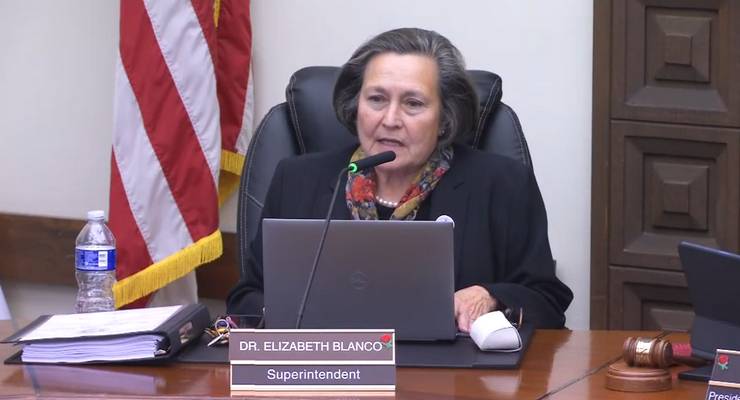




Pasadena’s Design Commission voted unanimously Tuesday night to continue review of a proposed four-story Caltech Innovation Center at 1364 East Green Street, asking developers to reduce the building’s mass along its southern edge where it borders St. Philip the Apostle School’s playground. The decision came after nearly two hours of public testimony that revealed deep divisions between parents fearful for their children’s safety and scientists advocating for economic development.
The 6-0 vote sends the 93,539-square-foot research and development project back to developer Trammell Crow Company and architect Gensler to address matters about the building’s scale and its relationship to the adjacent Catholic school campus, which serves approximately 550 students from transitional kindergarten through eighth grade.
Commissioner Rob Tyler, who made the motion to continue, directed the applicant “to work on the south elevation scale and proximity to the school parking lot, playground, and the overhead structure in an effort to reduce the mass of the building.”
Commissioner Srinivas Rao added that the design team should further study the building’s facade, noting that the architects’ stated inspiration from nearby Pasadena City College buildings “does not really work as yet. It’s a good start. I think it needs further work.”
The proposed building would replace an existing 115-space surface parking lot at the southeast corner of Green Street and Holliston Avenue, one block south of Colorado Boulevard. At 79 feet tall with a 17-foot mechanical screen, the structure would tower over the one- to three-story buildings that characterize the surrounding neighborhood, including St. Philip the Apostle Church and School.
Parents Voice Safety Concerns
More than two dozen speakers addressed the commission, with parents and parishioners expressing alarm about construction impacts, traffic safety and security vulnerabilities the building might create.
One parent of three children attending St. Philip the Apostle School told commissioners that “to put a building of this scale and create a higher ground with unobstructed vantage points into the school yard is baffling to me as a mother and in light of the tragic events in schools across the country.”
Joe Parker, a professor of biology and biological engineering at Caltech whose three sons attend St. Philip, said he felt “morally compelled as a parent and also a concerned faculty member to urge you guys to really take seriously many of the issues that are raised here.”
Mary Forrest, a parent of four boys at the school, argued the building “simply does not belong on this block” and would “permanently reshape the environment our children learn and worship in.”
Scientists Champion Economic Benefits
Supporters, many affiliated with Caltech, emphasized the building’s potential to retain scientific talent and startup companies in Pasadena.
Fred Farina of Caltech told commissioners that over the past 30 years, Caltech has launched an average of 12 startup companies annually, but “over 50% of these companies have been forced to relocate to San Francisco, Bay Area, San Diego, Boston, and other innovation labs” due to lack of suitable lab space.
Mory Gharib, a Caltech professor of medical engineering and aerospace, said he has founded approximately nine startups, but “out of my 12 startups, only one of them stayed in Pasadena because they could afford” local space. He added that his ventures have created 2,000 jobs total, none of them in Pasadena.
Viviana Gradinaru, a Caltech neuroscience educator and Pasadena resident, supported the project, noting her own lab’s work has led to biotech startups raising over $100 million and creating nearly 200 jobs.
“But none of those jobs were in Pasadena because when it came time to translate these discoveries, we and many others had no choice but to go elsewhere,” she said.
Design Changes Since May
The project had previously appeared before the commission in May for preliminary consultation. Since then, the design team has stepped back the fourth floor on all sides, differentiated facade treatments based on solar orientation, relocated the primary vehicular entrance from Green Street to Holliston Avenue and reduced the mechanical screen height by two feet.
Nancy Moses, a Principal of Trammell Crow Company, acknowledged community concerns, saying,”We know we’re not going to please everyone. We recognize that, but we do hope that based on our presentation today and our response to these comments, we’ve tried to the best of our ability incorporate those comments and those adjustments in there.”
The project includes 260 parking spaces located at-grade and within a three-level subterranean parking garage. Two protected street trees along Holliston Avenue were approved for removal by the city manager in September to accommodate the redesigned driveway entrance.
Traffic and Environmental Review Questioned
Several speakers challenged the adequacy of the city’s traffic and environmental studies. Erika Foy of District 7 argued the mobility analysis “uses commuter peak hours” rather than studying “the real conflict times at the school,” when dropoff occurs from 7:30 to 8 a.m. and dismissal at 3 p.m.
Ribeka Toda, an engineer with the Department of Transportation, responded that studying morning and afternoon commuter peak hours “is standard for us to study when the highest traffic volume is on the street network.”
City staff recommended the project be found exempt from the California Environmental Quality Act under the Class 32 infill development exemption, citing technical studies showing no significant impacts related to air quality, traffic, noise, water quality or cultural resources.
Commissioner David DiCristofaro expressed discomfort with the volume of detailed public comments received the day of the hearing, saying he wanted “a more robust response from the city as well as the developers in response to these concerns” before voting on the project.
The project will return to the Design Commission at a future date yet to be scheduled.
 Get our daily Pasadena newspaper in your email box. Free.
Get all the latest Pasadena news, more than 10 fresh stories daily, 7 days a week at 7 a.m.