







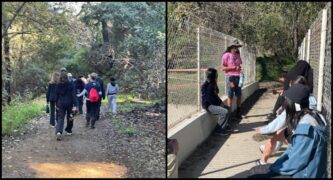


On a cool Wednesday morning in the Lower Arroyo Seco, the sycamores seemed to be holding their breath. A bright sun shone down on the concrete superstructure of the Colorado Street Bridge, and below, a class of sixth graders from Octavia E. Butler Magnet Middle School clustered around a patch of river-rounded stones, debating whether rocks can “hop out of the ground.” Their instructors—three Caltech graduate students—smiled patiently.
Go Outdoors is a new collaboration between Caltech, the One Arroyo Foundation, and the Pasadena Unified School District. The program, which will bring every sixth grader in the school through the Arroyo this fall and winter, promises hands-on geology in a basin best known for dog-walkers, archers, and the occasional wedding shoot or rock video.
Daniel Rossman, executive director of the One Arroyo Foundation, described the morning as a kind of homecoming. “The Arroyo is Pasadena’s greatest natural treasure,” he said. “And everybody should experience it.” The idea, he explained, was never just to get kids outside, but to bridge classroom science with the canyon beneath their feet.
“They’re going to come away with this as an opportunity—one, meet some inspiring young scientists, and two, really connect the textbook to things you could smell, hear, touch.”
A trio of those young scientists—Abby Keebler, Jordan Chastain, and Becky Williams, all Caltech graduate students—had just finished a lesson on how the river sorts and shapes its stones. “GO Outdoors is a really great opportunity to connect students with their natural environment,” Keebler said. “Just discover.”
In the Arroyo, she added, “we have these connections to the river and plants and the mountains that we live here. And these things all shape our day-to-day lives.”
Williams noted that outdoor exploration is “really fun and good for your mental health,” which, judging by the students’ sprint toward a cluster of willow roots, seemed immediately plausible.
Rossman motioned down the trail. “In fact, this is new,” he said, stepping over a section of recently reconstructed path. One Arroyo had rebuilt several stretches last December, adding drainage features that now made the trail firm underfoot despite recent rains.
“Part of that is just what we’ve learned about trail design over the last hundred years,” he said, noting with something close to pride that the canyon floor felt “like ten degrees colder than up on the street.”
The morning became a kind of walking seminar. Rossman pointed out upcoming restoration projects—among them the reopening of the historic Mayberry Parker Bridge, whose access points have washed out over the years. “We want to reopen that for pedestrian access,” he said. Doing so would restore a long-lost loop and give hikers an alternative path in and around the river bed.
Back underneath a towering rumbling freeway overpass, Chastain held up a small, smooth cobble. “Most of them are really nice and smooth,” he told the students, who nodded gravely. He asked where the rocks might have come from. “The ocean?” one offered. “The mountains?” another said, and Chastain beamed. “Really nice.”
As sunlight began to light the newly restored path, the class packed up their backpacks and water bottles. The Arroyo Seco, a modest trickle on its long journey from the San Gabriels to the Pacific, but full from recent rains, carried on. And for a few dozen sixth graders—eyes sharper now to the shapes of rocks and river paths—the canyon felt a little less like a place to pass through, and a little more like a place to know.
 Get our daily Pasadena newspaper in your email box. Free.
Get all the latest Pasadena news, more than 10 fresh stories daily, 7 days a week at 7 a.m.