



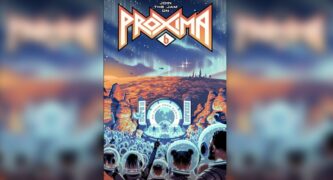

The poster, titled “Join the Jam on Proxima b” and released July 22, is the newest entry in JPL’s Exoplanet Travel Bureau series, a collection of retro-style travel advertisements for real planets that no human has ever visited. NASA’s website describes the release as marking the series’ 10th anniversary — the posters first appeared in 2015 — and honoring three decades of exoplanet discoveries since astronomers first confirmed a planet orbiting a Sun-like star.
JPL — managed by Caltech in Pasadena and home to NASA’s Exoplanet Exploration Program — has produced the poster series since 2015. The posters are free to download from NASA’s website in printable PDF and image formats, along with animated video versions, according to the agency’s resource page.
Proxima Centauri b was discovered in 2016 by a team led by astronomer Guillem Anglada-Escudé, according to the European Southern Observatory. The planet orbits Proxima Centauri, a red dwarf star in the Alpha Centauri system. It sits within what scientists call the habitable zone — the distance from a star where liquid water could theoretically exist on a planet’s surface — though whether the planet actually has an atmosphere remains unknown, according to NASA.
The poster plays on one of the planet’s most distinctive features: because Proxima Centauri b is tidally locked, one side always faces its star while the other faces away. The boundary between light and dark creates a permanent twilight zone — what the poster calls the “Perpetual Sunset Stadium,” according to NASA’s description. The poster’s tagline reads, “Tidally Locked and Ready to Rock!”
The Exoplanet Travel Bureau series was created by The Studio at JPL, an in-house design and strategy team that works with the laboratory’s scientists and engineers to visualize complex space concepts, according to JPL. David Delgado, who led creative strategy for the series, has said the posters were inspired by Depression-era Works Progress Administration posters for national parks.
The series now features destinations including Kepler-16b, where a planet orbits two suns; 55 Cancri e, a lava world; and TRAPPIST-1e, in what NASA calls the best “Hab Zone” vacation within 12 parsecs of Earth. The Proxima b poster is the newest and, at 4.2 light-years, depicts the closest destination in the collection, according to NASA.
NASA announced in September 2025 that the number of confirmed exoplanets had reached 6,000, a count monitored by the NASA Exoplanet Science Institute at Caltech’s IPAC in Pasadena.
The poster and downloads are available at science.nasa.gov/resource/
 Get our daily Pasadena newspaper in your email box. Free.
Get all the latest Pasadena news, more than 10 fresh stories daily, 7 days a week at 7 a.m.