







The subject matter is not optional in practice. Government Code section 8607, enacted through Senate Bill 1841 and signed in January 1993 after the 1991 Oakland Hills fire, directed the state to establish a Standardized Emergency Management System for use by all emergency response agencies. Under subdivision (e)(1), a local agency must use that system to coordinate multi-jurisdiction or multi-agency operations in order to be eligible for funding of response-related costs under disaster assistance programs.
The regulations took effect in September 1994 and sit in Title 19 of the California Code of Regulations beginning at section 2400. They build the system on the Incident Command System developed through the FIRESCOPE program, the Multi-Agency Coordination System, the operational area concept and the Master Mutual Aid Agreement. The regulations state the system “is intended to standardize response to emergencies involving multiple jurisdictions.”
The core curriculum is delivered by the Governor’s Office of Emergency Services and its California Specialized Training Institute through in-person courses that include a 12-hour class on center management and operations, an eight-hour field-to-center interface workshop, an eight-hour action planning course, and eight hours of position-specific training for each of the five center sections. Separately, federal adoption of the National Incident Management System is required under Homeland Security Presidential Directive 5 as a condition of federal preparedness awards.
Pasadena’s coordination was tested in January 2025, when the Eaton Fire started near Altadena Drive and Midwick Drive and burned 14,021 acres, with Pasadena Fire in unified command alongside the Los Angeles County Fire Department and the U.S. Forest Service, according to the California Department of Forestry and Fire Protection.
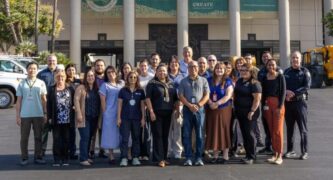
Fire Chief Chad Augustin recognized the graduating cohort this week. It included both city staff and community members, according to the city.
Fire season in California typically runs June through October. Voters will decide Nov. 3 on a parcel tax that would pay for emergency communications systems among other fire department needs.
 Get our daily Pasadena newspaper in your email box. Free.
Get all the latest Pasadena news, more than 10 fresh stories daily, 7 days a week at 7 a.m.