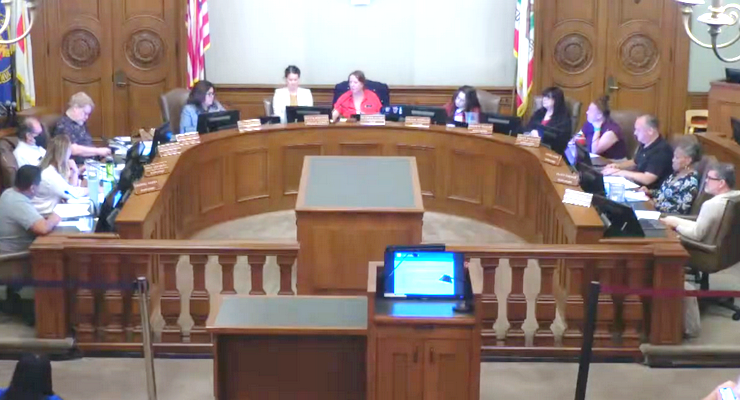










Director of Public Health Manuel Carmona laid out the contraction for the City Council’s Public Safety Committee in May, describing nine expiring grants that will pull about $2.9 million from the city’s health fund in fiscal 2027 — a 13.8% drop that brings projected health-fund revenue to roughly $15.7 million.
Because Pasadena is one of only three California cities that run their own health jurisdiction, funding and staffing public health directly rather than through Los Angeles County, those losses fall on disease-response and outreach programs the city cannot easily replace.
“Health and safety programs are really under threat,” Carmona told the committee, adding that the prospects for replacing the lost money are limited. “The grant opportunities are very slim,” he said. Asked whether the reductions were federal or state, he said they were “a combination, but the bulk of it this year is federal.”
Grants supply about 46% of the health fund’s revenue, and because the fund is legally restricted to public health purposes, the city cannot backfill grant losses from its General Fund without a formal council appropriation.
For fiscal 2027, appropriations are projected to fall about 14.3%, to roughly $17.7 million, with personnel costs down nearly 16%. The department’s projected $6 million negative fund balance is tied largely to $4.15 million in COVID-19 response costs, of which only $644,000 was recovered through federal reimbursement.
The cuts have fallen heavily on staffing. From a fiscal 2024 peak of about 144.7 full-time-equivalent positions, staffing has dropped roughly 43%, and the fiscal 2027 plan removes an additional 21.54 positions. Of 18 filled positions slated for elimination, the department expects 10 employees to remain with the city through reassignment, voluntary demotion or transfer.
The department has also been restructuring. In the City Manager’s weekly newsletter on July 9, it said it had consolidated “from six to four divisions” over the past two years and had reorganized programs “to enhance collaboration and align services with available resources.” It eliminated its Community Health Services Division during the fiscal year that began July 2025 and, for fiscal 2027, merged its Social and Mental Health Services Division into the Epidemiology and Disease Control Division.
Programs funded by the expiring grants include homeless outreach, infectious-disease outreach, infection control in long-term-care facilities, nutrition education, mental health promotion, H5N1 avian-influenza surveillance, community health workers and sexually transmitted disease intervention. The stakes were visible this spring: the department confirmed 17 pertussis cases across Pasadena — against an annual average of about three — with outbreaks investigated at Don Benito Fundamental School and Blair Middle School. Carmona cited the whooping-cough outbreak as evidence of the need to preserve disease-response capacity even as epidemiology positions are being cut.
The reductions surfaced as the council worked through a fiscal 2027 budget totaling about $383.4 million in General Fund spending and roughly $1.41 billion across all city funds.
Late adjustments recommended in the final budget would restore several of the threatened programs. One would transfer $315,000 from the Housing Department to cover the unfunded share of firefighter costs for the Pasadena Outreach Response Team, or PORT, whose firefighter costs were projected at about $552,000 with only $237,000 funded.
Another $560,000 would retain three community-engagement positions known as Promotoras, drawn from Pasadena Water and Power, the Rent Stabilization Department and the Transportation Department. A further $94,239 would convert the city Health Officer position from three-quarter time to full time, an expansion the council approved.
Councilmembers pressed the city to shore up the department.
“Our community’s health is number one,” Councilmember Tyron Hampton said. “We are not a community if we don’t have people, and if our people aren’t healthy, then it’s really hard to have a community.”
Councilmember Justin Jones called PORT “a very important team in our city” and questioned why it depends on volatile grant funding, asking whether the city could develop more stable support.
Councilmember Steve Madison said he was proud that Pasadena operates its own health department and that he believes “the council is committed to keeping it.”
Finance Director Karin Schnaider told the committee the city would continue pursuing grants before turning to the General Fund, noting a shift in what grants will support: “Sworn or badged portions of such programs are increasingly not being funded by grants, while non-sworn personnel continue to be more successful in receiving grant support.”
The department has begun walking residents through the new structure.
In the July 9 newsletter it profiled the Epidemiology and Disease Control Division, now led by Division Manager Dr. Matthew Feaster, who holds a bachelor’s degree in bioengineering from UC San Diego, a master’s in public health from USC and a doctorate in epidemiology from UCLA, and who has held leadership roles in state epidemiology and disease-control associations. Under the reorganization, that division takes on case management for people experiencing homelessness, opioid-abatement work and violence-prevention programs, alongside its existing work in disease surveillance, immunization and travel health, tuberculosis care, long-term-care infection control and communicable-disease nursing, and it oversees PORT. The city said it would profile each of the four divisions in the newsletter over the coming weeks.
Measure ER, a half-cent Los Angeles County sales-tax measure on the June 2 ballot that squeaked by, could bring Pasadena between $1 million and $2 million a year, but the recommended budget does not assume any revenue from it.
 Get our daily Pasadena newspaper in your email box. Free.
Get all the latest Pasadena news, more than 10 fresh stories daily, 7 days a week at 7 a.m.