








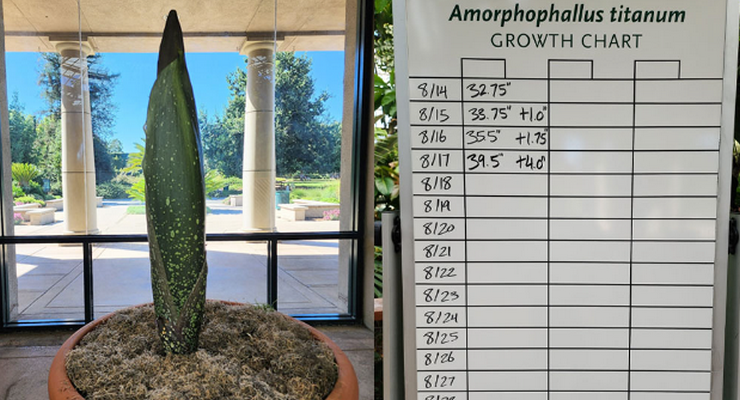
Known scientifically as the Amorphophallus titanum, this botanical wonder from the equatorial rainforests of Sumatra, Indonesia derives its nickname from its putrid aroma reminiscent of decaying flesh, a scent aimed at attracting insects for pollination.
Susan Turner-Lowe, The Huntington’s vice president for communications & marketing, notes that the blooming plant releases dimethyl disulfide and dimethyl trisulfide – gases found in decomposing animals and vegetables.
The Corpse Flower blooms for a mere 1 to 3 days every few years. It produces the world’s largest flower, capable of reaching over eight feet in height and four feet in diameter.
The Huntington’s Rose Hills Foundation Conservatory for Botanical Science houses the current Corpse Flower. Since Aug. 14, the specimen on display has grown an impressive seven inches, with its growth rate potentially reaching six inches daily at its peak.
The Huntington Library currently tends to 43 Corpse Flower plants.
In previous bloomings, the plants have been christened with names, such as 2021’s ‘Stankosaurus Rex’. This year’s blooming specimen has yet to receive a name.
The conservatory is open during regular public hours. Additionally, a livestream of the plant’s progress is available on YouTube, offering enthusiasts a chance to observe its development.
Tickets for in-person viewing can be obtained through The Huntington’s official website. As of Aug. 17, 2023, the public is encouraged to see the Corpse Flower’s imminent bloom either in person or via the livestream.
 Get our daily Pasadena newspaper in your email box. Free.
Get all the latest Pasadena news, more than 10 fresh stories daily, 7 days a week at 7 a.m.