



Pasadena is one of the three cities that own the airport through a joint authority. The Burbank-Glendale-Pasadena Airport Authority, a joint powers agency the three cities created in 1977, owns and operates the airport, and each city appoints three of its nine commissioners.
Pasadena Councilmember Tyron Hampton, one of Pasadena’s appointees, was elected the authority’s president July 20 and will preside over Monday’s event.
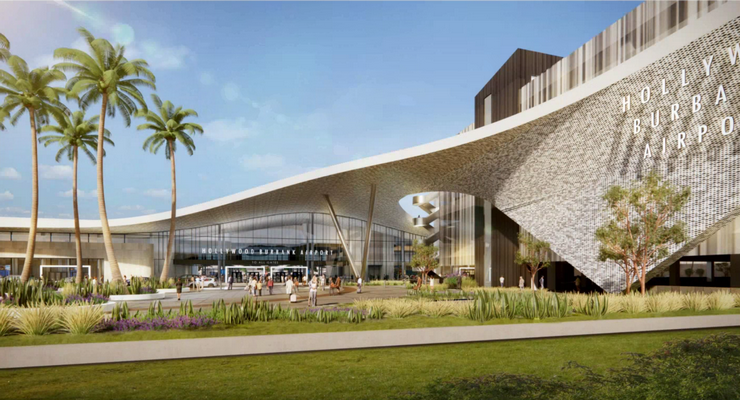
The airport has operated since 1930. The authority says the new terminal resolves long-standing safety exposures and accessibility drawbacks with the current one — which sits farther from the runways, in the northeast quadrant of the airfield, and is designed to meet current Federal Aviation Administration standards and current earthquake and accessibility requirements.
The new building covers 355,000 square feet and has the same number of gates as the terminal it replaces. The authority describes the work as a safety project rather than a capacity expansion and says the terminal is designed to serve the same size aircraft as the current one.
A San Fernando Valley neighborhood group disputes that framing. In an Aug. 23 post, Sherman Oaks & Encino for Quiet Skies wrote that critics and aviation watchdogs note that “gates do not equal capacity,” and that community advocates believe the terminal is designed to absorb the traffic demand generated by FAA flight-path changes rolled out in 2016 and 2017.
Burbank voters approved the replacement terminal as Measure B on Nov. 8, 2016, with 70 percent of the vote, after years of disagreement between the city and the authority.
That year the three cities also amended the agreement that governs the authority to require a supermajority vote, at least two commissioners from each city, to increase the number of commercial airline gates.
Ground was broken Jan. 25, 2024.
When the authority approved a guaranteed maximum price for design and construction in May 2024, it put the estimated total project cost at $1,298,700,000. A July 2026 project status report lists a budget and estimated cost at completion of $1.272 billion, targeted funding of $1.299 billion and secured funding of 85 percent.
The authority’s project FAQ says no state, county or local funds from Burbank, Glendale or Pasadena will be used. The FAQ says the project is to be funded through airport revenue bonds, federal grants, passenger facility charges and authority funds, and that airline rates and fees, along with revenue from concessionaires, hangar tenants and parking, will cover the debt. The authority closed on $724.78 million in revenue bonds in May 2024 and said at the time that it anticipated a second bond issue in 2026 to complete the project’s funding.
One of the nine public design workshops the authority held in 2019 took place in Pasadena; six were in Burbank and one each in Glendale and Los Angeles. Commissioners chose the design concept known as “The Icon” in April 2023.
When the terminal opens Oct. 13, the airport’s main entrance moves to Winona Avenue and Hollywood Way; it is now off Thornton Avenue. The parking structure and valet service move to the new terminal that day, and Lot E closes permanently. Rental cars stay at the Regional Intermodal Transportation Center, with shuttles to the new terminal.
The Burbank Airport–North Metrolink station will be linked to the new terminal by a pedestrian path and an on-demand shuttle, he said.
“The Airport is optimistic that the replacement passenger terminal will be conducive to greater transit use,” Galinis said.
 Get our daily Pasadena newspaper in your email box. Free.
Get all the latest Pasadena news, more than 10 fresh stories daily, 7 days a week at 7 a.m.