




According to the United States District Court for the Central District of California, the naturalization ceremonies — two sessions, each swearing in about 1,300 people from more than 80 countries — are expected to proceed as scheduled, even as the region has become a flashpoint in the national debate over immigration enforcement.
The setting itself carried symbolic weight. The Pasadena Civic Auditorium will be filled not with celebrities but with former refugees, green-card holders, and longtime residents who had passed civics tests, submitted to background checks, and waited years for this moment. The ceremony itself would last barely 45 minutes.
Since Dec. 2, when the Trump administration expanded its travel ban to 39 countries following the shooting of National Guard members in Washington, D.C., by an Afghan national, some naturalization applicants have been “pulled out of line” at ceremonies nationwide — their approvals revoked at the last moment, their oaths deferred indefinitely. The ceremonies continued around them.
U.S. Citizenship and Immigration Services has “paused all adjudications for aliens from high-risk countries,” according to agency Policy Memo PM-602-0192, issued Dec. 2, 2025, “while USCIS works to ensure that all aliens from these countries are vetted and screened to the maximum degree possible.”
The affected nations span Africa, the Middle East, the Caribbean, and Central America — including Afghanistan, Somalia, Haiti, Venezuela, El Salvador, and Guatemala.
It is not known if any of Wednesday’s 2,600 scheduled applicants received last-minute cancellation notices. USCIS does not publicly disclose the figures.
But the agency’s own data from past Pasadena ceremonies suggests the impact could be significant: at a June 2019 ceremony, the top five countries of origin were Mexico, the Philippines, China, El Salvador, and Guatemala. Two of those nations — El Salvador and Guatemala — are now on the restricted list.
More than 117 Democratic members of Congress have signed a letter to the Department of Homeland Security secretary and USCIS director condemning the selective cancellations. Representative Pramila Jayapal of Washington has led efforts demanding that USCIS disclose the number of affected individuals and provide a timeline for ending the pause.
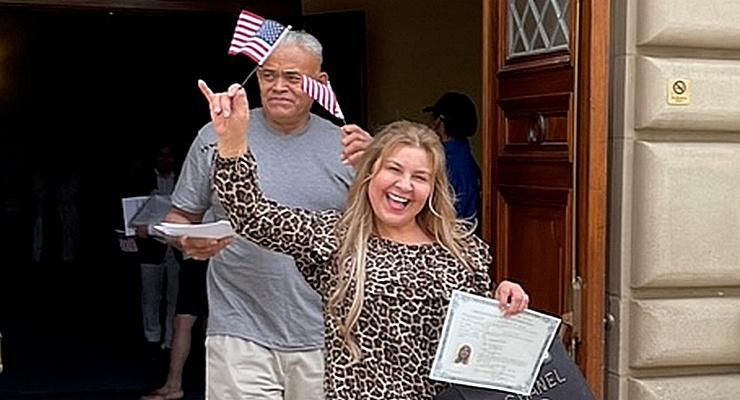
For those who do take the oath on Wednesday, the ceremony follows a script unchanged for generations. Applicants arrive hours early for security screening and document verification. They surrender their green cards — the plastic rectangles that had defined their legal status, sometimes for decades.
A federal judge from the Central District of California will administer the oath prescribed by the Immigration and Nationality Act. A video message from the president played. And then, row by row, the new citizens will receive their naturalization certificates and walk out into, for them, a changed reality.
 Get our daily Pasadena newspaper in your email box. Free.
Get all the latest Pasadena news, more than 10 fresh stories daily, 7 days a week at 7 a.m.