



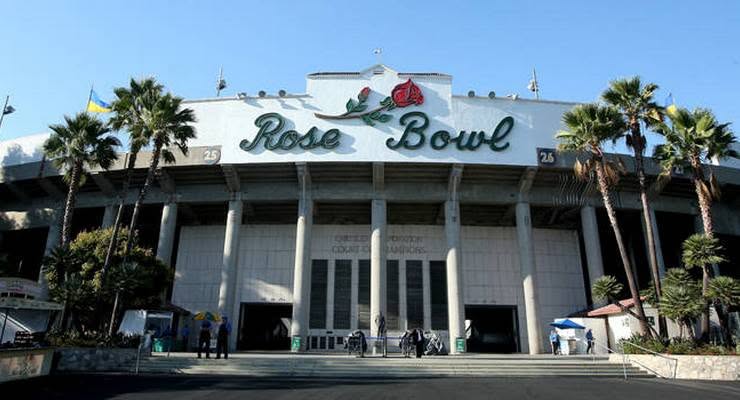
The Rose Bowl may be one of the most famous sports venues in the world, but for Pasadena residents it is something else as well: a publicly owned community asset.
How to preserve that dual identity while keeping the century-old stadium financially viable was the focus of Councilmember Rick Cole’s latest District 2 Issue Forum last Wednesday, which brought together members and staff of the Rose Bowl Operating Company (RBOC) for a wide-ranging discussion of the stadium’s finances, community role and future.
Joining Cole on the panel were Rose Bowl Operating Company board members Steve Olivas and Patty Barajas-Tavara and Dominic Corey, the stadium’s director of community relations.
Cole opened by contrasting the Rose Bowl with most modern stadiums.
“This is a public stadium in a public park,” he said. “This is not owned by billionaires. This is not a billionaire’s playground. This is a public asset.”
But maintaining that asset is an expensive business.
Cole outlined the Rose Bowl’s financial picture, noting that events at the stadium generated about $20 million in net income during fiscal year 2025. Overall operations for the Rose Bowl, golf course and related facilities produced about $65 million in revenue against $69 million in expenses.
The stadium also carries roughly $200 million in debt from previous improvements, requiring nearly $10 million annually in debt service. By contrast, the recently opened Field Club in the south end zone was financed entirely with private funds.
Further improvements are planned, including replacing many of the stadium’s traditional benches with individual seats with backs. That change would improve the spectator experience while reducing stadium capacity to roughly 72,000.
Panelists stressed that the Rose Bowl increasingly depends on a diverse mix of activities rather than simply football.
Olivas, Cole’s District 2 appointee to the RBOC, said the breadth of activity was what most surprised him after joining the board. Beyond UCLA football and the Rose Bowl Game, the property hosts concerts, music festivals, soccer, the monthly flea market and roughly 150 smaller “enterprise events” annually.
Corey described an equally broad range of community uses, including free events, youth programs, charity walks and runs, a backpack giveaway that drew 3,500 children, an annual Easter egg hunt and affordable golf programs.
The surrounding Arroyo is itself a major recreational asset. An estimated 2 million people annually use the area for walking, running, bicycling, golf, swimming, tennis, pickleball and other activities.
That intensity of use creates an unavoidable tension with nearby neighborhoods.
Corey said the Rose Bowl works to minimize the effects of major events through advance notification, sound monitoring, traffic management and a resident hotline that goes directly to his cellphone. During major events, he said, he personally circulates through surrounding neighborhoods checking conditions and talking with residents.
“We want to be good neighbors,” he said.
The stadium also faces growing competition in what Corey called the nation’s toughest sports and entertainment market. The Los Angeles region now boasts three major stadiums, five arenas and numerous other entertainment venues.
Concerts are particularly lucrative, but the Rose Bowl is currently limited to 25 major events annually. UCLA football takes seven dates, the Rose Bowl Game another and music festival promoter Goldenvoice reserves 10. Officials said expanding music festivals on the surrounding golf course offers another potential source of revenue.
The stadium’s longtime relationship with UCLA remains important. Cole noted that UCLA is contractually committed to playing at the Rose Bowl through 2044 and said the economic benefits extend well beyond the stadium to Pasadena hotels, restaurants and other businesses.
In his introduction, Cole outlined the “tectonic” shifts in the economics of collegiate football, noting that the cost of paying players under new rules is estimated at $25 million this year for UCLA — while other Big Ten schools like Ohio State and Indiana are spending roughly twice as much. UCLA’s new coach will earn $9.1 million this year.
“It will not surprise you that teams that pay their players more tend to win more games,” Cole noted dryly.
He also pointed to the implications for another Pasadena institution: the finances of the annual Rose Parade have long depended on revenue from the Rose Bowl Game, which now serves as a quarterfinal game under the new College Football Playoff format.
The 2028 Olympic Games offer another major opportunity — and challenge. The Rose Bowl will host five Olympic soccer matches, including the men’s and women’s finals. Corey said the stadium’s long experience with major international events leaves it well prepared.
“If the Olympics were to happen today, the Rose Bowl Stadium would be ready to go,” he said.
Cole acknowledged greater uncertainty surrounding proposed Olympic diving at the Rose Bowl Aquatics Center because retrofit costs have risen. Responding to a resident concerned that Aquatics Center users might ultimately bear those costs, Cole said the city would protect both taxpayers and Aquatics Center users — even if that meant not hosting diving.
The forum also touched on preserving Pasadena traditions, including the Turkey Tussle between Pasadena and Muir high schools. This year’s game has been interrupted because Pasadena High School is unable to field a varsity team.
Corey called the game an essential part of the Rose Bowl’s community identity and expressed determination to see it return.
“This is a tradition,” he said. “Some traditions should never leave.”
Environmental initiatives were also raised by residents. Panelists pointed to food-waste recycling, reusable materials at some events, discussions about solar installations and studies of stormwater capture near the Aquatics Center.
Throughout the evening, panelists repeatedly returned to the idea that the Rose Bowl belongs to Pasadena.
Barajas-Tavara urged residents to see themselves not simply as neighbors of an international landmark but as its owners.
“It is an asset owned by the City of Pasadena,” she said, “which means it is your asset.”
Cole closed with a personal story about playing a touch-football game on the Rose Bowl field while a Blair High School student more than half a century ago.
“For me, that was an extraordinary experience,” he said. “It’s one I’ll remember my whole life.”
It was also a reminder of the evening’s central theme: the challenge is not simply preserving the Rose Bowl as a world-famous stadium, but ensuring that Pasadena’s most famous landmark continues to enrich the life of the community that owns it.
 Get our daily Pasadena newspaper in your email box. Free.
Get all the latest Pasadena news, more than 10 fresh stories daily, 7 days a week at 7 a.m.