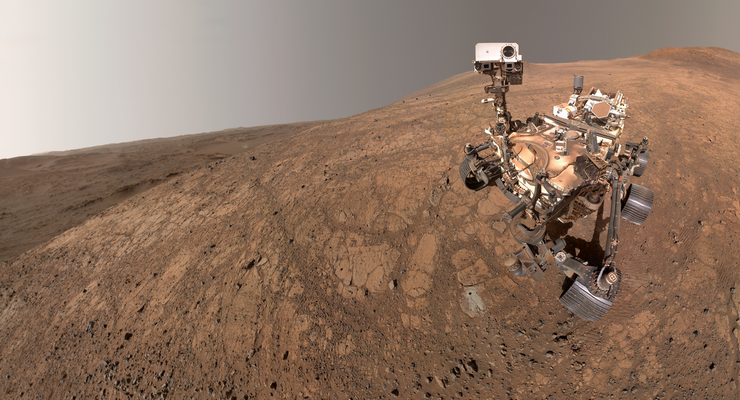
A geologic area on Mars that scientists expected to hold lakeshore sediment instead holds igneous rock that interacted with water on at least three separate occasions, according to a study published Monday that draws on data from NASA’s Perseverance rover.
The Jet Propulsion Laboratory, managed for NASA by Pasadena’s Caltech, built Perseverance and manages its operations. The findings bear on one of the rover’s key objectives, the search for signs of ancient microbial life.
The rover reached the site, called the Margin Unit, in September 2023. Because it stretches along the shoreline of an ancient Martian lake, mission scientists had expected sedimentary rocks, NASA said in a news release.
“Before we arrived at the Margin Unit, the main hypothesis — derived from orbital observations — was that the carbonate seen from orbit formed from interaction with the lake that existed in Jezero Crater,” said Candice Bedford, a research scientist at Purdue University and the study’s lead author. “But now we know that this location became a sort of crossroads for aqueous systems.”
Using its SuperCam instrument, Perseverance has analyzed more than 185 bedrock targets across the unit.
The team can determine the order of the water episodes but not their age, NASA said. First, carbon-dioxide-rich groundwater reacted with olivine, leaving ridges of carbonate in bedrock fractures. The second episode may have been related to the lake that once existed in the crater. Last came a heated underground-water event that produced mineral veins containing minerals such as calcium sulfate and fluorite.
“It is very rare that things are as we expect them to be from orbital data,” Bedford said.
The authors conclude that the Margin Unit and the samples Perseverance collected there are primary targets of astrobiological interest.
 Get our daily Pasadena newspaper in your email box. Free.
Get all the latest Pasadena news, more than 10 fresh stories daily, 7 days a week at 7 a.m.