




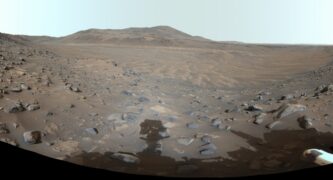

Credit: NASA/JPL-Caltech/ASU/MSSS
Pasadena’s Jet Propulsion Laboratory has helped measure tiny Mars dust grains that stick to spacesuit materials, a finding that could guide ways to protect future astronauts.
The study, published online Monday in the Proceedings of the National Academy of Sciences, used NASA’s Perseverance rover to examine dust on test materials.
Scientists used PIXL, an X-ray device, to find grains less than 2.5 micrometers wide, some only 100 to 300 nanometers across. Earlier Mars measurements could resolve grains only down to about 3 micrometers, NASA said in an Oct. 26 news release. (A human hair measures about 70 micrometers across.)
The rover carried Teflon, Vectran and basaltic glass targets. Five squares of spacesuit material were built into the test target for another device, SHERLOC. The team measured particles on surfaces, not dust levels in the air.
Years of Rover driving and drilling did not dislodge the smallest grains, NASA said. Static charge seems to affect what sticks to each material. Some surfaces collected less dust, a clue for suit fabrics and coatings.
The “smallest particles stay behind,” said Scott VanBommel, the paper’s lead author and a Perseverance scientist at Washington University in St. Louis.
The research did not test crew exposure or prove that Mars dust causes illness. Fine particles can reach deep into human lungs on Earth. Mars dust also has iron and other compounds that may harm health if crews breathe them in.
NASA has outlined designs that could keep dust out of living spaces. A suitport lets a crew member step into a spacesuit that stays outside the habitat. A two-chamber airlock could also limit dust brought indoors.
Katie Stack Morgan, the rover’s project scientist at JPL, said the mission was also built to “prepare for human explorers.”
JPL built Perseverance and runs it for NASA. Caltech manages the Pasadena lab. The findings could aid work on safer suits, habitat air systems and dust cleanup. Tests with real Mars dust would still be needed to judge its health effects, because no authentic airborne Martian dust samples have been brought to Earth.
 Get our daily Pasadena newspaper in your email box. Free.
Get all the latest Pasadena news, more than 10 fresh stories daily, 7 days a week at 7 a.m.