











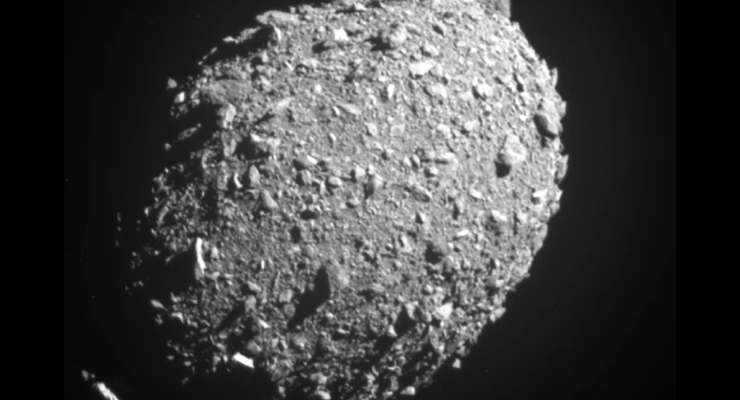
An asteroid roughly the size of an airplane passed safely by Earth on Sunday, tracked from start to finish by scientists at NASA’s Jet Propulsion Laboratory in Pasadena.
The space rock, designated 2026 CN3, came within approximately 2.05 million miles of Earth on February 22, according to JPL’s Asteroid Watch dashboard. That distance — about 8.6 times the gap between Earth and the moon — posed no threat. But the flyby offered a routine glimpse of the planetary defense work conducted around the clock at JPL’s Center for Near-Earth Object Studies, known as CNEOS.
CNEOS calculates the orbit of every known near-Earth object and assesses whether any could strike the planet. The center operates in support of NASA’s Planetary Defense Coordination Office in Washington, according to JPL. Its Sentry impact-monitoring system continuously scans for possible future collisions, and its Scout system flags newly discovered objects for immediate analysis.
At roughly 110 feet in diameter, 2026 CN3 falls well below the 460-foot threshold that defines a “potentially hazardous asteroid” — objects large enough and close enough in orbit to warrant heightened concern.
JPL classified the space rock as “airplane-size” on its dashboard.
The asteroid was not alone. Two other space rocks also made close approaches on February 22, according to the JPL dashboard: 2026 CQ4, a bus-size asteroid roughly 33 feet across, passed at about 2.09 million miles, and 2026 DH, also bus-size at 43 feet, passed at approximately 2.26 million miles.
Near-Earth objects are asteroids and comets whose orbits bring them within 120 million miles of the Sun, placing them in Earth’s orbital neighborhood, according to JPL. Most range from about 10 feet to nearly 25 miles across, and the vast majority pose no collision risk.
“The majority of near-Earth objects have orbits that don’t bring them very close to Earth, and therefore pose no risk of impact,” NASA states on JPL’s Asteroid Watch page.
CNEOS, which has operated since 1998, is directed by Paul Chodas, who has worked at JPL for more than 40 years. The center’s data draws on observations from telescopes worldwide and from NASA-funded survey programs, according to JPL.
There is currently no known significant threat of impact for the next hundred years or more, according to CNEOS. Residents can track upcoming asteroid approaches at JPL’s Asteroid Watch dashboard: https://www.jpl.nasa.gov/asteroid-watch/next-five-approaches/.
The next set of close approaches will be posted as CNEOS updates its tracking data, with new near-Earth objects discovered at a rate of about 3,000 per year, according to JPL.
 Get our daily Pasadena newspaper in your email box. Free.
Get all the latest Pasadena news, more than 10 fresh stories daily, 7 days a week at 7 a.m.