







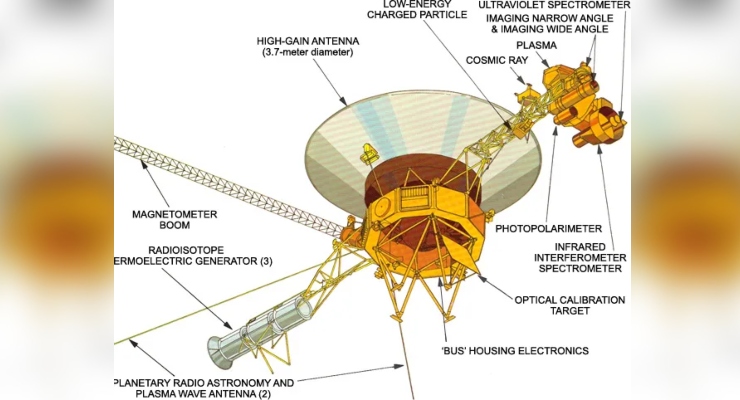
Voyager diagram NASA/JPL-Caltech
NASA and the Jet Propulsion Laboratory in Pasadena are celebrating a remarkable milestone: the 47th anniversary of the launch of Voyager 1 and Voyager 2 spacecraft. These intrepid explorers, launched in late summer 1977, have surpassed all expectations, venturing far into the cosmos.
The Voyagers capitalized on a rare planetary alignment that occurs every 176 years, when all four outer planets were positioned favorably. This cosmic opportunity allowed the probes to embark on their groundbreaking journey through the solar system and beyond.
Both spacecraft have now reached interstellar space, the vast region between stars filled with material from long-dead celestial bodies. Voyager 1 made this historic transition in August 2012, followed by Voyager 2 on November 5, 2018.
“Traveling uninterrupted through interstellar space, the Voyagers will endure forever, long after everything man has ever built has crumbled into dust,” JPL and NASA Solar System Exploration said in a joint post on Facebook.
The Voyagers’ primary mission focused on exploring Jupiter and Saturn, yielding significant discoveries such as active volcanoes on Jupiter’s moon Io and intricate details of Saturn’s rings. Their extended mission saw Voyager 2 become the only spacecraft to visit Uranus and Neptune.
Currently, both probes are engaged in the Voyager Interstellar Mission, exploring the outer edges of the Sun’s domain and the uncharted territory beyond. Despite their vast distances, they continue to transmit valuable scientific data back to Earth through the National Aeronautics and Space Administration’s Deep Space Network.
Launched just days apart, Voyager 2 departed Cape Canaveral, Florida on August 20, 1977, aboard a Titan-Centaur rocket. Voyager 1 followed on September 5, using an identical launch vehicle from the same location.
Space enthusiasts can track the Voyagers’ current positions and status through NASA’s Eyes on the Solar System app, which updates the spacecraft trajectories every five minutes. For more detailed information, NASA provides a dedicated webpage at https://science.nasa.gov/mission/voyager/where-are-they-now/. Additional mission details are available on the Voyager Home website: https://science.nasa.gov/mission/voyager/.
 Get our daily Pasadena newspaper in your email box. Free.
Get all the latest Pasadena news, more than 10 fresh stories daily, 7 days a week at 7 a.m.