





From the air, the destruction left by the Eaton Fire reads as a black-and-gray grid: scorched foundations, the ghost-prints of garages, driveways leading to nothing. But scattered through the ruins, pale and rectangular and stubbornly intact, are the swimming pools.
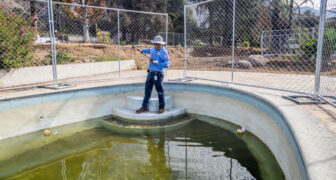
Following the fire, roughly 1,400 swimming pools inside the burn zone were identified. To date, over a thousand remain and over 400 pools were removed or repaired in the past year, according to the San Gabriel Valley Mosquito and Vector Control District.
A single unmaintained pool, district officials say, can produce up to three million mosquitoes in a month.
That arithmetic — multiplied across 1,000 pools, damaged septic tanks and fountains, and a Southern California summer — is a problem that continues to be controlled by one of the smallest public agencies in Los Angeles County. With just 33 full-time and 12 seasonal employees serving 26 cities and unincorporated stretches of the San Gabriel Valley, the district has spent more than a year quietly running what officials describe as one of the largest post-fire vector-control operations in recent California memory: an attempt to keep a wildfire’s standing water from becoming the next public health crisis.
“We responded by treating these pools with either a short-term treatment, which included a control for larval mosquito activity,” Anais Medina Diaz, the district’s director of communications, said in an interview, “or we were applying mosquito fish, which is a very biological way to control mosquitoes.”
But there was a problem with the fish.
“Initially, we were not able to deploy the mosquito fish as a first measure,” Medina Diaz said, “because the water was too toxic for them.”
A small agency, a wide map
The San Gabriel Valley Mosquito and Vector Control District was founded in 1989, after a spike in St. Louis encephalitis cases prompted residents of the valley to vote to create a special district. It celebrated its 35th anniversary last year. It is funded almost entirely by a $20-per-parcel benefit assessment collected in annual property taxes — the kind of obscure line item most homeowners never read on their bills — and is structured for routine work: trapping, testing, treating, educating.
It is not structured for disasters.
“We are funded to do day-to-day operations, not to respond to emergency measures,” Medina Diaz said. “And so while we are capable of doing so, the challenge becomes doing it effectively and ensuring that our other services can continue.”
The first round of post-fire pool treatments alone cost an estimated $306,000, according to figures the district provided to the Los Angeles Times — a sum drawn from emergency reserves.
The initial scope of the work required help. The district drew support from Los Angeles County, the California Office of Emergency Services, the California Department of Public Health, the Greater Los Angeles County Vector Control District, and the Orange County Vector Control District. Even so, the day-to-day field response falls largely on the same small team that responds to cases of West Nile virus and other mosquito-transmitted diseases every year.
What the surveillance traps started catching
Mosquitoes are creatures of habitat, and habitat in Altadena changed overnight. When the district’s surveillance crews began running traps in the burn area, they noticed something unusual: in addition to the native Culex mosquitoes that carry West Nile virus and are typical of suburban yards, they were finding species more commonly associated with wetlands.
“They weren’t new to our area,” Medina Diaz said. “They’re just not as common in suburban communities. They mirrored more of a wetlands kind of space or environment, and that’s because there were so many different sources of water in the community.”
The implication is straightforward. A neighborhood that two years ago drained into ordinary stormwater channels now holds standing water in thousands of small basins — pools, sunken garages, collapsed foundations, ash-clogged catch basins — long enough to support insects that ordinarily live in marshes.
However, West Nile virus is endemic to the San Gabriel Valley – there is no human vaccine and no cure. It is carried by Culex mosquitoes, which can travel up to a mile from the water where they hatched. That flight range and disease risk are the operational logic behind the district’s pool strategy: technicians must control mosquitoes in these remaining sources to reduce the risk of disease transmission to surrounding communities.
The fish, the pesticides, and the rotation
The district’s preferred long-term tool is biological: Gambusia affinis, commonly called mosquito fish, is dropped into a body of standing water, where it breeds and eats mosquito larvae more or less indefinitely. They are cost-effective, quick reproducers, and self-sustaining.
They are also, it turns out, vulnerable to the same things that make a post-fire pool dangerous in the first place.
“We drop mosquito fish, and they’re great at breeding,” Medina Diaz said. “So they’re able to control and reproduce in that water and control the mosquito larvae for a longer period of time.”
If fish can’t be deployed, the district relies on chemical larvicides, which last roughly 90 days and must be rotated among different active ingredients to prevent the local mosquito population from developing resistance. It is a quiet evolutionary arms race, conducted parcel by parcel.
As conditions in some pools improved over the months following the fire, fish began going in. Now, over 600 pools contain mosquitofish and are actively maintaining mosquito populations and under 200 swimming pools remain on a chemical regimen. Remaining pools are being kept empty and dry by the owner.
A program with a phone number
Property owners are encouraged to join the district’s dedicated program, SGVpools — Eaton Response, which helps the district and property owners establish a line of communication for treatment updates. To enroll, owners can text “Eaton Enroll” to (626) 314-6006, email the same phrase to SwimmingPool@SGVmosquito.org, or call the same number for help.
The Board of Trustees also authorized participation in Los Angeles County’s Direct Assessment Disaster Relief Program, which removes the district’s $20-per-parcel charge for Fiscal Year 2024-2025 on affected properties and refunds taxpayers who have already paid.
The cost recovery is not symmetrical. The fee waiver represents lost revenue. The treatment work represents a long-term expense the district was never designed to absorb. However, the District was able to secure Federal Emergency Management Agency reimbursements and a state budget allocation of $500,000 for continued mosquito control response.
What residents can do
The district’s broader message, as Southern California heads into the months when Aedes mosquito populations typically peak in August and September, is that mosquito control in the post-fire landscape is not something a 33-person agency can do alone.
“It really just takes a spoonful of water to breed hundreds of mosquitoes,” Medina Diaz said. “When folks say, ‘Oh no, I’m getting bit aggressively, it’s my neighbor or it’s the street channel behind my house’ — if you’re getting bit aggressively, it’s likely that you have a source very close to you on your property or on your neighbor’s.”
The district’s standard guidance is tip, toss and protect: tip out standing water, toss unused containers, and protect skin with insect repellent containing one of four active ingredients endorsed by the federal Centers for Disease Control and Prevention — DEET, picaridin, IR3535, or oil of lemon eucalyptus.
For homeowners returning to Altadena, Medina Diaz said, the district is offering free property-level consultations to identify hidden water sources and design a customized management plan.
The pools are visible from the air. The breeding sites that worry her, increasingly, are not.
 Get our daily Pasadena newspaper in your email box. Free.
Get all the latest Pasadena news, more than 10 fresh stories daily, 7 days a week at 7 a.m.