









Freddy Snyder, 30, was arraigned May 26 at the Antelope Valley Courthouse in Lancaster, where he pleaded not guilty to murder, carjacking, and first-degree residential burglary. The case will move to a preliminary hearing on June 5 in Department A2, where a judge will determine whether sufficient evidence exists to send it to trial. Snyder remains in custody on $3.175 million bail.
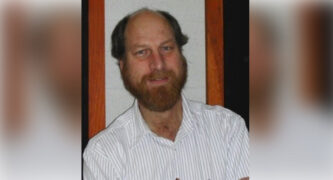
Grillmair, 67, was shot once in the neck on the front porch of his Llano home on the morning of February 16. Deputies responding to a 911 call found him at approximately 6:10 a.m. and paramedics pronounced him dead at the scene. He had worked at Caltech’s IPAC science and data center — the Infrared Processing and Analysis Center — in Pasadena since 1997, contributing to NASA missions and publishing 147 peer-reviewed papers over his nearly three-decade career there.
Los Angeles County District Attorney Nathan J. Hochman issued a statement when the not-guilty plea was announced.
“Carl Grillmair was a dedicated Caltech scientist who was ruthlessly shot and killed outside his own home,” Hochman said. “This senseless act of violence has devastated his family and cut short a life devoted to advancing science and improving the world around him. We will ensure justice is served for this victim and his loved ones.”
According to the DA’s office, Snyder allegedly armed himself with two rifles in the early morning of February 16, then demanded his mother’s car key inside their home. When she refused, he allegedly fired a shot into the ceiling before taking the keys and driving off in her vehicle. He then allegedly drove to the nearby home of Grillmair, who went outside after being alerted to the vehicle in his driveway. The case is being prosecuted by Deputy District Attorney Jeremy Davis of the Antelope Valley Branch and remains under investigation by the Los Angeles County Sheriff’s Department.
According to LASD records and court documents, Grillmair had called deputies on December 20, 2025, to report Snyder trespassing on his property. Deputies found Snyder carrying a loaded, unregistered rifle. He was arrested, charged, and released on his own recognizance on December 23. Those charges were dismissed on February 5 — 11 days before the fatal shooting. Snyder also faces a count of first-degree residential burglary connected to a separate incident on December 28, 2025. Authorities have not disclosed a motive and, according to prior statements from investigators, did not believe the two men were previously known to each other.
At Caltech’s Pasadena campus, where colleagues feel Grillmair’s absence, IPAC astronomer Sergio Fajardo-Acosta worked alongside him for 26 years. “It was always a pleasure to experience Carl’s creativity in doing science,” Fajardo-Acosta said. “His methods on exoplanets and galactic structure studies were truly detective work.” Tom Greene, IPAC’s executive director, said Grillmair’s passing touched the entire center. “He was part of IPAC’s bedrock for many years, and his passing impacts all of us across IPAC,” Greene said.
The charges against Snyder are allegations. The defendant is presumed innocent unless and until proven guilty in a court of law. If convicted as charged, he faces up to life in prison.
Grillmair discovered dozens of stellar streams — faint traces of stars left behind by ancient collisions between the Milky Way and other galaxies — and in 2007 was lead author on a study that for the first time captured enough light from planets outside our solar system to identify molecules in their atmospheres. In 2011, NASA awarded him its Exceptional Scientific Achievement Medal. The Los Angeles County Board of Supervisors adjourned its March 3 meeting in his memory. Fifth District Supervisor Kathryn Barger, who represents Pasadena, moved that tribute. “His life’s work expanded humanity’s understanding of the universe,” she said.
He had maintained a personal observatory at his Llano home with several telescopes, and colleagues said he chose to live in the remote desert in part because the darkness there sharpened the night sky. He was at work on a new project testing instrumentation at Caltech’s Palomar Observatory to monitor for meteor impacts on the Moon’s surface during an upcoming lunar eclipse. Fajardo-Acosta dedicated IPAC’s weekly science talk series, “The Next Seven Minutes,” to his memory.
“He was always ready to teach,” Fajardo-Acosta said. “To share his knowledge, he never held anything back.”
 Get our daily Pasadena newspaper in your email box. Free.
Get all the latest Pasadena news, more than 10 fresh stories daily, 7 days a week at 7 a.m.