





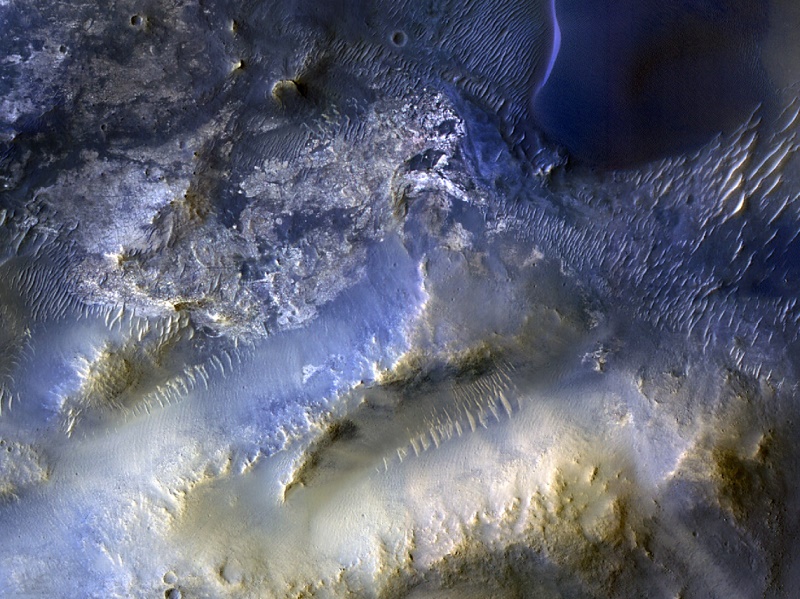
One of NASA’s key cameras orbiting Mars has reached a major milestone, capturing its 100,000th image of the planet’s surface—an achievement that reflects nearly two decades of continuous observation by the Mars Reconnaissance Orbiter, a mission managed by NASA’s Jet Propulsion Laboratory in Pasadena.
The image, taken Oct. 7 by the spacecraft’s High Resolution Imaging Science Experiment camera, known as HiRISE, shows mesas and wind-shaped dunes in Syrtis Major, a region roughly 50 miles southeast of Jezero Crater, where NASA’s Perseverance rover is currently conducting its surface exploration. Scientists are analyzing the image to better understand how windblown sand moves through the region and accumulates into dunes over time.
Watch highlights of images captured by HiRISE, the high-resolution camera aboard NASA’s Mars Reconnaissance Orbiter, including its 100,000th image showing the plains and dunes of Syrtis Major. Credit: NASA/JPL-Caltech/University of Arizona
After nearly 20 years at the Red Planet, HiRISE has served as the instrument the mission relies on for high-resolution images, producing detailed views of features ranging from impact craters, sand dunes and ice deposits to potential landing sites. Those images have helped scientists better understand how Mars’ surface changes and have supported planning for NASA’s future human missions.
“HiRISE hasn’t just discovered how different the Martian surface is from Earth, it’s also shown us how that surface changes over time,” said Leslie Tamppari, the Mars Reconnaissance Orbiter’s project scientist at NASA’s Jet Propulsion Laboratory in Southern California. She said the camera has documented dune fields moving with the wind and avalanches cascading down steep slopes.
While the Jet Propulsion Laboratory manages the Mars Reconnaissance Orbiter for NASA’s Science Mission Directorate in Washington as part of the agency’s Mars Exploration Program, HiRISE itself is operated by the University of Arizona in Tucson. The camera was built by Ball Aerospace & Technologies Corp. in Boulder, Colorado. Lockheed Martin Space in Denver built the spacecraft and continues to support its operations.
The choice of Syrtis Major for the milestone image reflects the mission’s open approach to selecting observation targets. The subject of the 100,000th image was recommended by a high school student through the HiWish website, which allows members of the public to suggest locations on Mars for study.
“Rapid data releases, as well as imaging targets suggested by the broader science community and public, have been a hallmark of HiRISE,” said Shane Byrne, the camera’s principal investigator at the University of Arizona. “One hundred thousand images just like this one have made Mars more familiar and accessible for everyone.”
In addition to still imagery, the HiRISE team produces three-dimensional models of Martian terrain, allowing scientists and the public to experience virtual flyovers of the planet’s surface.
As the Mars Reconnaissance Orbiter continues its work, the 100,000th image marks a scientific milestone achieved through collaboration among NASA centers, universities and aerospace partners, with mission management led from Pasadena.
 Get our daily Pasadena newspaper in your email box. Free.
Get all the latest Pasadena news, more than 10 fresh stories daily, 7 days a week at 7 a.m.