








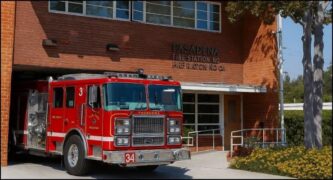
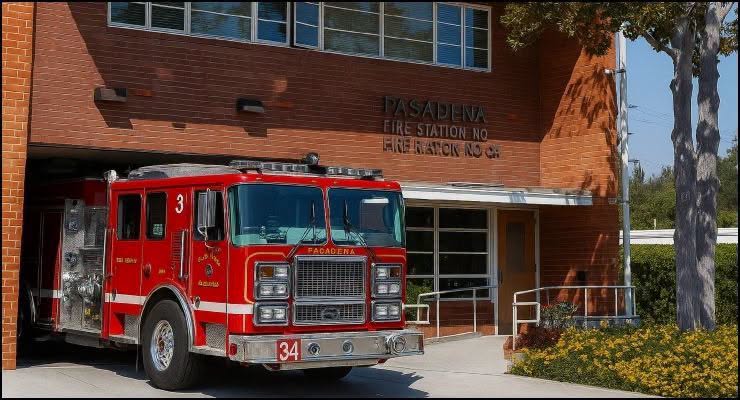
Pasadena voters decide Tuesday whether to tax improved property 19 cents per square foot a year for 14 years to pay for fire, paramedic, 911 and wildfire-preparedness needs, a special tax needing two-thirds of the votes cast on it to pass.
Measure PFD would raise approximately $22.1 million a year, according to the ballot question. City staff estimated a median-size Pasadena home of 1,600 square feet would pay $304 a year.
The City Council placed the measure on the ballot Aug. 3 on a 7-0 vote, adding the 14-year expiration and directing language guaranteeing the seismic retrofitting of Fire Stations 33 and 37, which the city’s plans call for rebuilding. On Hampton’s motion, the Council voted Oct. 6 to support the measure.
What the measure would do
The money would go into a special fund restricted to Fire Department uses. It could pay for capital projects, including fire stations, training centers, fire headquarters, rescue ambulances, fire apparatus, equipment and payments on money borrowed for them. It could also pay for improvements to emergency response, paramedic service, wildfire readiness and brush and debris removal.
Service improvements paid by the tax must go beyond a “baseline”: the department’s average budget for the three fiscal years before the tax takes effect and its front-line services at that time. The ordinance adds that its priority on capital projects “does not obligate the City to maintain any specific General Fund appropriation.”
The tax would expire 14 years after it takes effect unless voters extend it, and the rate has no automatic inflation increase. Interim City Manager Matthew E. Hawkesworth told the Council Aug. 3 it could lower or eliminate the tax but could not raise it without voter approval.
The fund would be independently audited each year, with an annual public report on revenue and spending. If voters later repeal the tax, the ordinance keeps its provisions on any borrowing in force until that debt is repaid.
The ballot question refers to a low-income senior exemption. The ordinance exempts government property; property of qualifying religious and community service organizations; owners who receive the senior or disability exemption from the city’s utility users tax; and owners with household income at or below the U.S. Department of Housing and Urban Development’s “Very Low” income limit for the Los Angeles-Long Beach-Glendale area, if they claim the exemption.
The case for the measure
The Aug. 3 staff report said the city’s General Fund “is insufficient to meet long term emergency response and wildfire preparedness needs” and that the city has balanced recent budgets with one-time revenues and reserves. Hawkesworth told the Council operating costs paid by the tax would include two new rescue ambulances, a new fire engine, a new fire truck and year-round brush abatement.
Raffy Bitchakdjian, president of Pasadena Firefighters Association Local 809, said the city is outgrowing its fire department and the plan is only meant to keep the department sustainable. “We’re just asking to keep up with the demand,” he said in a Los Angeles Times voter guide. The union is the Yes campaign’s largest financial supporter, the Times reported.
Supporters argue that a modernized department could respond faster, that Stations 33 and 37, which the department rated in poor condition, could endanger staff and equipment in an earthquake, and that spending now could head off larger losses from damage and rising insurance costs. Endorsers also include Los Angeles County Supervisor Kathryn Barger, the Los Angeles County Democratic Party and the West Pasadena Residents’ Association.
The case against the measure
Opponents, including the Apartment Association of Greater Los Angeles, the Pasadena-Foothills Association of Realtors, former Mayor William Paparian and the Pasadena Star-News editorial board, say the city should pay for fire services out of its existing budget, or explain more clearly why it cannot, before seeking a new tax, and that the measure puts the cost on property owners for a service the whole city uses.
“It imposes a broad-benefit tax on a narrow segment of the local community,” Daniel Yukelson, chief executive of the apartment association, wrote in an article the association posted Oct. 7. He also wrote that the tax ignores property value and that owners subject to the city’s rent control rules have no way to recover the cost.
Matt Klink, spokesperson for the No on Measure PFD campaign, said in an Oct. 9 statement that public safety should be the city’s top priority and that “City Hall should fund it first, ahead of everything else, from the general fund.” The California Association of Realtors is among the No campaign’s top funders.
How to vote Tuesday
Vote centers are open from 7 a.m. to 8 p.m., and voters in line by 8 p.m. can still vote. Vote-by-mail ballots must be postmarked by Tuesday or dropped at an official drop box or vote center by 8 p.m. Voting locations and election information are available at cityofpasadena.net/city-clerk/
If the measure falls short of two-thirds, the tax would not be levied. The L.A. County Registrar-Recorder/County Clerk will canvass the returns and certify the results to the City Council.
 Get our daily Pasadena newspaper in your email box. Free.
Get all the latest Pasadena news, more than 10 fresh stories daily, 7 days a week at 7 a.m.