





Front view, street: Cavon Hajimiri, 17, wears Hindsight as a car approaches from behind — the exact scenario that inspired the device, which delivers an average of about seven seconds of warning by sound or vibration. [Courtesy photo]

Device close-up: The Hindsight belt pairs a custom Doppler radar with an accelerometer and a machine-learning model trained on more than 170,000 frames of data Hajimiri collected himself. He holds United States Patent 12,372,637 as sole inventor. [Courtesy photo]
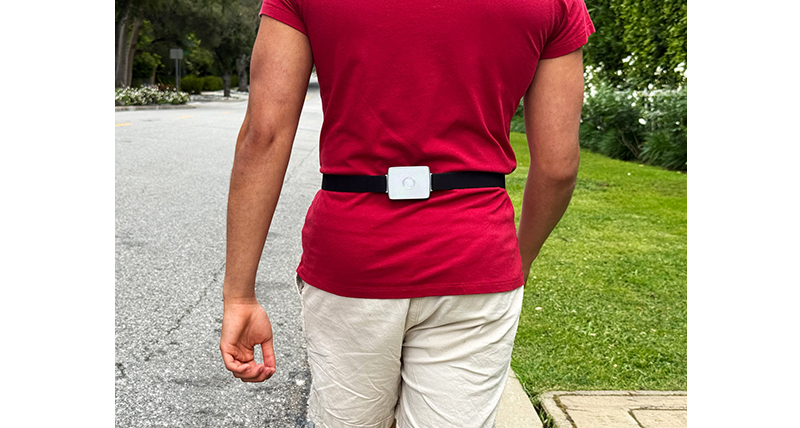
Rear view: Worn at the waist and small enough to sit under clothing, Hindsight scans for vehicles approaching from behind. In real-world testing, it detected all 340 approaching vehicles. [Courtesy photo]
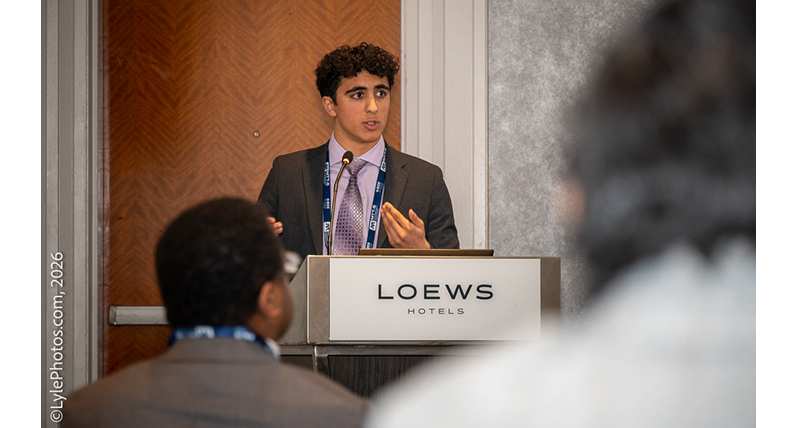
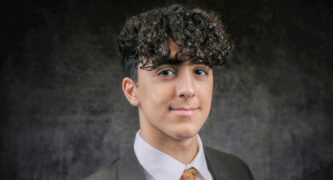
Podium: Hajimiri, a rising senior at Polytechnic School in Pasadena, presents the wearable radar he spent four years developing after ultrasonic sensors, lidar and commercial radar units all fell short — leading him to design his own. [Courtesy photo]
He was 13, walking near his home and talking with a friend, when a car came up behind him and he never heard it. Cavon Hajimiri takes a lot of walks, and in the neighborhoods around La Cañada Flintridge, where he lives, plenty of streets have no sidewalks. He’d had close calls before. But this one stayed with him.
“I completely missed the car, and I didn’t hear it coming at all,” he said.
Afterward, he went looking for something that could have warned him.
The way he thought about it, the risk was everywhere: people walk distracted, some wear headphones, some are hard of hearing, and electric vehicles now arrive almost silently from behind. Cars, he knew, already had early-warning and automatic-braking systems, and he assumed someone had built the version for pedestrians. He searched, and was surprised to find that no one had. There was a gap, he said, “in what existed and what was needed” — and he decided to close it himself.
Four years later, that gap has a name. Hindsight is a wearable radar — worn around the waist like a belt, small enough to sit under clothing — that senses vehicles approaching from behind and alerts the wearer with a sound or a vibration. Now 17 and a rising senior at Polytechnic School in Pasadena, Hajimiri entered it in the Regeneron International Science and Engineering Fair in May 2026 and came home with three awards, a United States patent, and a working answer to a problem his school’s city has spent the past year measuring.
The fair, held May 9–15, 2026, at the Phoenix Convention Center, drew more than 1,700 finalists from over 67 countries and regions, according to its organizers, Regeneron and the Society for Science. There, Hajimiri won first place for the Qorvo Innovator Award, first place for the Association of Old Crows Award, and second place for the Grand Award in Embedded Systems, according to the La Cañada Outlook and Society for Science records. The Qorvo award carries a cash scholarship and a year of mentorship from one of the company’s engineers.
The device is built around a custom Doppler radar. In a Polytechnic School article, Hajimiri said it provides an average of about seven seconds of warning and that he hopes the manufacturing cost can eventually fall below $10 a unit. A school press release states that it detected all 340 approaching vehicles in real-world testing and that Hajimiri was granted a utility patent as sole inventor — records show United States Patent 12,372,637, “Wearable Approaching Object Detection With Dynamic Motion Compensation,” filed in January 2025 and issued in July 2025.
Getting there took four years and a long process of elimination. He started with ultrasonic sensors, the simplest option, and found the range far too short. Next came light-based lidar — Light Detection and Ranging — but the affordable units were also short-range, and the powerful ones were too big, too power-hungry, or too expensive. He bought a commercial radar off the internet and hit its limits too. Nothing on the market did what he wanted at the price he needed, so he designed his own radar — teaching himself high-frequency electronics along the way — and then built the signal-processing system to make sense of what it returned. Keeping the cost low was the constant; he wanted the device within reach of “the people who need it the most … regardless of their income,” he said.
The hardest part was the wearer. A pedestrian, it turns out, is a difficult place to mount a radar. “The pedestrian is such an unstable platform,” he said — walking generates constant rotation, vibration, and shaking, and each of those throws off Doppler signals that are easy to mistake for an oncoming car. To separate the two, he added an accelerometer to measure the walker’s own motion and cancel it out, then a machine-learning model to bring down the false alarms. That model needed data, and no data set for this existed, so he went out and collected and labeled his own — more than 170,000 frames of it.
He is blunt that most of the work was failure. Once he ordered the wrong board and the radar wouldn’t run at all; more than once he sank hundreds of hours into an approach he ultimately had to throw away. New tariffs meant paying extra for boards and fighting through customs. His advice to younger students who have an idea but feel outmatched is to stop trying to build everything at once. “I didn’t have to build the whole project in one day,” he said. The other half of the advice is to find people who know more than you do. One of his Polytechnic teachers, Mr. Prater, had worked in high-frequency electronic design at the Jet Propulsion Laboratory, and Hajimiri went to him for exactly the part of the problem Prater knew best. He also credited another teacher, Ms. Barnes, with introducing him to the science-fair system.
He is now trying to pass that forward. After the January 2025 Eaton Fire — Hajimiri was in an evacuation zone, and classmates lost homes — he began building EmberAlert, a low-cost fire-detection system for houses, and deliberately made it a group project, so the students who had lived through the fire could build the response to it together. It was something, he said, “we had all experienced together.” He has been teaching the younger students what he knows and learning the rest alongside them.
Engineering is not his only pursuit, and by his account it is not even a separate one. He is a nationally recognized photographer, and after the Eaton Fire he spent time photographing the damage, trying to capture how personal the loss was. The act of photographing it, he said, is part of what pushed him toward EmberAlert. Photography and invention, to him, are “two sides of the same coin” — each a way to see something from an angle no one else is using. He also plays piano and water polo, and picks up magic tricks off the internet.
The problem Hajimiri set out to solve is one Pasadena has been quantifying. In fall 2025, the city’s Department of Transportation brought forward a Focused Local Roadway Safety Action Plan and a resolution committing Pasadena to eliminate traffic deaths and significantly reduce serious injuries by 2035. The plan was developed under the federal Safe Streets and Roads for All program, Pasadena Now reported. City analysis of collision data from 2020 through 2024 found that 13 percent of Pasadena’s roadways accounted for 80 percent of its fatal and serious-injury crashes, and that pedestrian crashes, while roughly 11 percent of injury collisions, made up about 28 percent of the fatal and severe ones. Nationwide, 7,080 pedestrians were killed in traffic crashes in 2024, according to the National Highway Traffic Safety Administration.
Hajimiri sees Hindsight fitting alongside that effort rather than competing with it. Fixed sensors at crosswalks, he notes, cannot catch a car coming up behind a walker mid-block; a wearable can. And because his device uses radar rather than a camera, he says it keeps working at night, in fog, and in smoke — the low-visibility conditions that account for a large share of pedestrian deaths. The protection, as he put it, is “always on you.” He did much of his own data collection on Pasadena streets, and he wants the city to be part of what comes next.
That next step is a pilot. He has tested the device on himself and on family members and now wants it worn in a wider range of settings before it goes public; he has built a survey both to recruit testers and to learn what the people most at risk want from a warning device. He hopes Pasadena will be one of the places it runs. “I’m really looking forward to finding a way to work with the city of Pasadena,” he said.
The trophies, he said, were never the point. The people he keeps coming back to are the ones a $10 device could reach and a pricier one could not — children, the elderly, anyone who has to share a street with traffic and cannot always hear it coming.
“My end result is not necessarily to create a good science fair project,” he said. “It’s to create a sensor that I can give to people, and they can really use to keep themselves safe.”
 Get our daily Pasadena newspaper in your email box. Free.
Get all the latest Pasadena news, more than 10 fresh stories daily, 7 days a week at 7 a.m.