

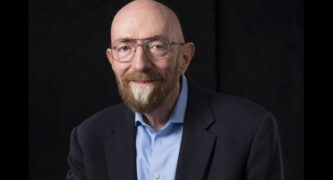
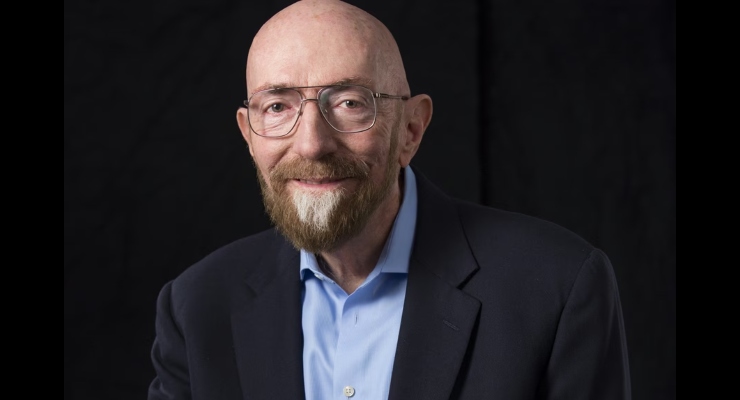
Kip Thorne, the Caltech alumnus and Nobel Prize-winning astrophysicist who helped detect gravitational waves for the first time, will deliver the keynote address at the institute’s 132nd Commencement on Friday at 10:00 a.m. on Beckman Mall. The ceremony is Rosenbaum’s final act as Caltech’s ninth president before he steps down on June 30, closing a 12-year tenure that saw the institution more than double its endowment and complete a record $3.4 billion fundraising campaign, according to Caltech.
The event is free and open to the public. No tickets are required, and seating on Beckman Mall is first-come, first-served, with roughly four guest seats available per graduate. A livestream begins at 9:50 a.m. at commencement.caltech.edu/watch.
Thorne, 86, is a Distinguished Alumnus of Caltech who earned his bachelor’s degree on the same Pasadena campus in 1962. He went on to co-found LIGO, the Laser Interferometer Gravitational-Wave Observatory, a Caltech-MIT collaboration funded by the National Science Foundation. On September 14, 2015, LIGO recorded what generations of physicists had pursued: the warping of space and time caused by two black holes colliding 1.3 billion light-years away. Two years later, Thorne shared the 2017 Nobel Prize in Physics with fellow researchers Rainer Weiss and Barry C. Barish for that achievement.
At Caltech, Thorne holds the title Richard P. Feynman Professor of Theoretical Physics, Emeritus. He also served as executive producer and science advisor on Christopher Nolan’s film “Interstellar.”
“Kip’s extraordinary career is a testament to his intellectual passion and capacious vision,” Rosenbaum said in a statement when Caltech announced the speaker in December. “He is a generous colleague, dedicated to Caltech students and faculty alike. Kip’s agreement to speak at the Institute’s 2026 graduation ceremonies, my last, could not provide a more significant statement about the values of scholarship and humanity to which we all aspire.”
Rosenbaum, the Sonja and William Davidow Presidential Chair and Professor of Physics, assumed the Caltech presidency on July 1, 2014. During his tenure, the institute completed Break Through: The Caltech Campaign, which raised $3.4 billion from more than 14,500 donors, according to Caltech — described by the institute as the largest fundraising effort in its history. He also steered the university through the January 2025 Los Angeles wildfires, which displaced more than 300 members of the Caltech community, according to the institute’s retirement announcement.
“Caltech boasts a solid financial footing, remarkable new research and educational facilities, and, most importantly, the capacity to recruit and sustain the brightest and most innovative individuals from every walk of life and from every corner of the world,” Rosenbaum wrote in his retirement letter to the campus. “Our secret for success is no more complicated than the people who comprise our community, but it requires diligence, awareness, and commitment to be able to soar ever higher.”
His successor, astrophysicist Ray Jayawardhana, was named Caltech’s tenth president on January 6, and takes office July 1. Jayawardhana comes from Johns Hopkins University, where he served as provost and professor of physics.
Caltech, founded in Pasadena in 1891, sits on 124 acres along California Boulevard. It employs approximately 2,500 people on campus and counts 49 Nobel Prizes among its alumni, faculty, and postdoctoral scholars, according to the institute. The university enrolls roughly 971 undergraduates and 1,398 graduate students, with a student-faculty ratio of 3 to 1.
Last year’s 131st Commencement conferred 619 degrees on 614 graduates. Caltech has not released the total degree count for 2026 ahead of the ceremony.
For those who cannot attend in person, indoor livestream viewing will be available at Browne Dining Hall, Red Door Cafe in the Hameetman Center, and Broad Cafe on the Caltech campus.
On Friday morning, Beckman Mall will fill one more time under Rosenbaum’s watch — and the speaker at the podium will be the same physicist who, more than six decades earlier, walked across a Caltech stage to collect his first degree.
 Get our daily Pasadena newspaper in your email box. Free.
Get all the latest Pasadena news, more than 10 fresh stories daily, 7 days a week at 7 a.m.