








Pasadena Water and Power on Tuesday will outline a refocused utility undergrounding strategy that prioritizes high fire threat districts.
The Municipal Services Committee will hear the overview at 4 p.m. in City Council Chambers at City Hall.
A preliminary report shows PWP shifting efforts toward burying high-voltage lines in Tier 2 fire threat areas. The work could take 12 to 16 years at an estimated cost of $32 million to $42 million.
General Manager David M. Reyes will submit the overview as an informational item in Tuesday’s meeting. The presentation will detail both completed projects and a new strategic direction.
Currently, 60.4% of Pasadena’s electrical conductors run underground citywide, the report showed. In high fire threat districts, that figure rises to 65.4%.
PWP has completed two formal Underground Utility District (UUD) projects recently. Hill Avenue’s 1.42-mile project cost $19.6 million and removed 60 utility poles. Alpine Street’s shorter project cost $7.8 million.
Two more UUD projects are scheduled. Raymond Avenue will begin in 2026 with a $43.8 million budget. Mountain Street follows in 2029 at $13.6 million.
But the utility now plans to pause formal UUD projects after those two are complete, the report said. Instead, it will concentrate on high-voltage undergrounding in fire-prone areas.
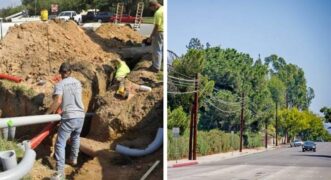
The approach differs from traditional undergrounding. Poles remain standing, but underground equipment powers them. This method costs less and moves faster than full undergrounding.
Two Tier 3 projects are already underway. Canyon Close and Fox Ridge will finish in early 2026 at $2.5 million. Florecita and Crestford will complete by year’s end 2026 at $1.8 million.
The proposed Tier 2 work would cover 5.1 to 6.5 miles across districts 1, 4 and 6. PWP estimates the effort would take 12 to 16 years, starting in fiscal year 2027.
PWP said the strategy aims to reduce wildfire ignition risk from high-voltage lines. Specific projects receive approval through existing Fire Threat Mitigation Capital Improvement Programs.
PWP installs underground electrical equipment in public rights-of-way. Once operational, overhead high-voltage lines come down. The method allows greater risk reduction sooner without eliminating future full undergrounding options.
The utility’s path forward would complete Raymond and Mountain UUD projects first. Tier 2 high-voltage undergrounding would then begin concurrently in 2027. Formal UUD projects would resume only after feasible Tier 2 work concludes.
 Get our daily Pasadena newspaper in your email box. Free.
Get all the latest Pasadena news, more than 10 fresh stories daily, 7 days a week at 7 a.m.