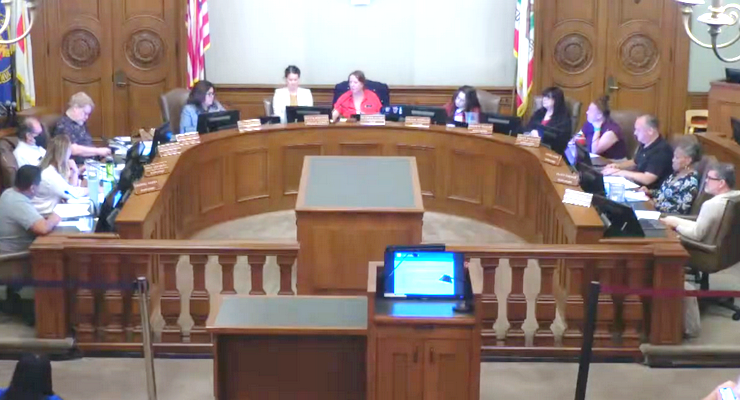











Pasadena officials supporting license plate reader cameras as crime-fighting tools collided Wednesday with residents who argued the technology now threatens immigrant-community trust because any data collected by local police could be used against locals if it reaches federal immigration enforcement.
The Pasadena Public Safety Committee took no final action on the information-only Flock Safety update, but the May 20 hearing exposed a split among committee members: Vice Mayor Jess Rivas leaned toward ending the city’s use of Flock without replacing it, councilmembers Tyron Hampton and Justin Jones said the city should consider moving away from Flock while preserving license plate reader technology, and councilmember Steve Madison said he intended to support the cameras but was open to adjustments on data retention and sharing.
Rivas, the committee chair, said the city had long accepted automated license plate readers, or ALPRs, as useful investigative tools if proper safeguards were in place. But she said the federal government had changed the terms of that debate.
“I don’t trust this administration,” Rivas said. “They don’t respect the law, the Constitution, court orders. They’re sure as hell not going to respect our policies.”
Rivas laid out four options: maintain the current course with Flock and continue expansion, keep Flock but reduce data retention or sharing and reconsider camera locations, replace Flock with another license plate reader vendor, or end the contract and not replace it. She said her inclination was the fourth option, citing a federal government she said could not be trusted with Pasadena’s laws or data.
Residents repeatedly linked Flock data-sharing fears to ICE, arguing that the issue was not simply whether cameras help solve crimes but whether local government can assure immigrant communities that surveillance data will not be used against them.
The city clerk’s office said the committee received 365 letters on the item, including 276 from Pasadena residents, and 19 speaker cards were submitted.
Those concerns surfaced even before the Flock item was discussed.
During public comment, Yadi urged the city to take a more active approach to protecting privacy and vetting surveillance technologies, and Sabrina Jimenez said both Flock and ICE were reproductive justice issues affecting people in Pasadena.
Nicholas Rabb, a District 2 resident and Cal State LA researcher with a doctorate in computer science and cognitive science, said Flock’s privacy safeguards were insufficient because “any Flock user within California could simply search Pasadena and personally tip off ICE.” He also criticized the presence of what he alleged was a Flock sales representative at the municipal meeting and called the city’s internal audit “far too narrow.”
(Pasadena Chief of Police Gene Harris said earlier that the Flock Safety representative was present to provide detail or clarify technical points if needed.)
Yadi, a longtime privacy advocate, said she had previously pushed for the city’s Flock transparency portal and a reduction in data retention from one year to 30 days. But she said the city still could not “confidently independently assure” that ALPR systems would not be abused and described the program as “mass warrantless government surveillance.”
One Pasadena resident said he downloaded searches from the Pasadena Police Department’s Flock transparency portal and found many stated search reasons too vague to be meaningful, including entries listed only as case numbers, “investigation,” variations of “suspect” or “target vehicle,” and variations of “wanted.”
Other speakers warned that the mere existence of the data could damage trust.
Jennifer Collins, a District 5 resident, said no federal agency could be trusted to respect residents’ privacy.
Collins alleged two Veterans Affairs Police searches of Pasadena’s Flock database. Harris said the two Veterans Affairs Police searches involved local crime and fraud issues related to Veterans Affairs benefits and were not related to prohibited search categories.
Police Chief Gene Harris defended the program, saying the city’s audit showed more than 5 million network searches in 2025 with no violations of SB 34 or SB 54.
Harris said immigration enforcement and reproductive health investigations are prohibited uses, that national lookup has been disabled, that data sharing with out-of-state agencies has been disabled, and that searches for immigration enforcement or reproductive care are prohibited.
Harris also acknowledged that department policy needs to be updated and said the city is working with the Community Police Oversight Commission on those updates.
Harris said “none of this relates to any immigration enforcement or reproductive health circumstances” and said Pasadena police do not participate when ICE comes into the city with a warrant.
He said the department uses the system for local crime warrants and other state-level investigations.
In discussing the first-quarter overview, Harris cited drugs and narcotics, motor vehicle theft, weapons offenses, guns and protective and protection orders as high-volume search reasons; the police presentation’s 2026 first-quarter slide also listed burglary/breaking and entering, assault/battery offenses and robbery among the top 10 search reasons.
City materials said Pasadena police enforce local and state criminal laws, not federal civil immigration law, and that ICE operations occur independently, with the Police Department’s role limited to situational awareness to keep the public and officers safe.
The agenda packet’s immigration-related activity presentation listed eight ICE-related calls for service and four ICE notifications from the start of 2025 through March 2026, with an April addendum listing one additional ICE-related call and six ICE notifications.
The police presentation said Flock helped recover more than 30% of stolen vehicles recovered in Pasadena in 2025 — 27 of 89 vehicles — representing about $700,000 in recovered stolen property.
So far in 2026, police said, four of 21 recovered stolen vehicles were found from Flock alerts.
Harris said Flock is designed to take, store and run license plates visible in public. People may appear in images by happenstance, he said, but the system has no facial recognition and no application for identifying them.
The police presentation in the agenda packet said Pasadena police conducted 18,648 Flock ALPR searches in 2025 and 9,162 searches in the first three months of 2026. Another slide in that presentation said the department’s all-offense clearance rate rose from 28.96% in 2023 to 31.10% in 2024 and 35.26% in 2025.
The system is currently installed at 20 of the city’s more than 2,300 intersections, according to the agenda packet. New Flock installations are pending at three intersections: two in District 4 and one spanning the District 5 and District 3 boundary.
Madison said he intended to support the cameras, arguing that the hearing was missing “the voices of crime victims,” including people whose stolen cars prevent them from getting to work or taking children to school. He said there is no expectation of privacy in a license plate or in one’s presence in public, but said he was open to adjustments on data retention and sharing “within the boundaries of the law and sound policing.”
Hampton credited license plate reader technology with helping address gun-related incidents, but that the city should explore a different vendor.
Jones said he had concerns about Flock sharing data with ICE and said many residents he represents share those concerns. But he said license plate reader cameras have helped solve crimes and said he would not support simply removing the cameras.
Jones said the city should look at another company, adjust the data retention policy and examine where cameras are placed.
Rivas said the issue should ultimately go to the full City Council, while Hampton suggested bringing it back first to the Public Safety Committee for a fuller framework discussion.
Committee members also discussed a possible special meeting dedicated to Flock.
“That’s where we are,” Rivas said. “We will continue the discussion.”
 Get our daily Pasadena newspaper in your email box. Free.
Get all the latest Pasadena news, more than 10 fresh stories daily, 7 days a week at 7 a.m.