









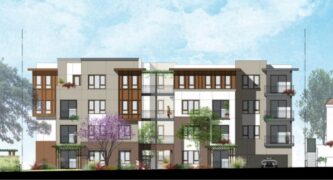


The Pasadena Design Commission on Tuesday grappled with balancing housing needs against neighborhood character as it reviewed plans for a dense 46-unit apartment complex on South Oak Knoll Avenue in a preliminary consultation.
The four-story, 47,360-square-foot project proposed for 511 South Oak Knoll Avenue by Odyssey Development Services would include six affordable units on a vacant lot zoned RM-48 HL-40(45) in a historic residential area near the Pasadena Unified School District offices. The proposal also calls for removing 13 existing trees, including three protected ones.
Several Commissioners and residents expressed concerns about the project’s height, density, parking, traffic, and compatibility with surrounding buildings, many of which are only one to two stories tall. The site is also near two individually designated landmark properties.

“Such a huge building would overwhelm the neighborhood,” said Buff Gontier, a local resident who spoke during public comments. “Restricting light into neighboring homes and creating additional parking and noise issues for the residents and for the schools on the streets.”
However, City staff members indicated the project’s density appears allowable under current zoning and affordable housing laws, limiting the Commission’s ability to require major changes.
“It has been determined to be allowed under the code,” said Kevin Johnson, principal planner for the City. “So there’s no opportunity to reduce that.”
The project would utilize density bonus provisions in state law to exceed typical height limits, proposing a height of 49 feet, 9 inches compared to the usual 40-foot maximum.
Adele Chang, the project architect, said the design aims to reference neighboring historic buildings while providing much-needed housing. She noted the height would be comparable to some existing three-story buildings with sloped roofs in the area.
“Housing is a much needed thing in this town, in this state, in this country,” Adele Chang said. “I’m happy to be part of this and to have this in my neighborhood.”
But several Commissioners urged the developer to refine the design to better fit the context, suggesting simplifying architectural details, reconsidering the massing, activating the street level, and improving the building’s relationship to its surroundings.
“I think it boils down to how the plan is organized,” said Commissioner Srinivas Rao. “There are probably five or six different elements that’s too much for a hundred foot wide façade.”
The Commission did not take any formal action, as the meeting was a preliminary consultation to provide initial feedback. The project will need to return for concept and final design review before approval.
Douglas Ewing, a local architect, argued the City should push back more forcefully against dense developments that could alter neighborhood character.
“We have too many greedy developers in this town that want to build every square foot,” Ewing said. “I think this project can be, it’s way, way too big.”
But City officials emphasized their hands are tied by state laws aimed at addressing California’s housing crisis by promoting denser development, particularly projects that include affordable units.
The tension highlighted Pasadena’s ongoing struggle to preserve its historic character while meeting state mandates to allow more housing amid skyrocketing costs.
As the meeting concluded near midnight, Commissioners urged the developer to carefully study ways to soften the project’s impact through design refinements before returning for further review.
 Get our daily Pasadena newspaper in your email box. Free.
Get all the latest Pasadena news, more than 10 fresh stories daily, 7 days a week at 7 a.m.


