


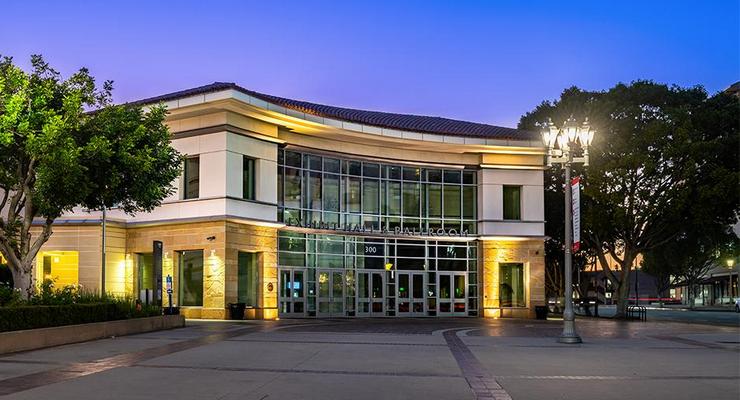
Hundreds of astronomers, students, educators and science professionals gather in Pasadena this week as the 248th meeting of the American Astronomical Society opened at the Pasadena Convention Center, with one of Monday’s major topics focused on a future NASA space observatory that has strong ties to Pasadena.
The Nancy Grace Roman Space Telescope, NASA’s next flagship astrophysics mission, will be featured in multiple sessions Monday during the five-day conference, known as AAS 248. The telescope’s science operations are supported in part by Caltech/IPAC in Pasadena in partnership with NASA’s Goddard Space Flight Center and the Space Telescope Science Institute.
The conference runs through June 18 at the Pasadena Convention Center.
A discussion titled “The Roman Space Telescope Is Almost Here. Are You Ready?” is scheduled Monday in Exhibit Hall A, followed later in the day by a Roman Space Telescope Town Hall meeting in Ballroom A.
According to a session description from the Space Telescope Science Institute, the Roman telescope has a launch readiness date in 2026. The observatory is designed to investigate some of astronomy’s biggest unanswered questions, including the nature of dark energy, the search for planets around distant stars and large-scale surveys of the universe in near-infrared light.
The telescope’s Wide Field Instrument will allow scientists to study vast regions of the sky, while a separate Coronagraph Instrument is intended to directly image and analyze planets orbiting other stars.
The mission’s connection to Pasadena extends beyond the conference venue.
Caltech and NASA’s Jet Propulsion Laboratory are located just a few miles from the convention center, and Caltech/IPAC plays an important role in supporting Roman’s science operations. The Space Telescope Science Institute, which manages science operations for both the Hubble Space Telescope and the James Webb Space Telescope, said in a conference description that it will partner with Caltech/IPAC and NASA Goddard to support Roman science activities.
“We will play a key role in helping to support the science operations for the Nancy Grace Roman Space Telescope, partnering with Caltech/IPAC and NASA’s Goddard Space Flight Center,” the institute said in its meeting materials.
The American Astronomical Society’s gathering brings together researchers from around the world to discuss new discoveries, emerging technologies and future missions. In a May 20 media advisory, the organization said the meeting would include plenary lectures, science sessions, workshops, town halls and networking events.
Several Monday sessions examined the growing role of artificial intelligence in astronomy. The program included a plenary presentation by computer scientist Sanmi Koyejo on artificial intelligence and astronomy, as well as a special session titled “AI-Driven Science in the Survey Era.”
Other workshops focused on new ways for researchers to access and analyze large scientific datasets, including sessions on Europe’s Euclid space mission and a scientific computing platform known as Fornax.
Additional Roman-related and space telescope discussions are scheduled throughout the week. On Wednesday, Space Telescope Science Institute Director Jennifer Lotz is expected to present a talk titled “JWST: This Is Just the Beginning!” referring to the James Webb Space Telescope. The institute also plans to hold a public town hall session later that day.
For Pasadena, the conference highlights the city’s continuing role as one of the nation’s major centers for astronomy and space science, bringing together researchers whose work is closely linked to institutions such as Caltech, JPL and other organizations that help shape NASA’s exploration of the universe.
 Get our daily Pasadena newspaper in your email box. Free.
Get all the latest Pasadena news, more than 10 fresh stories daily, 7 days a week at 7 a.m.