






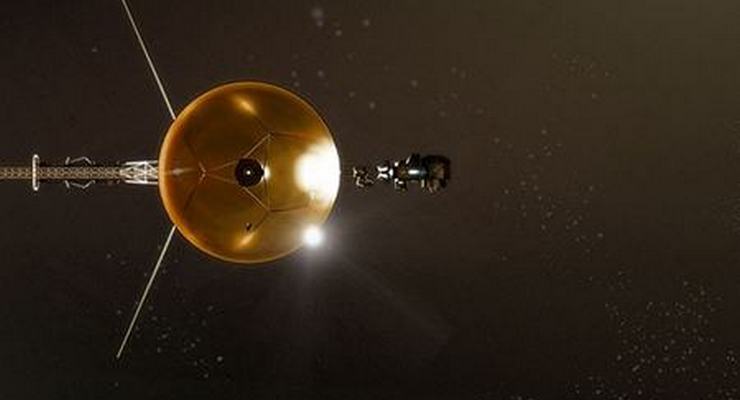
Pasadena residents are invited to raise a light to the evening sky Tuesday in honor of Voyager 1, the JPL-built spacecraft that, nearly 50 years after launch, is about to reach a distance from Earth equal to one full day of light travel.
Caltech will hold “Shine Bright for Voyager at Caltech” outside Beckman Auditorium from 5:15 p.m. to 5:30 p.m. Tuesday, Nov. 17, with a coordinated lighting at 5:20 p.m. The gathering coincides with NASA’s invitation for people around the world to create what the agency calls “a symbolic wave of golden light encircling the planet after sunset.”
The celebrations mark a milestone NASA predicts for 2:16:07 a.m. Pacific time Wednesday, Nov. 18, when Voyager 1, the most distant human-made object, will be about 16.1 billion miles (25.9 billion kilometers) from Earth. A light-day is the distance light travels in 24 hours. At that distance, a radio signal takes a full day to travel from Earth to the spacecraft, and another full day to come back.
The distance is measured from Earth, and JPL says crossing it will produce no change aboard Voyager 1 or in its immediate environment.
NASA’s Jet Propulsion Laboratory, which Caltech manages for NASA, built and operates Voyager 1 and its twin, Voyager 2. NASA’s Deep Space Network, also managed by JPL, carries communications with both probes. NASA will follow Tuesday’s lighting with a moderated discussion about the mission at JPL’s von Kármán Auditorium at 9 a.m. Thursday, Nov. 19, streamed online.
Lights on at Beckman
Caltech describes its gathering as family friendly and open to people from off campus as well as the campus community. A limited supply of lights and glow sticks will be handed out beginning at 5:15 p.m., ahead of the collective lighting five minutes later. Caltech Community Relations is sponsoring the event.
Residents who cannot get to campus can take part wherever they are. NASA invites participation after sunset Tuesday and has created a web tool that turns a smartphone or tablet into a flashing light spelling out “VGR,” Voyager’s call sign, in Morse code.
Participants who prefer to signal by hand can use flashlights, glow sticks, solar lanterns or bike lights. In Morse code, V is three short flashes followed by one long flash; G is two long flashes followed by one short flash; and R is short, long, short.
NASA encourages participants to photograph or record their light-day signals and share them on social media, tagging @NASA.
A Thursday conversation with the mission team
Thursday’s discussion will take place in the von Kármán Auditorium, where JPL hosted Voyager briefings during the spacecraft’s grand tour of the outer planets. Mission members and NASA leadership are scheduled to talk about the status of Voyager 1 and Voyager 2, the science the twin probes continue to gather in interstellar space, and the engineering challenges of keeping spacecraft operating for so long over such vast distances.
A question-and-answer session with media and other audience members will follow, along with a preview of an upcoming NASA+ Voyager documentary planned for release in 2027, the mission’s 50th anniversary year.
The scheduled participants are Nicky Fox, associate administrator of NASA’s Science Mission Directorate; Jonathan Lunine, JPL chief scientist and professor of planetary science at Caltech; Suzanne Dodd, Voyager project manager at JPL; Linda Spilker, Voyager project scientist at JPL; Kareem Badaruddin, Voyager mission manager at JPL; and Jamie Rankin, Voyager deputy project scientist at Princeton University.
The discussion will stream on X and YouTube.
Nearly half a century of travel
Voyager 2 launched Aug. 20, 1977, and Voyager 1 followed Sept. 5, 1977. The twin spacecraft were designed to explore the outer planets by taking advantage of a planetary alignment that occurs once every 176 years.
Voyager 1 entered interstellar space in 2012. Voyager 2, following a different trajectory, crossed the heliopause — the outer edge of the heliosphere, the protective bubble created by the Sun — on Nov. 5, 2018. Both spacecraft continue to return scientific observations of the environment beyond that bubble.
“It has been a remarkable journey,” Caltech’s Edward Stone said, reflecting on his 50 years as Voyager’s project scientist upon his retirement in 2022.
Each spacecraft loses about four watts of power a year, and engineers have shut down instruments and made power-saving changes to keep the spacecraft operating.
On April 17, NASA sent commands to shut down Voyager 1’s Low-energy Charged Particles experiment and said the plasma-wave and magnetic-field instruments were the spacecraft’s two remaining operating science instruments. Badaruddin said the goal was “keeping both Voyagers going for as long as possible.”
NASA reported Aug. 4 that power-saving changes on Voyager 2 should support its three instruments for at least another year, and JPL made a corresponding power-saving change on Voyager 1 in early September.
Communication with Voyager 1 paused briefly last month. Attempts to communicate with Voyager 1 on Oct. 18 and Oct. 19 were unsuccessful before the spacecraft’s signal returned Oct. 20. The cause of the interruption remained under investigation as of Oct. 29.
“We’re relieved to be back in contact with Voyager 1,” Badaruddin said.
Spilker addressed the uncertainty of operating spacecraft this old in 2025, as NASA turned off two Voyager science instruments to extend the mission: “That also means every day could be our last.”
The Voyager mission is funded by NASA’s Heliophysics Division at NASA Headquarters in Washington. NASA’s Fiscal Year 2027 budget request lists $5.5 million for Voyager.
Getting there
Beckman Auditorium’s address is 332 S. Michigan Ave., one block south of Del Mar Boulevard. Under Caltech’s general visitor parking policy, visitors may park without a permit in commuter/unreserved stalls after 5 p.m. on weekdays; the campus permit requirement otherwise runs from 7 a.m. to 5 p.m. on weekdays. Visitors should check posted signage.
Shine Bright for Voyager at Caltech, 5:15 p.m. to 5:30 p.m. Tuesday, Nov. 17, outside Beckman Auditorium, 332 S. Michigan Ave., Pasadena. Caltech Community Relations, (626) 395-3485. https://www.caltech.
 Get our daily Pasadena newspaper in your email box. Free.
Get all the latest Pasadena news, more than 10 fresh stories daily, 7 days a week at 7 a.m.


